
Business process outsourcing and its advantages


- Business Process Outsourcing and its advantages
What is business process outsourcing and its advantages?
Business process outsourcing and its advantages come down to one idea: you hand non-core tasks to a trusted partner, so you can focus on growth while saving time and money.
- It frees up your time for core work that drives revenue.
- It cuts costs through lower labor rates and fewer fixed expenses.
- It gives you quick access to skilled experts in many fields.
Entering the business world can be an exciting adventure. From small start-ups to large firms, every company aims to give quality service to customers. However, as a company grows, admin tasks can pile up fast. As a result, day-to-day work starts to weigh the business down.
Business process outsourcing (BPO) helps businesses get ahead in their industry. As demand grows, you can hand some non-core work to a third-party provider. In turn, you gain an edge and free time for your real goals. In this article, we explore the benefits of outsourcing for companies of every size. If you are new to the idea, this guide on how outsourcing helps a business is a good place to start.
1. Advantages of BPO for a solopreneur
Contrary to what many think, outsourcing does not work only for big firms. In fact, even a small business owner can use outsourcing services. Running your own brand can be draining at the best of times.
You may love what you do. Still, daily tasks add up, and there is never enough time in the day. Making a business succeed is hard, even with many staff. This gets much harder when you run the whole show alone.
The main benefit of offshore sourcing for solopreneurs is simple. It boosts the speed and efficiency of your business. After all, you cannot handle every task yourself and still expect strong results.
Offshore outsourcing can be your fix. A good outsourcing company becomes a trusted partner in your growth. With a reliable provider handling menial tasks, you free up real time. As a result, you can focus more on core work. In turn, you use your time and resources to make high-quality products or services.
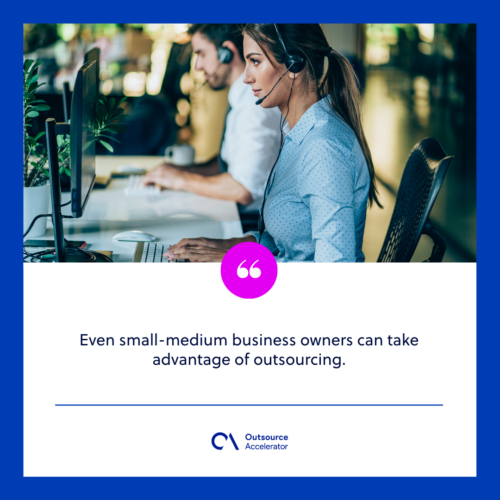
2. Advantages of BPO for SME companies
There is a growing trend of small and medium enterprises, which lifts economic growth. These firms can grow even more with the advantages of offshoring activities.
Many people think outsourcing is costly for small firms. However, that is not true at all. In fact, BPO is a cost-efficient business solution. It works for large companies and for SMEs alike.
Even a small business can cut overhead and payroll costs by outsourcing some tasks. This is because outsourcing taps lower labor costs in other regions, instead of hiring a full in-house team. Skill gaps in certain tasks often hold small firms back. With an outsourced provider, SMEs need not stress about niche skills like accounting or IT. Outsourcing gives you high-quality output from trained pros.
So what is the outsourcing advantage for SMEs? It brings high flexibility and more financial freedom. On top of being cost-effective, it also makes work faster. As a result, you save real time and resources.
It also lets you choose which tasks to keep and which to hand to service providers. Because of this, you no longer face the burn of too much daily work. If you want a balanced view first, weigh these pros and cons of outsourcing for small businesses. It also helps to know the different types of outsourcing before you pick a model.
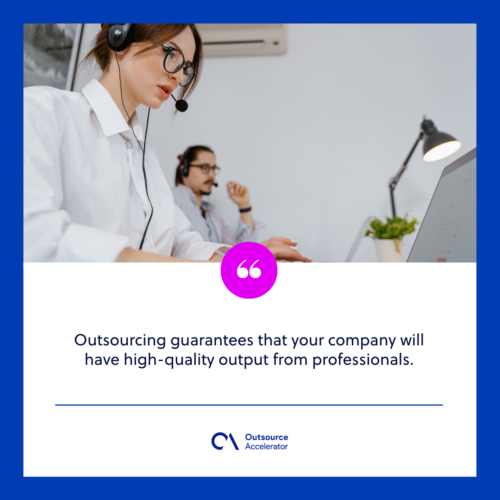
3. Advantages of BPO for large corporations
So how does an outsourcing company, especially a big one, gain from this strategy? Large firms are often hard to manage. There is always a flood of tasks to finish. As a result, a smooth operation can be tough to keep.
What is the outsourcing advantage for large corporations? The main reason to outsource is to lower costs. It cuts spend on things like manpower and equipment. Big companies have many staff, so labor and benefits cost a lot.
However, with outsourcing, fixed costs like this can be reduced. As a result, you can move funds to revenue-driving work. On top of this, a trusted BPO means no hidden costs spring up on you.
Work efficiency is also tricky in large firms. After all, it is hard to keep tabs on every person and function. With outsourcing, you gain an edge in time-driven work. It also frees in-house staff from constant multitasking. In turn, they get more time to build strategy and skills.
No firm is so large that in-house staff cover every skill. BPO gives you access to niche experts and trained people. Because of this, your overall performance improves. Many firms also tap the top BPO companies in the Philippines for this reason. Some start with back office outsourcing to test the model before they scale.
Frequently asked questions about business process outsourcing
What is business process outsourcing in simple terms?
It is when a company hands certain tasks to an outside provider. These are often non-core jobs, like accounting, IT, or customer support. The provider does the work, so the company can focus on its main goals.
What are the main advantages of BPO?
The top gains are lower costs, more time, and access to skilled staff. It also adds flexibility. As a result, firms can scale up or down as demand shifts.
Is outsourcing only for large companies?
No. Solopreneurs, SMEs, and large firms all use it. In fact, small firms often gain the most, since it frees the owner’s time and cuts overhead.
Which tasks can a business outsource?
Common ones include accounting, IT, admin, data entry, and customer support. Firms usually keep core work in-house and outsource the rest.
Does BPO always save money?
It often does, thanks to lower labor rates and fewer fixed costs. Still, savings depend on the tasks and the provider. So it helps to compare in-house and outsourced costs first.
Key takeaways
- BPO lets you hand non-core tasks to a trusted third-party provider.
- Solopreneurs gain more time and speed for their core work.
- SMEs cut overhead and reach skilled staff without a full in-house team.
- Large firms lower fixed costs and free staff from constant multitasking.
- Compare in-house and outsourced costs to confirm the savings.






 Independent





