
Understanding Filipino traits, values, and culture

What are Filipino traits and values?
Filipino traits and values are the shared cultural attitudes, rooted in the concept of kapwa (a shared inner self), that shape how Filipinos relate to family, community, and work. In short, they explain much of the cultural and linguistic compatibility that makes the Philippines a leading destination for outsourcing and offshore teams.
- Core values center on close family ties, social harmony, faith, hospitality, and optimism in the face of hardship.
- They are shaped by pre-colonial Asian trade, more than three centuries of Spanish rule, and later American influence, which also gave the country its strong English proficiency.
- For employers, these traits translate into a loyal, adaptable, and communicative workforce that thrives in customer-facing and creative roles.
Many businesses prefer to outsource their processes to BPO companies in the Philippines. One major reason is the high linguistic and cultural compatibility between Filipinos and their clients.
This compatibility does more than raise the quality of service. It also shapes how office dynamics work day to day. To build a harmonious and effective working relationship, therefore, both sides should take the time to understand the culture and values of the people they work with.
To understand Filipino talent and the wider BPO industry, it helps to look first at the country’s history and its traditional values.
Top Filipino traits and values
The term kapwa, or a shared inner self lies at the core of Filipino psychology. A person who treats another as a kapwa shares a sense of identity and consciousness with that other person.
As a result, strong emphasis falls on social acceptance and social harmony at both the individual and community level. Social approval, and caring about what others think, therefore shapes much of daily behavior.
Here are some of the common traits and values the country is known for.
The family
Filipinos are known for strong family ties. For this reason, it is common to see several generations, or even multiple families, living in a single home.
The family sits at the center of the Filipino community. Children are not expected to leave their parents’ house until they marry. Even then, many couples choose to stay with or near their own or their spouse’s parents.
Filipinos are also expected to care for their aging parents rather than send them to a retirement home. This deep respect for family is one reason why Filipino nurses and caregivers give their patients such attentive care.
Humor and positivity
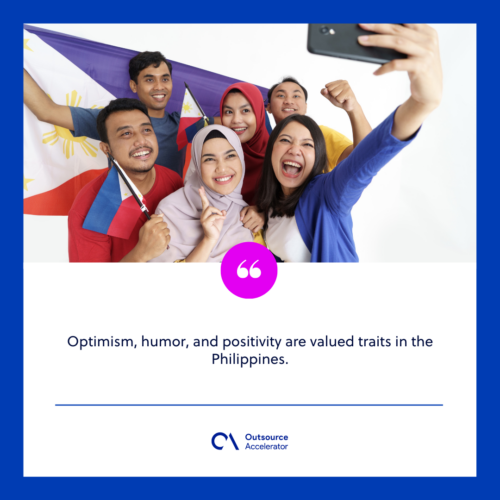
Optimism, humor, and positivity are highly valued in the Philippines.
Filipinos love celebrations and festivities. The country has a long list of national holidays, and many provinces and cities add their own. Even so, families still make time to celebrate birthdays, Christmas, and other occasions together.
In difficult moments, community members are encouraged to look at the brighter side of things. This instinct for finding good in the bad traces back to the country’s location, which lies in the path of typhoons and sits along the Pacific Ring of Fire.
Because natural calamities are common, humor and positivity work as a coping mechanism. It is much like how some children laugh to hide their embarrassment after a fall.
Flexibility and adaptability
The phrase bahala na, which loosely means “whatever happens, happens,” is one of the most familiar expressions in the country.
It captures how Filipinos value adaptability and quick thinking. In effect, the phrase expresses a belief in a higher power and a readiness to accept what cannot be controlled.
People who say bahala na see it as a positive affirmation that helps them face a problem head-on. Critics, however, call it a negative Filipino trait, viewing it as fatalistic or as a way to avoid responsibility.
Faith and religion
Spirituality runs deep in Filipino culture. Long before Spanish rule, many pre-colonial societies practiced animism, and Islam was firmly established in the southern islands.
Today, religion still shapes society and daily life. For example, the Catholic Church’s views influence some laws, most towns hold fiestas for their patron saints, and many non-working holidays mark religious events. To many Filipinos, religion helps define their values and principles.
Filipino hospitality
Filipinos are naturally hospitable. Hosts welcome guests warmly, no matter where they come from or how well they know them.
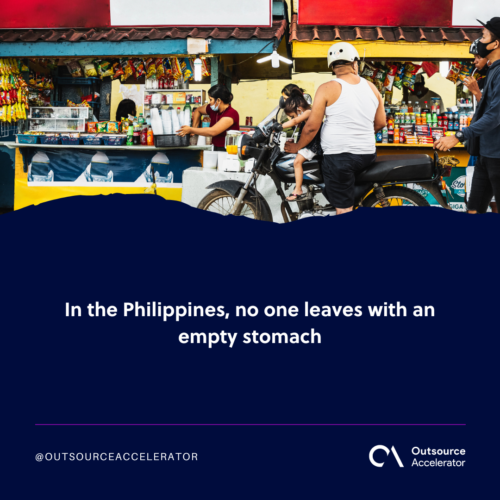
Typically, hosts offer food, entertainment, and, if there is time, a tour of local sights. In the Philippines, no one leaves with an empty stomach. Before guests go, hosts even send them home with pasalubong, or souvenirs, which often take the form of local delicacies and sweets.
Other positive Filipino traits and characteristics
Besides the traits above, Filipinos are also known for the following.
Respect for the elderly
Filipinos hold their elders in high regard, including their parents. For instance, young adults still take an elder’s hand to their forehead and say “mano po” when arriving home.
Industrious attitude
Filipinos are resourceful and hardworking. As a result, they push to finish their goals despite difficult circumstances and limited resources.
Generosity
Filipinos are naturally helpful and generous. They give what they can to family members, and even to strangers, when the need arises. You can see this in the many charity drives and foundations that spring up whenever calamities strike.
Roots of Filipino values, traditions, and culture
To understand how these values took shape, it helps to look at Philippine history and the many cultures that influenced society over time.
Brief Philippine history
The pre-colonial Philippines
Long before the Spanish arrived, communities in the archipelago traded with what is now China, India, Indonesia, Thailand, and Vietnam. Because it sat beside continental Asia and along the Pacific, the archipelago gave its people constant contact with different cultures. India and Arabia, in particular, left a strong mark.
The Spanish occupation
The Spanish colonial period began in 1521 and ended in 1898, lasting 333 years in total. The islands were named the Republic of the Philippines in 1543, in honor of King Philip II of Spain. During this time, Christianity took firm root.
The American occupation and beyond
After Spain lost the Spanish-American War, the Philippines came under American rule, then Japanese occupation, and then American rule again after World War II. By 1946, the United States had ceded its sovereignty, and the country elected the first president of its independent republic.
Languages of the Philippines
There are around 181 languages used in the Philippines. Most are living languages, and two, Filipino and English, are official.
Most Filipinos grow up bilingual, and many speak three languages: English, Tagalog, and the indigenous language of their region. Over time, these languages have borrowed heavily from one another. In 1937, Filipino was named the national language of the Philippines.
Spanish influence on the Filipino language
Roughly a third of Filipino words come from Spanish. During the occupation, friars and priests ran religious instruction and most formal schooling in Spanish. As a result, Tagalog absorbed many Spanish words that are still in use today.
American occupation and the English language
Under American rule, English became the main language of instruction in schools across the country. Before and after World War II, the government also worked to build a national language based on Tagalog, which nearly half the population already spoke as a second language.
Today, schools and universities teach both Filipino and English and use them as languages of instruction. News and entertainment programs air in both as well. This deep English proficiency is a key reason global companies choose the Philippines for customer support and back-office work.
Religion
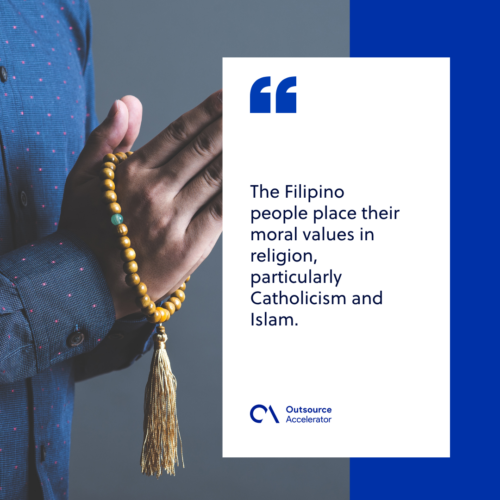
More often than not, Filipinos ground their moral values in religion, especially Catholicism and Islam. Religion is seen as a shared value that strengthens the family and, at times, even influences those in power.
For business owners, this should not be a concern, because BPO in the Philippines drives much of the country’s economic growth. That growth eases tension between the government and foreign investors, which in turn makes it easier for investments to go through and to earn tax relief. Because Filipinos hold strong religious beliefs, however, it is best to keep any religion-related conversation professional and friendly.
Filipino cuisine
Filipinos prepare great-tasting food, especially on special occasions with visitors around. In fact, Filipino cuisine blends Chinese, Mexican, Malay, Spanish, Indian, and American cooking.
Meals are frequent and usually include breakfast, snacks, lunch, merienda, and dinner. Most dishes feature rice, served alongside other food. Filipinos generally eat with spoons, forks, and knives, though hands come in handy with seafood.
Some of their most popular dishes include:
- Chorizo
- Lumpia
- Paksiw (pork or fish in vinegar and spices)
- Kare-kare (a stew made with oxtail)
- Sinigang (a sour soup made with pork, prawns, or fish)
- Longanisa (sweet sausage)
Popular snacks include bibingka (rice cake made with margarine or butter), polvoron (powder candy), puto (steamed rice cakes), and chocolate.
Filipino work ethic
If you plan to hire from or outsource to the Philippines, it helps to understand these cultural differences first. That way, you can get the best from your workforce.
The Filipino workforce is among the most loyal and hardworking in the world. Filipinos are also strongly community- and family-oriented, which naturally carries into the workplace and into management styles.
Generalizations are risky, but Filipinos tend to excel in creative and communication-based roles. Design, content production, the arts, and most customer-facing work are good examples. They are also very strong in English, both spoken and written, even though it is historically a second language.
To keep people motivated and engaged, everyone needs to benefit from the relationship. In other words, it has to be a win-win.
Philippines, a top outsourcing destination
Read this article to see why the Philippines is a top outsourcing and employment destination. It lays out the main reasons the country has become the Swiss banking of outsourcing.
Managing a Filipino workforce
Managing people is never easy. To get the best from any team, you have to invest in the environment and the processes that develop people’s skills and careers. The Philippines is no different.
Managing and nurturing a Philippine-based team takes real effort. Get it right, however, and you can build an incredibly dedicated, loyal, and effective team. We have written several articles on how to do exactly that, and a few favorites follow below.
Get the best from employing young professionals
This article reviews a podcast interview with Eileen Juan, the founder of The Picture Company. She explains how she motivates and gets the best from her Filipino workforce.
Get the best out of your Filipino workforce
This piece explores how to draw the best performance from your Philippines-based team.
Resilience and adaptability of the Filipino workforce
This one sums up our podcast interview with Gerrard Aguelles, a technical trainer and web developer. In it, he explains how Filipinos adapt and respond when working with foreigners.
Payment solutions for a Filipino workforce
The Philippines also keeps pace on the technology side, especially in payment solutions. This progress shows how far the country has come on financial inclusion.
For example, in its 2021 Financial Inclusion Survey, the Bangko Sentral ng Pilipinas (BSP) found that account ownership rose to 56% of adults, up sharply from 29% in 2019. E-money accounts drove much of that gain, and many previously unbanked citizens now keep money on mobile platforms.
Thanks to mobile payment and B2B platforms, tasks like receiving remittances, transferring allowances, and opening a savings account now take just a few taps. As a bonus, businesses no longer have to worry about steep transfer fees when paying across currencies.
Holidays in the Philippines
The Philippines is renowned for its national and local celebrations. Many of them honor the core values described above. Because of all this festivity, the country has more holidays than most other nations.
The main holidays appear below. For the current, official dates, you can get the full list of Philippine holidays here, since the government sets them by proclamation each year.
In practice, the country observes both regular holidays and special non-working days that mark national, religious, and cultural events. Regular holidays include:
- New Year’s Day (January 1)
- Maundy Thursday and Good Friday (movable, March or April)
- Araw ng Kagitingan, or Day of Valor (April 9)
- Labor Day (May 1)
- Independence Day (June 12)
- National Heroes’ Day (last Monday of August)
- Bonifacio Day (November 30)
- Christmas Day (December 25)
- Rizal Day (December 30)
Special non-working days, meanwhile, are holidays enacted by Congress or declared by the president, and they can shift from year to year. Common examples include Chinese New Year, the EDSA Revolution Anniversary, Ninoy Aquino Day, All Saints’ Day, and the Feast of the Immaculate Conception.
Pay rules differ by holiday type. Employees who work a regular holiday earn 200% of their daily rate plus their cost of living allowance, while those who work a special non-working day generally earn 130%.
How Filipino traits and values benefit outsourcing
Again, many businesses outsource to BPO companies in the Philippines largely because of the strong cultural and linguistic fit between Filipinos and their clients.
That fit raises service quality, and it also shapes how office dynamics work. For the best results, both sides should invest time in learning about each other’s culture and values.
Comprehensive guide to payroll, salary, compensation, benefits, and allowances in the Philippines
If you plan to hire in the Philippines, especially through outsourcing, read our Comprehensive Guide to Payroll Salary Compensation, Benefits, and Allowances in the Philippines. It is our most complete resource on salaries and the many details that come with them.
The guide also covers holidays, allowances, and general expectations. As noted above, holidays are a core part of the culture, and there are also many allowances to account for when you hire a Filipino workforce.
Filipino salaries and income
The Philippine workforce earns considerably less than its Western counterparts, which some observers see as an ethical concern. At the same time, the economy has grown steadily. In fact, GDP expanded by 5.7% in 2024 before easing to 4.4% in 2025, according to the Philippine Statistics Authority.
A young, increasingly skilled workforce fuels much of that growth. A young Filipino graduate can also live relatively well on a modest starting salary, as we explore in this article.
Filipino culture and values shine
The people of the Philippines can take real pride in their culture and values. It is an exciting time of rapid growth and relative prosperity, and it is well earned. Managing a team here is not always easy, but people management is complex everywhere. Once you master it, the rewards are substantial for everyone involved.
Frequently asked questions about Filipino traits and values
What are the most common Filipino values?
The most commonly cited Filipino values are close family ties, kapwa (a shared sense of self with others), social harmony, hospitality, faith and religiosity, respect for elders, and optimism and humor in the face of hardship.
Why are Filipino traits important for outsourcing?
Traits like adaptability, loyalty, strong English skills, and a customer-focused, family-oriented mindset make Filipino teams a strong cultural fit for Western companies. This fit is a major reason the Philippines is a leading outsourcing destination.
What is kapwa?
Kapwa is a core Filipino concept that means a shared inner self. Treating someone as kapwa means recognizing a shared identity and consciousness, which underpins the value placed on social harmony and acceptance.
What shaped Filipino culture and values?
Pre-colonial trade with neighboring Asian nations, more than three centuries of Spanish colonization, and later American influence all shaped Filipino culture. That mix is why Catholicism, a Spanish-influenced language, and widespread English proficiency all coexist today.
Key takeaways
- Filipino traits and values center on kapwa, family, faith, hospitality, and optimism, and they draw on Asian, Spanish, and American influences.
- Strong English proficiency and a customer-focused, adaptable mindset make Filipino teams highly compatible with Western businesses.
- The Philippine economy grew 5.7% in 2024 and 4.4% in 2025, supported by a young, skilled workforce and rising financial inclusion (56% account ownership in 2021).
- Understanding these values helps employers manage and motivate a loyal, high-performing Philippine-based team.






 Independent





