
The resiliency and adaptability of the Filipino workforce

What makes the Filipino workforce so resilient and adaptable?
The Filipino workforce is known for resilience, adaptability, and strong English and tech skills, which make the Philippines a top choice for outsourcing.
- Filipinos adapt fast to new tools and global work styles.
- Family values drive them to work hard and keep learning.
- A large, skilled talent pool powers the BPO industry.
Gerrard Aguelles is a technical trainer and web developer. Here, he shares his view on the traits of the Filipino workforce that make them competitive and highly skilled.
In an ideal world, hard data drives every business choice. However, some things are hard to measure, and that turns simple calls into tricky ones.
On paper, outsourcing in the Philippines is a smart option. In fact, for some firms it is the only logical choice to keep growing. Still, one worry is a lack of knowledge about the Filipino workforce and what it can do.
On episode 82 of the Outsource Accelerator podcast, Derek Gallimore spoke with Gerrard. He kindly shared how his mindset helped him grow his career.
Derek does not aim to promote any one person. Instead, this chat gives business owners abroad a peek into the traits and skills of Filipinos.
Ultimately, the goal is to bridge the Philippine BPO industry and future clients. As a result, it clears up some of the unknowns.
Number of the Filipino workforce
The Philippines is one of the most populous countries in the world. Its total population reached about 112.7 million in the 2024 census.
The Filipino workforce stands at about 47 million people. More recently, the country’s labor force has grown to more than 51 million as of early 2026.
The size of the Filipino workforce keeps rising each year. However, it still trails the fast pace of population growth. So, more people enter the job market than leave it, which strains jobs and wages.
This is where the outsourcing industry comes in.
Adapting to changes in technology
Gerrard worked for a firm that trained large corporations. Mainly, his specialty was JavaScript.
“I took that teaching opportunity to learn more about technology,” he said. “To be honest, I was not confident enough when I graduated.”
The country is close to joining the world’s fast-rising economies. Even so, some worry about its schools, above all in tech.
In some cases, tech moves so fast that skills age soon after graduation. Still, this is a worldwide concern, not just a Philippine one.
In an emotional segment, CNN’s Anderson Cooper thanked Filipinos for showing the world how to live. He had seen the aftermath of a devastating storm that hit Tacloban City.
“Can you imagine the strength it takes living in a shack, to be sleeping on the streets next to the body of your dead children?” Anderson asked. “Can you imagine that strength? I cannot.”
In the worst of times, Filipinos show great resilience. It is a trait built into a warm and faith-driven nation. As a result, this same trait pushes Filipinos to strive and adapt.
“I need to learn more. Being trained and teaching where you try to learn new technology, not only for yourself but others is effective,” Gerrard explains. “When you study something that you will teach, you understand more and learn faster.”
While Filipinos work to learn, the fast growth of the BPO industry has opened doors. In addition, it offers more than a paycheck.
It is also a platform to reach higher levels of skill. So, clients tap into this potential by outsourcing to the country.
Filipinos are family-oriented
The BPO industry is broad and goes beyond call centers. In most cases, Filipinos work on a company’s site.
However, some staff work from home. Meanwhile, the number of online freelancers keeps rising fast.
Working across cultures is never simple. After all, even working with your own countrymen can be a challenge.
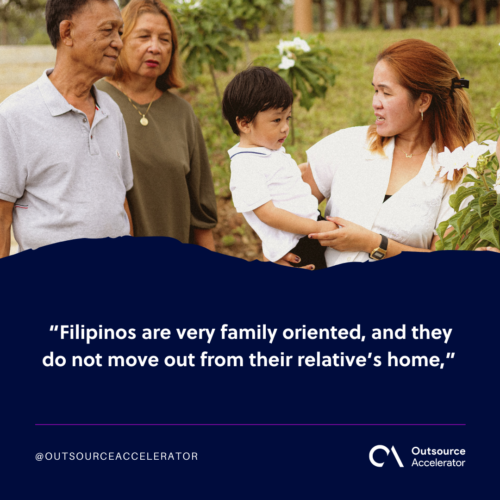
“Filipinos are very family oriented, and they do not move out from their relative’s home,” Gerrard notes. “Most of the Filipinos live with their families, and if you live with many people, it is very hard to focus.”
Breaking cultural barriers takes more than good intent. So, one role of BPO firms and consultants is to close that gap. In short, they have the skills to handle the local culture.
Outsourcing does not always mean using a BPO firm. In fact, many small and midsize firms hire online freelancers directly.
In this setup, home distractions can cut into output. Still, there are positive signs too.
Many Filipinos now see freelancing as a solid, well-paying career. Because of this, competition rose, and so did the level of professionalism.
Some skilled workers also choose to stay home for personal reasons. As a result, the pool of skilled remote workers has widened.
Working with foreigners
It has been five centuries since Ferdinand Magellan claimed the islands for Spain. For much of its history, the country was a colony of Spain and, briefly, the United States.
Arguably, few nations hold as much mixed foreign influence as the Philippines. So, its culture is truly diverse.
Past colonial powers shaped the country, and so did migrants from across Asia. Furthermore, it is one of the few places where Christians and Muslims live in relative peace.
Some may see foreign influence as a threat to national pride. However, it also gave Filipinos the uncanny ability to adapt to the international culture.
“A lot of the guys that people work with (in the Philippines) are very experienced in working in outsourcing firms and BPOs and all that,” Derek said.
“So actually, the people that need the most training are the employers, owners of the businesses and clients of the BPOs because there are some subtleties and nuances they have to get used to, to get the best out of their teams.”
Derek speaks from real experience, having seen both sides. So, his view carries weight.
In the past, some old-timers saw work with foreigners as a “colonial mentality.” This was more common among those who lived through the Second World War.
Today, that view has changed. At its core, the drive is the chance to earn a decent living.
“… A fun thing about it is you get to work with people overseas, and you compare how they work with your current work setup,” Gerrard explains. “Getting to work with people overseas will teach you a lot.”
A growing part of the Filipino workforce sees this as a chance to learn. In addition, globalization opens borderless opportunities.
By outsourcing to the Philippines, firms tap into a skilled and very competitive workforce.
Putting it all together
Gerrard has shared a rich view of Filipino traits. He showed how resilient Filipinos are and what they do to stay competitive. First, though, there must be the desire. With that, all things become possible.
People from Western countries may find it odd that most Filipinos live with their parents. In fact, it can be a distraction at times. Still, that routine has its own rhythm. If nothing else, family is a constant push to work harder.
For Filipinos, there is no bigger motivation than to provide for family. So, they not only work hard but also find ways to set themselves up to win.
Click here to hear the full episode 82 of the OA podcast between Derek Gallimore and Gerrard Aguelles.
Frequently asked questions about the Filipino workforce
Why is the Filipino workforce popular for outsourcing?
Filipinos bring strong English, tech, and service skills. In addition, they adapt fast to global work styles. So, many firms choose the Philippines for outsourcing.
How big is the Filipino workforce?
The labor force has grown to more than 51 million as of early 2026. Meanwhile, the total population reached about 112.7 million in the 2024 census.
What traits make the Filipino workforce stand out?
Resilience and adaptability stand out the most. In addition, strong family values push Filipinos to work hard and keep learning.
Does the Filipino workforce only work in call centers?
No. The BPO industry is broad and goes beyond call centers. For example, many Filipinos work in IT, design, and freelancing.
How does family culture shape Filipino workers?
Family is a key driver for most Filipinos. As a result, they work hard to provide and to grow their skills over time.
Key takeaways
- The Filipino workforce is known for resilience and quick adaptability.
- The labor force has grown to more than 51 million as of early 2026.
- Strong family values push Filipinos to work hard and keep learning.
- The BPO industry offers income and a path to higher skills.
- These traits make the Philippines a top choice for outsourcing.






 Independent





