
Outsourcing customer service 101

What is outsourcing customer service?
Outsourcing customer service means hiring a third-party team to handle your calls, emails, and chats, so you cut costs and keep support running around the clock.
- It can save you a large share of labor costs while keeping service quality high.
- A good partner covers breaks, absences, and after-hours demand for you.
- The main risks are less control and language gaps, so pick your provider with care.
Outsourcing has grown steadily over the past few decades. Today it is one of the most popular corporate strategies worldwide. Because of its low cost and strong returns, it has won many fans in global business.
Outsourcing customer service keeps someone ready to handle your company’s calls. So you never worry about breaks or absences. Good providers have continuity plans in place.
Firms like MVP Asia Pacific, one of the leading BPO providers in the Philippines, help businesses get high-quality customer service. As a result, you free up valuable hours and focus on what matters most.
Aside from cost savings, outsourcing gives you a skilled workforce and on-time delivery. In addition, it leads to better efficiency and ROI.
What is customer service?
Customer service is the work of helping buyers use, improve, and fix a product or service. If you want to keep customers and ensure customer satisfaction, you need great service.
Customer service runs through email, the web, text messages, and social media. In many cases, firms outsource it to a call center that employs trained agents. So your calls stay covered by skilled staff.
Areas of customer service
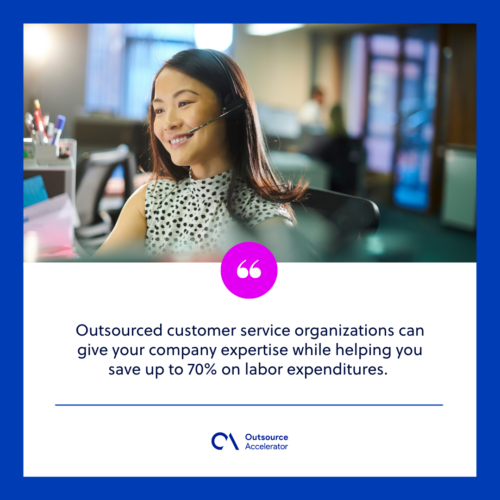
Outsourced customer service organizations give your company expertise while cutting labor costs by up to 70%. Still, you must put in the same effort you would to build a team at home. That means active hiring, training, and onboarding into your culture.
Good support needs a clear plan. Here are some of the most crucial customer service areas and what they focus on:
Communication methods
In every department, communication is key. So the choice of words, and the intent behind them, matters a lot. Many teams now blend channels through omnichannel support to keep those conversations smooth.
Customer success monitoring
Customer success monitoring sits outside the daily routine. In short, a manager sets up systems so buyers get the tools and information they need. As a result, customers can use your product with ease.
Speed
Speed can set you apart from rivals. So first learn what buyers expect. Then set clear targets for your staff to meet those expectations.
Friendliness and amiability
Being approachable sounds simple, yet many teams miss the chance to impress. So set clear guidelines for your staff. Also explain why a warm tone matters. After all, first impressions count.
Outsourcing customer service: pros and cons
Customer service is key to your success. A well-run service plan keeps buyers happy without straining your staff. Still, many owners find it hard to decide whether to outsource to a third party.
Even so, you want your company to keep deliver excellent customer service to meet rising consumers’ needs. So here are the common pros and cons of call center outsourcing.
Benefits of outsourcing customer service
There are many clear advantages of outsourcing customer service to a third party. In fact, the world’s top firms outsource their support for good reason.
Cost-effectiveness
You can hire a team overseas and pay a lower hourly rate. So you save money. You also skip spending on tools, supplies, and extra operations.
Workload reduction
Dealing with customer calls and emails pulls time from work like sales. So outsourcing frees your staff. As a result, everyone can focus on more important sales tasks.
Improvements in risk management
One big benefit of outsourcing customer service is lower company risk. Providers often know how to reduce threats thanks to their deep expertise. As a result, your company becomes a safer bet. In turn, investors are more likely to back its growth.
Flexibility
Based on your needs, customer service support can flex with demand. So it is the most practical fix when you need help outside normal hours. You can close your shop for the day while your outsourced team keeps taking calls.
You grow your resources
Smaller firms often lack the staff to run complex projects. So outsourcing helps a lot. Despite a small in-house team, a targeted outsourcing plan lets you handle a heavier workload with ease.
Outsourcing customer service drawbacks
Outsourcing saves your company time and money. But it also has its fair share of drawbacks. So it pays to work only with trusted providers like MVP Asia Pacific. Here are some downsides to weigh.
Loss of control
Control is one of the biggest drawbacks. When you lose control of service, your contact center may struggle to keep your brand promise. In addition, weak quality checks can lead to poor service.
It needs management and training
Agents need a full training program to do the job well. Without it, phone work can overwhelm them. So poor management can hurt your center and make it less efficient.
Communication barriers
If you outsource to another country, some agents may lack the cultural fit or language fluency you need. So choose your partner with care. That way, you make sure agents are well trained and clear to talk with.

Where to outsource your customer service
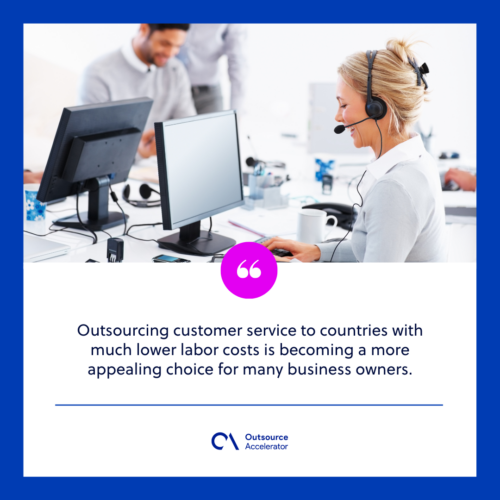
Many buyers know that big firms often send customer service to offshore call centers. Today, outsourcing to countries with lower labor costs appeals to many owners. Naturally, they want to save money while keeping the great customer experience that brings buyers back. It also helps to compare the main offshore outsourcing models before you choose.
The most famous offshore hubs are India, South Africa, Jamaica, and the Philippines. Because labor costs there are much lower than in the United States, these centers often charge less.
The Philippines
Customer service outsourcing to the Philippines keeps growing fast. Demand has fueled big growth in hubs like Metro Manila, Cebu, Davao, and Baguio, and it was once expected to rise by up to 50% by 2022. Even now, the sector keeps expanding. Many buyers start with call center services in the Philippines for this reason.
Filipino workers come from many fields, from IT and healthcare to graphic arts, accounting, and real estate. Combine that with high education levels, and you get staff who give excellent service. In addition, providers can tailor solutions for your business thanks to this wide range of skills.
One big draw is the deep talent pool. Hiring service staff back home is not easy. Finding skilled people is even harder, since few rush to take support jobs. So it pays to work with trusted providers like Helpware.
India
India has made itself a top outsourcing hub. The government allows imports of goods and services and grants tax breaks for exported IT services. So many skilled, English-speaking agents are ready to help. This makes India a strong pick for inbound call center outsourcing.
Indian call centers can offer 24-hour service to firms in the United States, Western Europe, and the Asia Pacific. India also has advanced infrastructure and new technology. As a result, its teams train often to stay sharp. This helps Indian BPO firms meet high client demands and finish key projects fast.
South Africa
For business process outsourcing, South Africa is a fast-growing market. The government has set clear goals to cut poverty and lift its middle class. So foreign investment in call centers has drawn strong attention.
The call center and BPO industry in South Africa has become a top global market for English and bilingual services. For over a decade, it has earned praise for skilled staff, strong language skills, and high emotional intelligence. In addition, the country has built advanced systems for many sectors, from telecom to manufacturing.
Jamaica
Jamaica has spent a decade opening its industries to lower costs for nearshore investors. The Global Services Sector (GSS) program helps upskill the BPO workforce. So the government can boost sector growth. Its skills programs prepare high school students for call center work, and they include:
- Technical language.
- Communication skills training.
- Customer service certification courses.
- A career path for customer service and data operations.
Jamaica has built business conditions that favor call centers and nearshore growth. As a result, it keeps drawing foreign investment. In short, the country shows a long-term commitment to BPO operations.
Frequently asked questions
How much can you save by outsourcing customer service?
Savings vary by country and provider. Still, many firms cut labor costs by up to 70%. You also save on tools, office space, and training. As a result, outsourcing often frees budget for growth.
Is outsourced customer service lower quality?
Not always. A trusted provider trains agents well and tracks quality closely. So service can match or beat an in-house team. The key is careful vendor choice and clear standards.
Which country is best for outsourcing customer service?
It depends on your needs. The Philippines is strong for voice and rapport. India offers deep IT skills. South Africa and Jamaica suit nearshore and bilingual work. So weigh cost, language, and time zone.
What are the main risks of outsourcing customer service?
The top risks are less control, training gaps, and language barriers. So set clear rules and quality checks. In addition, choose a partner with a strong track record.
Can small businesses outsource customer service?
Yes. In fact, small firms often gain the most. Outsourcing gives them skills and coverage they could not build alone. As a result, they can serve more customers without a big in-house team.






 Independent





