
Different types of outsourcing that you need to know


What are the different types of outsourcing?
The main types of outsourcing include business process, professional, IT, multisourcing, manufacturer, process-specific, project, offshore, onshoring, and nearshoring.
- Each type suits a different business need or budget.
- Some focus on location, while others focus on the task or skill.
- The right choice depends on cost, quality, and how close you want the team.
Outsourcing helps you keep up with demand for staff and services. Even during disruption, it supports business continuity. After all, you do not put every resource in one place. Outsourcing also keeps growing each year. In fact, many companies still plan to increase outsourcing. Meanwhile, BPO firms run smoothly and follow the rules that keep your data safe.
10 types of outsourcing
| Business Process Outsourcing | Traditional original outsourcing |
| Professional Outsourcing | Advisors, consultants, and agencies |
| IT Outsourcing | Common outsourcing specialization |
| Multisourcing | Common in high-complexity sectors |
| Manufacturer Outsourcing | “Made in China” is stereotypical outsourcing |
| Process-Specific Outsourcing | outsourcing one specific function of a business |
| Project Outsourcing | Typically big or complex projects are outsourced |
| Offshore Outsourcing | Emphasizing the offshore location |
| Onshoring | Outsourcing to domestic suppliers |
| Nearshoring | Outsourcing to near or neighboring countries |
Outsourcing comes in many forms. Each one fits a different business need. So it helps to know the basics first. Beyond the simple definition of outsourcing jobs, you should learn the different types of outsourcing.
Business Process Outsourcing
Business process outsourcing is the most common type of outsourcing. Basically, it means contracting a business process to a third party. This type often covers repetitive tasks. For example, it includes customer support and admin roles. It is also known as operational outsourcing.

Business process outsourcing examples
- A realtor hires a virtual assistant to set appointments and reply to customer emails.
- Telecom firms such as Verizon and Sprint hire teams for technical and billing support.
- Small businesses outsource lead generation to gather more customers at home and abroad.
- Firms of all sizes may outsource Human Resource functions like recruitment and benefits admin.
Professional Outsourcing
Some tasks are too complex for small teams. In fact, they may need extra training or a professional license. Hiring locally can also cost a lot due to low supply. In these cases, professional outsourcing is a smart option. As a result, it cuts costs while getting high-quality talent.
How professional outsourcing works
- Accountants and bookkeepers help with annual tax filing and income statements.
- CAD operators and engineers handle building layouts, floor plans, and mechanical designs.
- Businesses can outsource marketing to experts who manage promotions and strategy better.
Knowledge process outsourcing (KPO) is a form of professional outsourcing. This type relies on staff with advanced degrees. It also needs deep skill in a specialized field.

IT Outsourcing
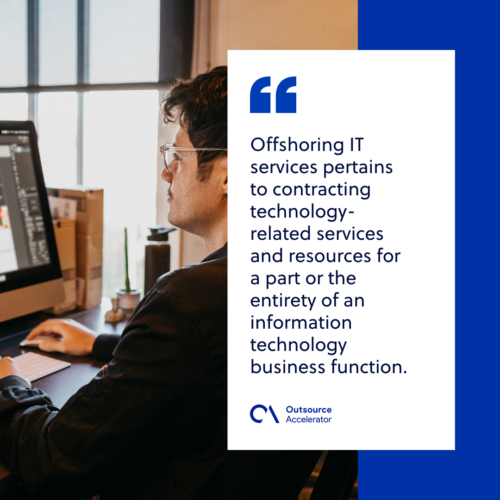
IT outsourcing is one of the most common types of outsourcing today. Basically, it means contracting tech services for part or all of an IT function. Every business has IT needs, from a start-up to a large firm. After all, they all deal with technology on some level.
Examples of IT outsourcing
- Since Alibaba could not find local developers, they outsourced to the USA.
- Slack‘s platform interface was outsourced to a software firm in Canada.
- Telecom firms have been outsourcing IT infrastructure to India and the Philippines to improve service.
Multisourcing
Multisourcing fits any business area. Still, it is most common in complex sectors. For example, tech, avionics, cars, and space travel all rely on it. Simply put, multisourcing combines output from several specialized firms. Then it brings those providers together to build one finished product.
Multisourcing forms best-of-breed teams to hit business goals. In practice, the business builds a partnership with each provider. As a result, the model stays outcome-focused. This type also needs a clear strategy. Furthermore, it needs a network of governance and strong relationships.
Manufacturer Outsourcing
Making your own products in-house can be very costly. First, raw materials are expensive. Next, paying factory workers adds up fast. On top of that, you need capital for equipment and infrastructure. However, manufacturer outsourcing can reduce your cost a lot. As a result, you skip the worry of equipment, infrastructure, and labor.
Manufacturing outsourcing examples
Apple outsources product manufacturing to China once its designs are ready.
Fashion firms such as H&M and Zara use clothing factories in Bangladesh to make their products worldwide.
Ikea, the biggest furniture firm, outsources its furniture to China. So it saves on costs and lifts profit.
Process-specific outsourcing
Some outsourcing targets one task or internal step. This is known as process-specific outsourcing. It is common to hire an external provider that specializes in one service. For example, a retailer can outsource its delivery, especially for global shipping. This type usually has a detailed contract. In fact, it covers the timeline, product costs, and customer contacts.
Process-specific outsourcing cuts costs and saves time. As a result, businesses can focus more on their core work.
Types of process outsourcing
- Knowledge process outsourcing (KPO). This handles research and data analysis for product improvements.
- Recruitment process outsourcing (RPO). This covers posting, application tracking, and evaluation.
- Legal process outsourcing (LPO). This covers litigation and regulatory compliance.
Project outsourcing
Juggling many projects is often hard. As a result, quality can slip when time runs short. In this case, a business can outsource a project to an external service provider. There are many reasons to do this. Still, the most common one is a lack of people or skills for the job.
What projects can be outsourced
- Legal firms hire contract attorneys to keep up with heavy caseloads.
- Promotions and ads are contracted to firms for on-demand projects.
Offshore outsourcing
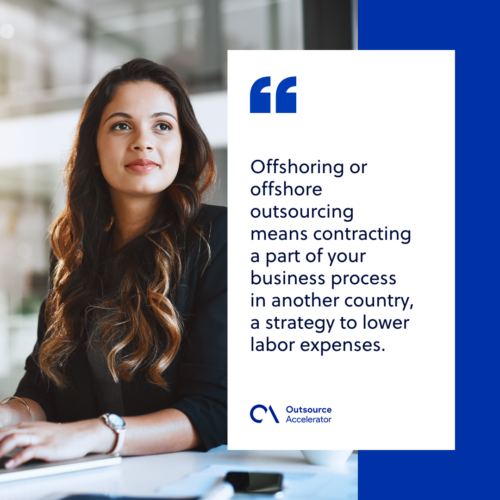
Offshoring, or offshore outsourcing, moves part of your process to another country. Mainly, it lowers labor costs. In fact, some countries can finish a task far cheaper than local teams. In addition, offshoring taps global skills and opens new markets. Furthermore, it can help firms work around local rules that block certain activities.
Examples of offshore outsourcing
- Part of Amazon‘s customer service and logistics is offshored to the Philippines.
- Cisco offshores its IT services to India and the Philippines for 24/7 support.
- American Express offshores its back office to India for wider client support.
Onshoring
Some firms find offshore labor cost-effective. Others do not, so they bring work back home. This is known as onshoring, or reshoring. Simply put, it means outsourcing within your own country. Onshoring has clear perks. For example, you share a similar culture and time zone. However, it offers little cost saving, since local pay stays close to in-house rates.
Nearshoring
Nearshoring sits between offshoring and reshoring. Instead of a far-away country, firms pick a nearby one. The main goal is faster, smoother service. So it cuts shipping and time-zone delays, which are common in offshoring. Meanwhile, it still saves money by using a cheaper neighbor. Basically, this type blends the benefits of both while lowering the risks.
Want to learn more about outsourcing? Check out the Inside Outsourcing book as well as the Inside Outsourcing book review today!
Frequently asked questions about the types of outsourcing
What is the most common type of outsourcing?
Business process outsourcing (BPO) is the most common type. It covers tasks like customer support and admin work. So many firms start here first.
What is the difference between offshoring and nearshoring?
Offshoring sends work to a far-away country for lower costs. Nearshoring picks a nearby country instead. As a result, nearshoring cuts time-zone and shipping delays.
Is onshoring a type of outsourcing?
Yes, onshoring is a type of outsourcing. Here, you hire a provider in your own country. So you keep a shared culture and time zone.
Which type of outsourcing saves the most money?
Offshore and manufacturer outsourcing often save the most. Both use lower-cost labor abroad. Still, the best choice depends on your goals and quality needs.
How do I choose the right type of outsourcing?
First, define your task, budget, and quality needs. Then match them to a type. For example, pick professional outsourcing for licensed work and BPO for routine tasks.
Key takeaways
- There are 10 main types of outsourcing, from BPO to nearshoring.
- Some types focus on the task, while others focus on the location.
- BPO is the most common, and offshoring often saves the most money.
- Nearshoring blends offshore savings with fewer time-zone delays.
- The right type depends on your cost, quality, and control needs.






 Independent





