
Real-life success stories: how BPO continues to change lives


- Real-Life Success Stories: How BPO Continues to Change Lives
How does BPO continue to change lives?
BPO changes lives through real-life success stories that show how outsourcing helps entrepreneurs grow, companies scale, and employees build careers.
- Entrepreneurs and companies gain more output, profit, and a stronger brand image.
- Employees get stable pay, flexible shifts, and room for career growth.
- The industry connects talent across the globe and opens doors in many countries.
Who would not want to hear a great success story? In this guide, we share some of the best outsourcing wins. We have grouped them into three: the entrepreneurs, the companies, and the employees.
In most cases, you likely know these people and brands. However, you may not know that outsourcing was a big part of their success.
The Business Process Outsourcing (BPO) industry is one of the leading businesses today. In fact, the global BPO market is now worth more than $325 billion, and it keeps growing fast.
Many working people join this industry for good reasons. These include career growth, mental challenge, and customer service work. If you work in BPO, you will likely agree.
BPO companies also offer flexibility. Because there are many accounts to staff, both employer and employee can make the most of the worker’s skills. So the fit is often strong on both sides.
BPO companies provide jobs opportunities locally and globally. From single workers to parents with families, many people find real support here.
One clear example is the BPO industry in India. In this country, the sector keeps thriving year after year. Here are some reasons behind its success:
- Competitive workforce
- Human resources that are ready for global market demands
Many companies that outsource to India point to these same strengths. For employers and entrepreneurs, outsourcing has driven real growth and expansion. So we will look at this through the lens of real people and companies.
First, though, it helps to define the term clearly.
How do you define outsourcing?
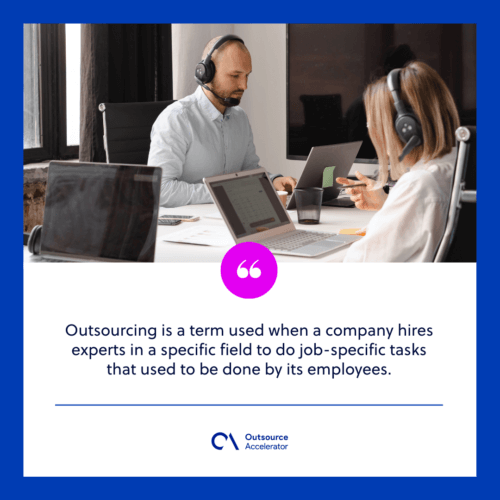
Outsourcing is when a company hires outside experts to do specific tasks. These tasks used to be done by its own staff. As a result, management can focus on more urgent areas.
As a result, this idea drives many companies to the top. In short, it is the central theme of this guide.
For example, Company A hires Expert A, often another company, to run its IT and programming work. In this way, Company A drops the burden of coding issues. So it can focus on its main strength. Common outsourced tasks include payroll, HR, IT, and building management.
There are many reasons why companies outsource. Cost-cutting is one of the best. Even when you pay a bit more for an expert, the return is often strong. Plus, expert work and extra hands raise the quality of the services that a company offers. As a result, customers stay happier. These benefits of outsourcing apply to firms of every size.
Is offshoring different from outsourcing?
Why do companies outsource overseas? In the BPO world, offshoring is a common term linked to outsourcing.
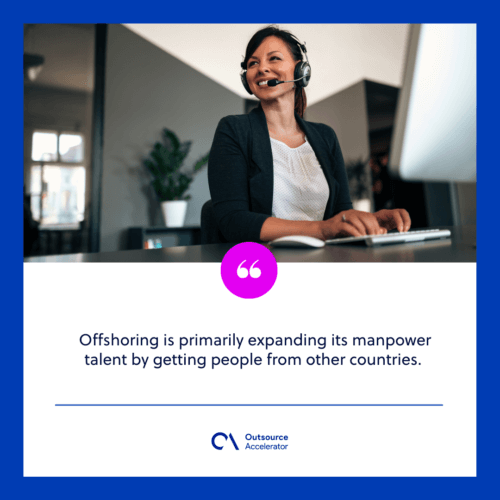
Offshoring means growing your talent by hiring people in other countries. Often, companies use it to focus on what they do best. As a result, this supports growth and expansion. This is one of the main offshoring benefits. For more, see these examples of offshoring in action.
Here are some clear benefits of offshoring:
- Reduced risk thanks to a diverse pool of talent
- Extra support for your existing staff through an offshore team
- Strong business growth because of lower costs
- Wider coverage across different time zones
These are just a few. Still, the biggest impact of offshoring is how it changes lives.
How does business process outsourcing change lives?
The BPO industry keeps changing lives today. This is true for entrepreneurs, companies, and employees alike.
- For entrepreneurs and companies, outsourcing adds people, which lifts output and profit.
- It also builds a strong brand image, because tasks go to skilled experts. As a result, work is done well and looks professional.
- It lets employees focus on what they know best. Meanwhile, they leave the rest to experts. So burnout from heavy workloads drops.
- It supports clear task delegation. As a result, teams work more efficiently and clients feel more satisfied.
- For employees, the BPO industry offers strong pay for them and their families. Plus, shift options let workers pick what fits their lifestyle.
- It also provides training. So workers who lack a skill can quickly catch up.
- It connects people across the globe. In addition, it creates jobs and career growth in developing countries as big firms offshore work.
Since the rise of the BPO industry, the world has never been better connected. This growth is clear in the BPO industry in the Philippines, a global leader in the field.
Frequently asked questions about BPO success stories
How does BPO help entrepreneurs succeed?
In short, BPO gives entrepreneurs extra hands and expert skills at a lower cost. As a result, they can grow faster and focus on their core business. So many well-known founders have used outsourcing to scale.
How does BPO change employees’ lives?
BPO offers stable pay, flexible shifts, and training. As a result, workers can build careers and support their families. It also opens doors in developing countries.
Why is the BPO industry growing so fast?
The industry grows because it cuts costs and boosts quality. In addition, technology and global talent keep expanding what BPO can do. So the market is now worth more than $325 billion.
Which countries lead in BPO?
The Philippines and India are among the top BPO hubs. In addition, both offer skilled, English-speaking workers at competitive rates. So many global firms outsource there.
Is outsourcing only about cutting costs?
No. Cost savings matter, but outsourcing also improves quality and speed. Meanwhile, it frees teams to focus on core work. As a result, both companies and customers benefit.
Key takeaways
- BPO changes lives for entrepreneurs, companies, and employees around the world.
- Outsourcing cuts costs, lifts quality, and frees teams to focus on core work.
- Offshoring adds diverse talent, wider time zone coverage, and strong growth.
- Employees gain stable pay, flexible shifts, training, and career growth.
- The global BPO market is now worth more than $325 billion and keeps rising.






 Independent





