
Top 20 coworking spaces in East Asia

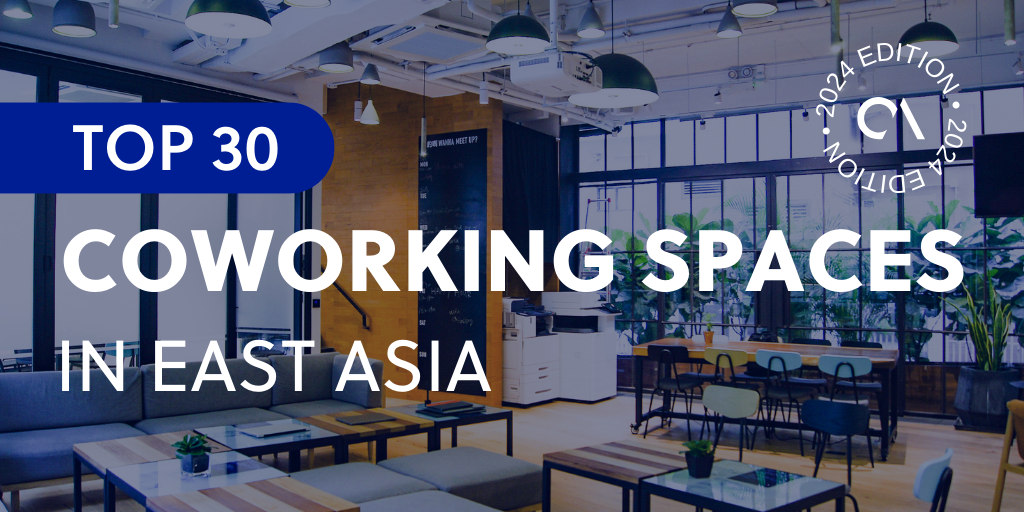
List of top coworking spaces in East Asia
- WeWork
- Regus
- The Hive (Hong Kong)
- Impact HUB (Tokyo, Japan)
- The Executive Centre
- Servcorp
- JustCo
- SparkPlus (Seoul, South Korea)
- ATLASPACE (Hong Kong)
- Cow & Dog (Seoul, South Korea)
- FutureWard (Taipei, Taiwan)
- theDesk (Hong Kong)
- .andwork (Japan)
- Monospace (Taichung and Taipei, Taiwan)
- CIC Tokyo (Tokyo, Japan)
- Heyground (Seoul, South Korea)
- KR Space (Shanghai, China)
- FastFive (Seoul, South Korea)
- Garage Society (Hong Kong)
- Connect Lounge (Taipei, Taiwan)
The top coworking spaces in East Asia split into two groups. Global networks such as WeWork and Regus sit alongside independent hubs in Seoul, Tokyo, Taipei and Hong Kong. This guide lists 20 of them, with locations, published pricing and what each one does best.
East Asia here means China, Hong Kong, Macau, Taiwan, Japan, South Korea and Mongolia. Singapore, Manila and Bangkok sit in Southeast Asia, so they are covered on a separate list.
Coworking is still growing. Industry title Allwork.Space counted roughly 42,000 shared workspaces worldwide in 2025, with about 44,000 expected by 2026. Asia Pacific is the fastest growing region, at close to 23% of the global flexible workspace market.
Who uses coworking spaces?
Coworking is no longer a freelancer product. Allwork.Space puts freelancers and self-employed workers at 40% to 42% of members, and corporate employees at about 36%.
Four groups make up most of the demand across the region.
Freelancers
Freelancers are still the largest single member group in most spaces. They use hot desks to escape the distractions of working from home, and to keep client meetings out of cafes.
Remote workers
Remote workers and hybrid workers book desks close to home rather than commute to a head office.
A 2015 study in Harvard Business Review found that remote workers thrive in coworking spaces. The researchers pointed to a sense of community and a break from office politics.
Startups and SMEs
Startups and small businesses build their first teams in rented space to avoid a long office lease. Larger firms have gone further and built coworking floors of their own.
Most operators bundle internet, printing, meeting room credits and a pantry into the monthly rate. That keeps the setup cost close to zero.
Outsourcing teams
Small outsourcing companies often start in a private office inside a coworking hub. It gives them tools, equipment and utilities without a capital outlay.
Some providers go on to sell seat leasing from those same floors.
Coworking space types compared
Operators across East Asia sell broadly the same five products. Knowing which one you need makes quotes easier to compare.
| Space type | Best for | Typical commitment | What to check first |
|---|---|---|---|
| Hot desk | Travellers and occasional users | Day pass to monthly | Seat availability at peak hours |
| Dedicated desk | Solo workers based in one city | 1 to 12 months | Storage, mail handling, 24/7 access |
| Private office | Teams of 2 to 40 people | 3 to 24 months | Deposit size and headcount flexibility |
| Virtual office | Company registration and mail | 6 to 12 months | Whether the registrar accepts the address |
| Meeting or event room | Client sessions and workshops | Hourly | Included credits and after-hours rates |
Top global outsourcing lists
Outsource Accelerator is the world’s leading outsourcing marketplace and advisory. We list over 3,000 BPO firms located across the globe in our global directory, and we provide detailed information, price guides, and reviews.
Whether you’re a solopreneur, SME owner, or corporate executive, we can help you find the most suitable outsourcing provider for your business.
Explore our outsourcing directory now. You may also check out our top coworking spaces lists here:
- Top 12 coworking spaces in LA
- Top 20 coworking spaces in New York
- Top 15 coworking spaces in Southeast Asia
- Top 15 coworking spaces in Manila, Philippines
- Top 20 coworking spaces outside Metro Manila, Philippines
- Top 20 coworking spaces in India
Top 20 coworking spaces in East Asia
Most of the region’s flexible space sits in Seoul, Tokyo, Taipei, Hong Kong and Shanghai. Those five cities carry the bulk of the supply.
Coworking also churns fast. Individual sites close and operators restructure, so every entry below was checked against the operator’s own website in September 2026.
Pricing appears only where the operator publishes it. Everywhere else, expect to request a quote.
1. WeWork
Locations: China, Hong Kong, Taiwan, Japan, South Korea
Pricing: Quoted per location
WeWork is the best known coworking brand in the world. Its own locations page lists more than 600 open and upcoming sites across 125 cities.
The company filed for Chapter 11 in November 2023 and left bankruptcy protection in June 2024 as a private company. It shed unprofitable sites in that process, so check the specific building before you commit.
In East Asia it still lists Beijing, Shanghai, Shenzhen, Guangzhou, Hangzhou, Hong Kong, Taipei, Tokyo, Osaka, Fukuoka, Seoul and Busan.
2. Regus
Locations: China, Hong Kong, Japan, South Korea, Taiwan
Pricing: Varies by location
Regus is the serviced office arm of IWG and the widest network in the region by city count. It sells private offices, coworking floors, virtual offices and meeting rooms.
Coverage is the main reason to choose it. If one membership has to work in Osaka this week and Shenzhen the next, Regus is the easiest option.
3. The Hive
Locations: Hong Kong
Pricing: Quoted per location
The Hive calls itself Asia Pacific’s leading coworking network. Its site lists 22 locations across eight countries.
Hong Kong is now its only East Asian market. Sites there cover Poho, Wan Chai, Kennedy Town, Causeway Bay, Sai Kung and Lai Chi Kok. Its former Japan and Taiwan pages no longer carry live locations.
The rest of the network sits in Southeast Asia and Australia. That helps if your team moves between the two regions.
4. Impact HUB
Location: Impact HUB Tokyo, 2-11-3 Meguro, Meguro City, Tokyo 153-0063, Japan
Pricing: Quoted on enquiry
Impact HUB runs a global network of more than 80 member-owned hubs built around social and environmental ventures. Members join one hub and get access to the others.
Its East Asian presence is now a converted printing factory in Meguro, which the Tokyo Metropolitan Government lists as a certified incubation facility. The team is bilingual, which helps foreign founders.
The former Kyoto and Taipei hubs no longer appear in the network directory.
5. The Executive Centre
Locations: Hong Kong, China, Taiwan, Japan, South Korea
Pricing: Quoted per centre
The Executive Centre sits at the premium end of the market. It targets established firms rather than freelancers, and its centres are usually in grade A towers.
Hong Kong alone carries 13 centres, including One IFC, AIA Central and the Nexxus Building. Mainland coverage runs to Beijing, Shanghai, Shenzhen, Guangzhou, Hangzhou, Chengdu, Chongqing, Nanjing, Tianjin and Xi’an.
It also operates in Taipei, Tokyo, Yokohama and Seoul.
6. Servcorp
Locations: Japan, China
Pricing: Varies by location
Servcorp is an Australian operator selling serviced offices, coworking and virtual offices. Its site claims more than 150 locations across 40 cities in 19 countries.
In East Asia it runs dedicated country sites for Japan and China. Its Hong Kong domain now redirects to the Singapore site, so treat Hong Kong as no longer served.
The virtual office product is strong if you need a prestige business address without a desk.
7. JustCo
Locations: Japan (Tokyo, Osaka, Yokohama), South Korea (Seoul), Taiwan (Taipei, Hsinchu)
Pricing: Quoted per centre
JustCo is one of the larger pan-Asian operators, with centres in 10 countries. It sells hot desks, dedicated desks, private offices and event space.
Its East Asian footprint is unusually broad for an independent. Few operators cover Tokyo, Seoul and Taipei on one membership.
Hsinchu is worth noting. It puts JustCo next to Taiwan’s semiconductor cluster rather than only in the capital.
8. SparkPlus
Locations: Seoul, South Korea
Pricing: Quoted on enquiry
SparkPlus bills itself as Korea’s leading shared office operator. It runs branches in Seolleung, Gangnam, Yeouido, Seongsu, Dongdaemun and Hongdae, with new sites in Gangdong and Seolleung opening in 2026.
The model leans towards teams rather than individuals. Several branches offer rooms for 50 to 260 people, and some include parking allocations.
It also sells a lounge pass for people who only need somewhere to work for the day.
9. ATLASPACE
Location: 16/F, Tower 5, The Gateway, Harbour City, Tsim Sha Tsui, Kowloon, Hong Kong
Pricing: Quoted on enquiry
ATLASPACE runs one large site in Tsim Sha Tsui, inside Harbour City. It offers private serviced offices from 3 to 30 workstations, plus coworking, meeting rooms and virtual offices.
The floor holds up to 700 workstations in total, so it can absorb a growing team without a move.
Rates are not published. The operator runs periodic discounts on offices, meeting rooms and event space.
10. Cow & Dog
Location: 20 Wangsimni-ro 2-gil, Seongdong-gu, Seoul, South Korea
Pricing: Cafe spend on the ground floor, meeting rooms by reservation
Cow & Dog is a work cafe in Seongsu, Seoul’s social venture district. The name is a play on “co-work and do good.”
The ground floor is an open work cafe with power at the tables. The floor above holds bookable meeting rooms for workshops and client sessions.
It suits non-profits, social enterprises and anyone who wants a desk for a few hours. The operator no longer runs a public website, so call ahead on 02-6008-0675.
11. FutureWard
Locations:
- FutureWard Central, B1F., No. 343, Changchun Rd., Songshan Dist., Taipei City
- FutureWard Civic, 10F., No. 206, Sec. 3, Civic Blvd., Da’an Dist., Taipei City
Pricing: Published on the operator’s price sheet
FutureWard is one of the larger independent coworking operators in Taipei. It runs two sites, both close to an MRT station.
It sells private offices, desks and event space, and leans heavily on maker and hardware communities. The Central site sits five minutes from Nanjing Fuxing station.
Opening hours are office hours rather than 24/7, so check access if you work late.
12. theDesk
Locations:
- Wan Chai, Dah Sing Financial Centre, 248 Queen’s Road East
- Sheung Wan, Strand 50
- Kwun Tong, One Pacific Centre
- Hung Hom, Kerry Hotel extension
- Tsim Sha Tsui, Silvercord
Pricing: Quoted on enquiry
theDesk is a Hong Kong operator with five sites split across the island and Kowloon. It sells private office suites, dedicated desks and hot desks.
The spread matters. Kwun Tong and Hung Hom cost less than Central, while the Wan Chai site keeps you inside the business district.
Meeting rooms and event space can be booked through its public calendar without a membership.
13. .andwork
Locations:
- .shibuya, The Millennials Shibuya, Tokyo
- .shibuya-higashi, HOTEL GRAPHY Shibuya, Tokyo
- .azabujuban, THE LIVELY Tokyo Azabujuban
- .kyoto, The Millennials Kyoto
- .osaka, THE LIVELY Osaka Honmachi
- .fukuoka, THE LIVELY Fukuoka Hakata
- .kawasaki, slash kawasaki, Kanagawa
- .okinawa, ESTINATE HOTEL Naha
Pricing: Flexible plans from hourly drop-in to monthly, quoted at sign-up
.andwork puts its workspaces inside hotel lounges rather than office towers. All eight sites are in Japan.
You join online, generate a QR code and check in at the hotel front desk. Payment happens on site.
It is the best option here for anyone moving between Japanese cities on a short trip.
14. Monospace
Location: 16F.-2, No. 2, Sec. 2, Taiwan Blvd., West Dist., Taichung City 403, Taiwan, plus a second site in Taipei
Pricing: Day pass NT$300, hot desk from NT$3,000 per month, dedicated desk from NT$4,500 per month, virtual office from NT$1,500 per month
Monospace started in Taichung and now runs sites in Taichung and Taipei. It is aimed squarely at digital nomads and small teams.
The operator runs more than 100 community events, and argues that interaction is the real value of a shared workspace.
Published rates make it one of the easiest spaces on this list to budget for.
15. CIC Tokyo
Location: Toranomon, Minato City, Tokyo, Japan
Pricing: Quoted on enquiry
CIC Tokyo was the Cambridge Innovation Center’s first campus in Asia. It covers roughly 6,000 square metres, which makes it one of the largest innovation campuses in Japan.
CIC Japan works with about 450 member companies across its Tokyo and Fukuoka campuses. Residents range from early stage startups to corporates, investors, universities and local government teams.
It also runs more than 400 events a year, so the programming is a real part of the offer.
16. Heyground
Locations:
- Seoul Forest branch, 115 Wangsimni-ro, Seongdong-gu, Seoul
- Seongsu Sijak branch, 5 Ttukseom-ro 1na-gil, Seongdong-gu, Seoul
Pricing: Quoted on enquiry
Heyground is run by the non-profit Root Impact and calls itself a community office rather than a shared office. Both branches sit in the Seongsu social venture valley.
More than 100 impact-focused organisations and over 1,000 members work from the two sites. The space passed its ninth year in 2026.
It is a strong fit for social enterprises and non-profits, and a poor fit if you only want an anonymous desk.
17. KR Space
Locations: Shanghai, China
Pricing: Quoted on enquiry
KR Space began as a spin-off from tech publisher 36Kr and became one of China’s best known coworking brands. It expanded fast, then pulled back sharply.
Its current site lists Shanghai communities including Huashan Road, two near People’s Square, Zhangjiang and Hongqiao. The old krspace.cn domain no longer resolves, so use the .com address.
Confirm the specific community is open before you travel. The network is much smaller than it was at its peak.
18. FastFive
Locations: Seoul and other South Korean cities
Pricing: Quoted on enquiry
FastFive is the largest domestic shared office brand in South Korea. Its site lists 64 branches, well ahead of most rivals in Seoul.
Branches usually sit within a short walk of a subway exit. That density is the main reason Korean teams pick it over a global operator.
It also sells a lounge membership covering a much wider set of drop-in spaces nationwide.
19. Garage Society
Locations:
- Garage Central, Hong Kong Island
- Garage Causeway Bay, Hong Kong Island
- Garage Wan Chai, Hong Kong Island
- Garage Sheung Wan, Hong Kong Island
Pricing: Quoted on request
Garage Society is a Hong Kong operator with four sites, all on Hong Kong Island. It sells private offices for 1 to 40 people, hot desks, dedicated desks and virtual offices.
Community programming is its main differentiator. The operator builds its offer around place, programmes and people.
Its former Sai Ying Pun site no longer appears on the locations page.
20. Connect Lounge
Location: 5F., No. 1, Ln. 147, Sec. 4, Zhongxiao E. Rd., Da’an Dist., Taipei City, Taiwan
Pricing: Drop-in NT$400 per day or NT$3,600 for 10 days, coworking membership NT$5,700 per month, private rooms from NT$15,000 per month, all before 5% tax
Connect Lounge sits a minute from Zhongxiao Dunhua MRT station in Taipei’s Eastern District. It is one of the few operators in the region that publishes a full rate card.
Members get 24-hour access and free meeting rooms. A cheaper night and holiday membership covers people who work outside office hours.
It also sells company registration and bookkeeping services, which suits founders setting up in Taiwan.
How to choose a coworking space in East Asia
Most spaces look alike in photographs. These are the things that actually differ.
- Access hours. Some operators close in the evening. If you work with clients in Europe or the Americas, insist on 24-hour access in writing.
- Internet and power. East Asia has excellent connectivity, but building speeds still vary. Run a speed test during your tour.
- Language support. Contracts in Japan, Korea, Taiwan and China are often in the local language only. Check whether the team can serve you in English.
- Deposit and notice period. Private offices usually carry a one to two month deposit and a notice period. Ask before you sign, not after.
- Company registration. Not every coworking address can be used to register a company. Confirm it with the operator and your accountant.
- Meeting room credits. Included hours vary widely. If you meet clients often, this changes the real monthly cost.
Frequently asked questions
How much does a coworking space cost in East Asia?
Day passes are the cheapest entry point. Published rates among the Taiwanese operators on this list start at NT$300 to NT$400 a day, and monthly hot desks start around NT$3,000. Private offices in prime Hong Kong, Tokyo and Seoul towers cost several times more, and most premium operators quote rather than publish. Budget for a deposit on top of the monthly rate.
Should I take a hot desk or a private office?
Take a hot desk if you work alone, travel often, or want to test a city first. Move to a dedicated desk once you need storage, a fixed seat and a consistent mailing address. A private office is worth it from roughly three people upward. Go there sooner if you handle confidential client work or take calls all day.
How long is a typical coworking contract?
Hot desks are usually daily or month to month. Dedicated desks commonly run 1 to 12 months. Private offices are normally 3 to 24 months, with a deposit and a notice period attached. Longer terms attract discounts, so ask what a 12-month commitment saves before you accept a rolling rate.
What should I check before signing a coworking agreement?
Check access hours, the deposit, the notice period and what happens if your headcount changes. Confirm which meeting room hours are included and what overruns cost. Ask whether the address can be used for company registration, and get the answer in writing. Visit at your usual working hour rather than a quiet mid-morning slot.
Which East Asian city suits remote workers best?
Seoul and Taipei have the deepest supply of affordable independent spaces, and Taipei operators are the most likely to publish rates openly. Tokyo suits people who want programming and startup community, through hubs such as CIC Tokyo and Impact HUB Tokyo. Hong Kong carries the highest prices but the widest choice of premium serviced offices.
Partner with the right workspace in East Asia
Coworking in East Asia moves fast. Sites open and close, and operators change their footprint from one year to the next.
Shortlist two or three spaces and tour each one at the hour you actually work. Then compare the total monthly cost, not the headline desk rate.






 Independent





