Concentrix Corporation is a customer experience (CX) and business process outsourcing company headquartered in Newark, California, and listed on Nasdaq under the ticker CNXC. It became a separately traded company on December 1, 2020, when it was separated from TD SYNNEX through a tax-free distribution. Its annual report describes a team of approximately 455,000 employees and staff across approximately 483 locations in 74 countries and six continents, serving more than 2,000 clients.
Concentrix reported revenue of $9,825.8 million for fiscal year 2025, which ended November 30, 2025, an increase of 2.2% year on year.
The defining event in its recent history is the September 2023 acquisition of Webhelp, which brought significant operations and client relationships in Europe, Latin America and Africa and made Groupe Bruxelles Lambert its largest shareholder. That deal moved Concentrix from a US-centred technology-support specialist towards a broad global CX group, placing it in direct competition with Teleperformance and Foundever across most markets.
2026 has been a year of strain between its legacy labour-based model and AI. In the third quarter of fiscal 2026, to August 31, 2026, revenue fell 1.2% year on year and the company booked a non-cash goodwill impairment charge of $1,050.0 million, which it attributed primarily to the trading range of its stock price and market capitalisation. Chief Executive Chris Caldwell said the company is aggressively disrupting its own traditional business, and that 50% of revenue now comes from business won and deployed in the last 3 years since the introduction of AI.
The picture is of a very large operator managing a deliberate transition: shrinking traditional voice and support volumes while trying to grow AI-enabled services fast enough to offset them.
Services & Capabilities
Concentrix organises its offer by the outcome it sells to clients, a framing that moves the conversation from seats and handle times towards business results.
- Revenue Growth: demand generation, conversion and customer lifetime value, including sales and marketing programmes.
- Experience Optimization: customer journeys, engagement and service performance, the core of its customer care and technical support work.
- Enterprise Protection: trust, resilience, governance and compliance, including trust and safety and risk services.
- Operational Productivity: efficiency, automation and workforce performance, including back-office processing.
Behind these sit capability areas that it lists as strategy, intelligence, experience, engineering, platforms and operations.
Recent acquisitions: Concentrix has bought capability in the areas where it wants to grow. In September 2025 it acquired SAI Digital, a digital commerce and CX technology company with a strong presence in Asia. In September 2026 it acquired CastleHill to strengthen its enterprise risk and compliance capabilities, arguing that AI-related risks are accelerating. Both deals push the portfolio away from pure contact-centre labour and towards technology and governance work that is harder for AI to displace.
Verticals: Its annual report lists its main industries as technology and consumer electronics; retail, travel and e-commerce; communications and media; banking, financial services and insurance; and healthcare. The weighting towards technology and consumer electronics reflects its origins as a support provider to technology firms.
Positioning: The breadth puts Concentrix against several different peer groups at once: the large CX operators such as Teleperformance, Foundever and Alorica; digital-native providers such as TaskUs; and IT services firms such as Genpact and Accenture that are pushing into AI-led operations. The outcome-based framing is its answer to clients that increasingly buy automation rather than headcount.
Client Base & Market Position
Concentrix serves more than 2,000 clients, including more than 160 Fortune Global 500 clients as of November 30, 2025. Its five largest clients collectively represented approximately 19% of revenue in fiscal year 2025. That level of concentration is meaningful but not extreme for a CX provider of this size: losing or repricing one large account would hurt, but no single client dominates.
Named references: The company publishes case studies with MYOB, the Australian accounting software firm, Transurban, the toll-road operator, and Nespresso, each framed around AI-driven support or self-service. In September 2026 it also published a study finding that a retailer answered 31% faster with AI.
Business mix: The most important client fact in its 2026 disclosures is how its book is turning over. Chris Caldwell said in September 2026 that 50% of revenue now comes from business won and deployed within the last 3 years since the introduction of AI. Read alongside a 1.2% revenue decline in the quarter, it shows new AI-era work arriving while legacy volumes fall away.
Recognition: In September 2026 Concentrix was named a Leader in Customer Experience Management, and the same month it was reported as one of just two companies ranked as leaders for customer service in all three regions assessed. It also won two Best in Biz International Company of the Year awards in September 2026.
Market position: Webhelp gave Concentrix a much larger presence in Europe, Latin America and Africa, so it now competes for multi-region programmes rather than mainly North American technology support. The revenue miss in its fiscal third quarter of 2026, which sent the stock down 10%, shows that clients are buying cautiously and that AI is reducing the volume of traditional interactions they outsource.
Delivery Infrastructure & Operations
Concentrix runs one of the largest CX delivery networks in the industry. As of November 30, 2025 it had approximately 455,000 full-time staff, of whom approximately 85,000 were based in the Americas, approximately 240,000 in Asia-Pacific and approximately 130,000 in EMEA. They work across approximately 483 locations in 74 countries and six continents.
Asia-Pacific therefore accounts for more than half of the workforce, centred on the Philippines and India, which gives Concentrix a low-cost base for English-language work. The EMEA workforce, much of it from Webhelp, supports multilingual European programmes, and Latin America provides near-shore capacity for North American clients.
Current hiring: Open roles show the spread of the network and the shift towards technical and multilingual work.
- An RPA developer in Guatemala City.
- Trilingual technical sales specialists for French and Portuguese markets in Bogota.
- A transformation manager in Quezon City.
- Spanish-market customer service agents, including a pharmaceutical programme, in Barcelona.
- An account manager and a sales development representative in Yokohama.
- A dealer support supervisor in Farmington Hills, Michigan, serving automotive work.
- Work-at-home roles in Malaysia and Texas.
The platform tracks 1,646 active job postings, a volume that reflects the constant replacement hiring of a large contact-centre workforce as much as net growth.
Model: Work-at-home roles sit alongside large physical sites, giving Concentrix flexibility on cost and resilience. The challenge for this footprint is utilisation: as AI absorbs routine contacts, a network built for 455,000 people has to be reshaped towards fewer, more skilled roles such as automation development, transformation and technical sales, which is the direction its current postings point to.
Ownership, Financials & Scale
Ownership: Concentrix is a public company listed on Nasdaq under the ticker CNXC. It was separated from TD SYNNEX on December 1, 2020. Groupe Bruxelles Lambert (GBL), the Belgian investment holding company, became its largest shareholder following the Concentrix and Webhelp combination, which closed in September 2023, and a GBL partner joined the board. GBL's stake gives Concentrix an anchor shareholder with board representation.
Financials: Concentrix reported revenue of $9,825.8 million for fiscal year 2025, up 2.2% as reported and 2.1% in constant currency.
It recorded an operating loss of $918.2 million for fiscal 2025, inclusive of a goodwill impairment, and its non-GAAP operating margin was 12.8% of revenue, against 13.7% a year earlier. Cash flow from operations was $807.0 million and adjusted free cash flow $626.4 million. It returned $258 million to shareholders through dividends and share repurchases while reducing net debt by $184 million.
Fiscal 2026: For the third quarter, to August 31, 2026, Concentrix reported revenue of $2,453.7 million, down 1.2% as reported and 0.5% in constant currency. A non-cash goodwill impairment charge of $1,050.0 million produced a net loss for the quarter, against a profit a year earlier. Non-GAAP operating income was $309.0 million, or 12.6% of revenue, and operating cash flow was $268 million. The company guided full-year reported revenue of $9.827 billion to $9.877 billion, implying a constant-currency decline of 0.3% to 0.8%.
Capital returns: The board raised the quarterly dividend to $0.37 per share, payable on November 3, 2026, from $0.36. No shares were repurchased in the third quarter, leaving $396.6 million of authorisation.
Taken together, the figures describe a cash-generative business whose margins have held up through two goodwill write-downs, but whose revenue has stopped growing.
Scale: Earlier records put the workforce at 450,000, consistent with the approximately 455,000 the company reported for November 2025.
People, Leadership & Culture
Leadership: Chris Caldwell is President and CEO of Concentrix. He has framed the company's strategy in direct terms, saying in September 2026 that Concentrix is aggressively disrupting its own traditional business and that the underlying new business is stronger and healthier. Andre Valentine is Chief Financial Officer.
Board: The Webhelp combination reshaped the board. Olivier Duha, co-founder and former CEO of Webhelp, joined as Vice Chair, and Nicolas Gheysels, a Partner at GBL, joined as a director. Their presence gives the former Webhelp founders and the largest shareholder a direct voice in strategy.
Executive change: In September 2026 Concentrix disclosed that Cormac Twomey, Executive Vice President, Customer Success, will step down effective December 31, 2026, and move into a consulting role for a transition period. The departure of a client-facing executive comes during a period of revenue pressure, when retaining large accounts matters most.
Talent movement: Over the past 24 months the platform recorded 30 senior hires into Concentrix and 56 senior departures. Arrivals came from Genpact, Tech Mahindra, Accenture, Probe CX, Conduent and Capgemini, while departures went most often to TaskUs, Teleperformance, Firstsource, IQ BackOffice, Alorica and Foundever. The pattern shows Concentrix drawing talent from IT services and analytics firms while losing operators to CX competitors, consistent with a shift in the skills it needs.
Culture: Concentrix calls its staff game-changers, and it publicises recognition such as its two Best in Biz International Company of the Year awards in September 2026. The workforce of approximately 455,000, spread across 74 countries, makes consistent culture and engagement a large management task, particularly while AI changes the content of front-line roles.
Technology & Innovation
Concentrix is repositioning itself as a technology and services company, with AI products sitting on top of its operations business.
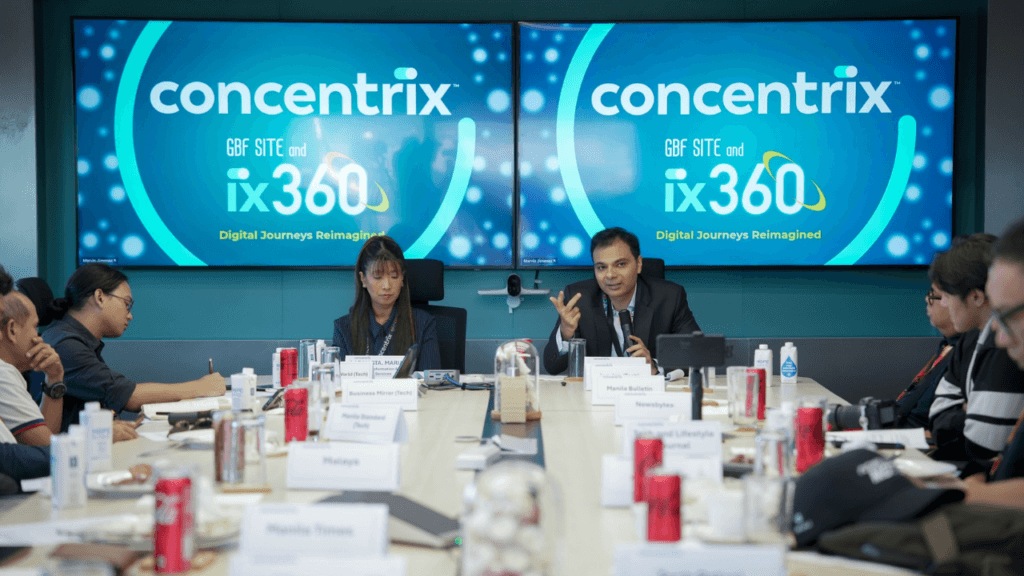
iX Product Suite: Its own platforms, iX Hero and iX Hello, form the iX Product Suite, which the company describes as AI built by the people who actually run processes. iX Hero supports agents and automates workflow, while iX Hello handles conversational self-service. In September 2026 Concentrix won an Artificial Intelligence Excellence Award for iX Hero.
AI transition: The company's third-quarter fiscal 2026 materials highlighted an AI milestone reached amid revenue headwinds, and Barron's reported in September 2026 that the AI transition was weighing on revenue. The tension is structural: every contact that iX Hello or a client's own AI resolves is a contact Concentrix no longer bills for in its traditional model, so it must earn more from software, orchestration and higher-value work to compensate.
Evidence of outcomes: In September 2026 Concentrix published a study finding that a retailer answered 31% faster with AI. Its case studies with MYOB, Transurban and Nespresso are framed around AI-driven support and self-service rather than headcount.
Governance and risk: The September 2026 acquisition of CastleHill adds enterprise risk and compliance capability, which the company linked to accelerating AI-related risks. Governance is becoming part of the AI sale, as clients need assurance on how automated agents handle their customers and data.
Digital commerce: The September 2025 acquisition of SAI Digital added digital commerce and CX technology capability with a strong presence in Asia.
The strategy mirrors moves by Teleperformance and TaskUs to sell AI alongside people. The difference at Concentrix is the explicitness of its bet: management says half of revenue already comes from AI-era business, and it is accepting near-term revenue decline to get there.
Strategic Assessment
Strengths
- Scale and reach: Approximately 455,000 staff across approximately 483 locations in 74 countries, and more than 2,000 clients, including more than 160 Fortune Global 500 clients.
- Cash generation: Fiscal 2025 operating cash flow of $807.0 million and adjusted free cash flow of $626.4 million, with $258 million returned to shareholders.
- Margin resilience: Non-GAAP operating margin of 12.6% in Q3 fiscal 2026, close to the 12.8% of fiscal 2025.
- Business renewal: 50% of revenue comes from business won in the last 3 years.
- Anchor shareholder: GBL is its largest shareholder, with board representation.
Risks and Vulnerabilities
- Revenue decline: Q3 fiscal 2026 revenue fell 1.2%, and full-year guidance implies a constant-currency decline of 0.3% to 0.8%.
- Impairments: A goodwill impairment charge of $1,050.0 million in Q3 fiscal 2026 followed an impairment in fiscal 2025.
- AI cannibalisation: Automation reduces the traditional volumes on which its model was built.
- Talent and leadership churn: 56 senior departures against 30 arrivals over 24 months, and the exit of its EVP for Customer Success.
- Client concentration: Its five largest clients represent approximately 19% of revenue.
Opportunities
- AI products: The iX Product Suite gives it software to sell into its existing client base.
- Risk and governance: CastleHill extends Enterprise Protection into AI-related risk and compliance.
- Multilingual and near-shore work: The Webhelp footprint in Europe, Latin America and Africa supports complex, multi-region programmes that are harder to automate.