
5 business functions Australian organisations are successfully offshoring right now


This article was contributed by Access Offshoring, an Australian-owned workforce advisory firm that assists companies of all sizes in structuring skilled, dedicated offshore teams based in the Philippines.
The macroeconomic shift in global talent
The macroeconomic landscape governing corporate operations has shifted dramatically over the past decade.
Sourcing specialised talent across borders was once an operational strategy restricted exclusively to ASX-listed corporations and massive multinational entities possessing the capital to establish complex captive global delivery centres.
Today, international workforce optimization has evolved into a practical mainstream growth strategy utilised by organisations of virtually every scale, from ambitious founders scaling their first critical support roles to mid-market companies and larger enterprises restructuring entire corporate departments.
For Australian business leaders navigating persistent domestic skill shortages, escalating localised wage pressures, and intensifying marketplace competition, offshoring has transitioned from a temporary cost-containment tactic into a core structural requirement for sustainable expansion.
The contemporary debate among executive teams is no longer centred on whether global talent acquisition is a viable path; instead, it is focused on identifying the precise operational sectors where deployment should begin.
Whether an organisation is a lean mid-market operator aiming to free up executive time or a large enterprise looking to scale back-office throughput without expanding domestic physical footprints, specific departments consistently yield the highest returns.
Here are five business functions that Australian organisations are successfully transitioning to dedicated offshore structures right now.
1. Corporate administration and executive support
Administrative workflows represent the foundational layer of international team integration, providing immediate operational relief across companies of any size.
For mid-market business owners and corporate executives spending valuable hours each week navigating repetitive logistical details rather than executing high-value business development, transitioning these administrative tracks delivers immediate operational clarity.
The contemporary scope of a dedicated offshore Executive Assistant (EA) or Administrative Officer extends far beyond historical, basic data entry roles. Today, these professional positions encompass:
- End-to-end calendar management and complex email triage.
- International travel procurement and corporate document preparation.
- CRM database auditing and client onboarding logistics.
- Cross-departmental scheduling and internal communication tracking.
For smaller scaling firms, a single dedicated offshore EA frequently acts as an operational lifesaver, transforming a chaotic workflow into an organised process by managing the leader’s day-to-day administrative burdens.
For larger corporate operations, entities build out entire administrative support pools offshore, assigning dedicated assistants to multiple department heads to streamline executive efficiency without the high overhead costs associated with local domestic hiring.
The success factor: The defining variable for success in this category is the formalisation of Standard Operating Procedures. The companies that derive the highest value from an offshore administrative asset are those that take the time to map out their workflows, communication guidelines, and software permissions before the onboarding phase commences.
2. Bookkeeping, finance, and accounts administration
Financial management and corporate accounting functions are among the fastest-growing areas of offshore recruitment for Australian companies.
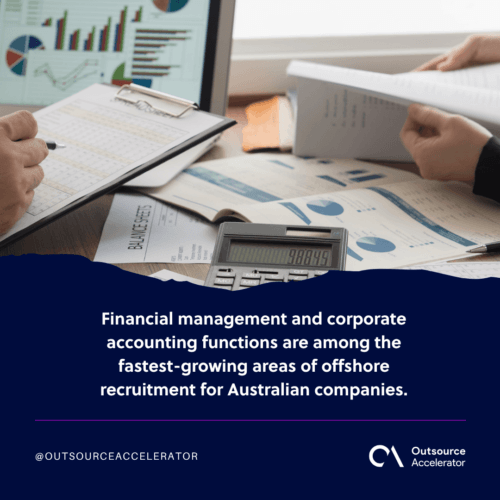
Corporate functions such as accounts payable processing, accounts receivable management, bank reconciliation routines, multi-tiered payroll administration, and standard monthly financial reporting are all being successfully transitioned to dedicated global financial professionals.
This operational transition routinely delivers substantial overhead relief, frequently reducing the cost base associated with these specialised roles by up to two-thirds relative to local domestic equivalents.
Why the Philippine financial talent pool excels:
- Education: Filipino accounting professionals are highly educated, with the vast majority holding formal university degrees in accountancy and maintaining active corporate CPA qualifications.
- Compliance: The modern Philippine financial talent pool is explicitly trained in Australian compliance frameworks.
- Systems: Professionals are highly proficient in cloud accounting platforms such as Xero and MYOB, alongside localised payroll nuances.
For growing mid-market businesses, offshoring these transactional accounting functions introduces structural optimisation. By embedding a dedicated offshore bookkeeper to manage daily transaction processing and account health, local financial leadership can step away from basic data management and focus entirely on high-level tax planning and cash-flow strategies.
For large enterprises, companies can scale entire shared-services accounting departments offshore, creating dedicated teams focused purely on high-volume invoice matching, debtor collection, and complex international multi-entity consolidations.
3. Digital marketing and multi-channel content execution
Modern digital marketing is an incredibly labour-intensive operational function. Many expanding firms find themselves trapped in a difficult position: they either under-resource their internal marketing departments leading to inconsistent campaign execution, or they pay high monthly retainers to external agencies that lack a deep, daily understanding of the brand’s core identity.
Offshoring these specialised roles to a dedicated full-time resource offers a sustainable alternative.
Common offshore marketing configurations include:
- Digital campaign managers and social media coordinators.
- Graphic designers and search engine optimisation analysts.
- Email marketing copywriters and paid advertising specialists.
The creative and analytical talent pool in major Philippine metropolitan centres is exceptionally deep, featuring professionals who are deeply proficient in modern marketing tech stacks, including Adobe Creative Suite, Canva, HubSpot, Salesforce, Google Analytics, and meta-advertising ecosystems.
When an organisation transitions to a dedicated, full-time offshore marketing team member or group, the volume, consistency, and structural quality of their brand output typically increases.
Because those employees work entirely within your systems and focus entirely on your specific market objectives, they develop a level of brand alignment that no external third-party agency can match.
Larger enterprises utilise this pool to build out content-production centres that can produce localised campaigns at scale, while mid-sized companies get a dedicated creative resource they previously could not afford to hire full-time domestically.
4. Omnichannel customer support and client services
Customer care is historically synonymous with offshore operations, but the underlying operational methodology has evolved significantly. The modern enterprise-grade offshore customer support framework has completely evolved past rigid, impersonal scripts and mass call-centre environments.
Today, dedicated customer service professionals handle multi-channel environments across live chat software, email ticketing platforms, social media engagement queues, inbound voice channels, and complex client onboarding workflows.
Filipino professionals are highly regarded on a global scale for their exceptional empathetic communication skills, service-oriented mindset, and natural capacity for customer care. They manage client accounts with a degree of professionalism and active listening that matches or exceeds what domestic operations can procure at the exact same price point.

For growing service brands, integrating a dedicated offshore customer support tier provides immediate operational scalability, ensuring your brand provides a responsive experience without requiring a massive expansion of local domestic office space.
For high-volume mid-market and large enterprises, the model allows for the seamless architecture of Tier 1 and Tier 2 technical support desks, running structured operational shift schedules that ensure continuous coverage across various time zones and service level agreements.
5. Project coordination and operations support
As an organisation scales its client base and operational complexity, the requirement for professional intermediaries, people who sit between senior leadership and functional delivery teams to track timelines, manage milestones, and ensure project continuity, becomes critical.
This project coordination and operations support layer is a highly sophisticated corporate function that progressive firms are actively transitioning offshore.
A dedicated offshore project coordinator handles the daily administration of platform infrastructure like Asana, Monday.com, Jira, or ClickUp. They maintain project documentation, audit resource allocation, follow up on internal deadlines with various stakeholders, and generate status reports for the executive team.
Filipino professionals entering these specific roles typically possess solid corporate backgrounds in business administration, industrial engineering, or international project management frameworks. They understand agile methodologies and bring a structured, process-oriented mindset directly into your business operations.
While a smaller business might employ a single operations coordinator to keep the owner on track, larger companies scale this up by embedding dedicated project management office support teams offshore.
These teams handle the administrative grunt work of multi-million dollar corporate projects, keeping timelines aligned across diverse global departments.
Establishing your sourcing roadmap
For corporate leadership teams approaching international workforce expansion for the first time, the most reliable path to success involves starting with a highly precise operational requirement rather than a vague corporate directive.
Management should audit their current workflows to isolate a specific, well-defined function that is consuming significant domestic hours or acting as a clear bottleneck to efficiency. That specific node is your ideal starting point.
| Business Function | Mid-Market Application | Large Enterprise Application |
|---|---|---|
| Corporate Administration | Dedicated EA to free up executive time | Assigned support pools for multiple department heads |
| Finance & Bookkeeping | Handling transaction processing and daily account health | Shared-services departments for high-volume consolidations |
| Digital Marketing | Affordable full-time dedicated creative resource | Content-production centres for scaled, localised campaigns |
| Customer Support | Scalable Tier 1 support without local physical footprint | Tier 1 and Tier 2 multi-time zone support desks |
| Operations Support | Operations coordinator to manage timeline tracking | Dedicated PMO support teams managing massive corporate projects |






 Independent





