
5 Best practices for thriving with offshore teams


What are the best practices for offshore teams?
The core offshore teams best practices are clear communication, defined roles, a culture of trust, steady training, and full legal compliance from day one.
- Set clear communication rules so remote staff know how and when to reach you.
- Treat the offshore team as a true extension of your business, not a cheap add-on.
- Use a proper BPO or Employer of Record to stay compliant and lower risk.
Global talent is now a smart way to grow. If your business ignores it, you likely leave money and skills on the table. So the old habit of hiring only local staff is fading fast.
Offshore teams are no longer just about cutting costs. Instead, they help you reach large talent pools, lower expenses, and run around the clock. However, turning that promise into real results takes more than good intentions.
In the 545th episode of the Outsource Accelerator Podcast, Rodney Frost from Integrated OS shares his tips for managing remote teams. Below, we unpack the key practices and the common hurdles. As a result, you will be ready to build an offshore team that drives real growth.
5 best practices for successful offshore teams
Here are five offshore teams best practices to keep in mind when you manage remote staff.
1. Establish crystal-clear communication and collaboration
Good communication is the base of any remote setup. Still, it is not enough to just own the tools. Teams must know how and when to use them well.
So set up solid platforms for video calls, project management, and instant messaging. Next, agree on response times and preferred channels. This clears up confusion before it starts.
As Rodney states, “You’ve gotta clearly articulate your model and clearly articulate the value you’re adding to the team.”
2. Define roles, expectations, and accountability with precision
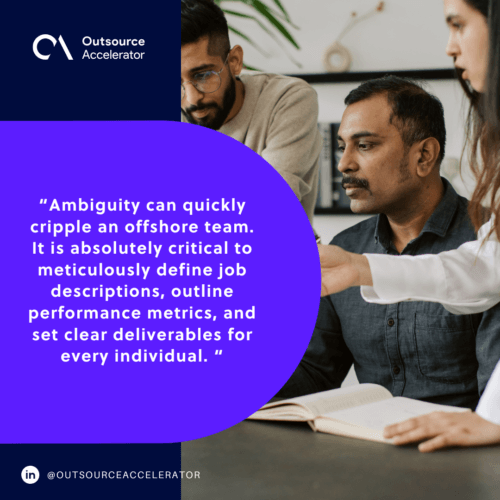
Vague roles can quickly weaken an offshore team. Because of this, you must spell out job duties, list clear metrics, and set firm deliverables for each person.
For example, frameworks like RACI matrices (Responsible, Accountable, Consulted, Informed) help map out who owns what. In addition, clear role definitions guide the skills you hire for.
Rodney notes that Australian firms sometimes lack written processes because “we’ve had lots of long-serving people that have done it and they just know it.” But with offshore teams, “you can build them as you’re doing the teaching.” As a result, misunderstandings drop and daily work runs faster.
3. Foster a culture of trust and integration
An offshore team is not just a line item. Instead, it is a real part of your core business. So build trust through openness, steady feedback, and mutual respect.
Rodney puts it plainly: “This is a business of trust.” Cross-cultural training also helps bridge the distance between sites. In addition, virtual and in-person team events can foster camaraderie and loyalty, which lifts retention.
Rodney points to their 95% retention rate as proof. Their “family culture with family values” works because, as he says, “you really do want to make sure that they’re engaged.” For teams built this way, strong offshore staffing benefits tend to follow.
4. Invest in ongoing training and professional development
Your offshore team is only as strong as its skills. So start with full onboarding that covers your culture, tools, and set processes. This gives new hires a fast, fair start.
Beyond that, offer steady upskilling so staff stay sharp. For example, Rodney runs “soft skills training out of hours,” and it covers common areas like advanced Excel. Good training for your offshore team keeps people engaged.
Give remote staff the same learning tools as onshore staff. As a result, motivation rises, retention improves, and output climbs.
5. Ensure legal & HR compliance from day one
The “easy start” models in outsourcing can hide real legal traps. So Rodney warns against hiring people offshore as direct contractors.
He cites the “Joanna Pascua case,” where an Australian firm faced heavy penalties. It had breached Australian workplace protections for a Philippine-based paralegal. Because of this, businesses must accept that “workforce regulations in every country need to be abided by.”
So partner with a proper BPO or Employer of Record (EOR) to manage risk, tax, and local benefits. If you are weighing the model, this guide to EOR versus BPO differences helps. In short, it protects both your business and your offshore team members.

Common challenges when building and managing offshore teams
The benefits are clear. Still, offshore teams bring hurdles that need proactive fixes.
Communication and cultural barriers
Language nuances, work styles, and cultural norms can all cause mix-ups. For example, Rodney admits that expanding into South Africa as an offshore location was “harder than we thought.” He had underrated the “cultural aspect of it.” So managing norms and holidays across sites is key.
Data security and compliance concerns
Moving sensitive data across borders carries real risk. Clients often raise “InfoSec information security concerns” and worry about compliance. As a result, you must map varying rules like GDPR and HIPAA and set firm protocols. These data security tips for outsourcing are a useful starting point.
Performance monitoring and management
Overseeing remote staff can be tough. In fact, studies show that 80% of companies now monitor their remote and hybrid workers to close this gap. So steady output across distance needs the right tools and clear metrics.
Rodney also shared an “interesting stat.” Work-from-home teams in the Philippines took “one third” the sick leave of office workers. He wondered if they worked while unwell or simply took less leave. Either way, he suggests office-based or hybrid models for better oversight.
Building resilient global teams
Offshore teams thrive on clear communication, strong culture, smart training, and steady operations. So embrace these offshore teams best practices and tackle the hurdles head-on. As a result, your business can lead the way in using global talent for growth.
Frequently asked questions about offshore teams
What is an offshore team?
An offshore team is a group of staff who work for your business from another country. They handle set roles remotely, often at lower cost. In practice, they act as a true extension of your in-house team.
How do you manage an offshore team well?
Start with clear communication rules and defined roles. Next, build trust and invest in training. Finally, stay compliant with local labor laws through a BPO or EOR partner.
Are offshore teams cost-effective?
Yes, they often lower payroll and overhead costs. Still, the real value comes from access to skilled talent and around-the-clock work. So treat cost as one benefit among many.
What are the biggest risks with offshore teams?
The main risks are legal missteps, data security gaps, and cultural mix-ups. However, clear contracts, strong protocols, and cross-cultural training reduce each one.
Key takeaways
- Clear communication and defined roles are the foundation of offshore teams best practices.
- Trust and cultural integration lift retention and daily performance.
- Steady training keeps remote staff sharp and engaged.
- Proper compliance through a BPO or EOR protects both sides from legal risk.
- Plan for communication, data security, and oversight challenges early.






 Independent





