
The ultimate guide to startup types


What are the main startup types?
The main startup types are small business, buyable, lifestyle, social, scalable, and large company startups, plus tech-focused types like e-commerce and software.
- Entrepreneurship-based startup types differ by goal, size, and growth plan.
- Tech startup types include e-commerce, software, cybersecurity, and app businesses.
- The right type depends on your idea, your funding, and how big you want to grow.
Many people today choose to start their own business. However, it is rarely a smooth or easy path. Before you launch, and before you seek investors and funding, you need to know the startup types you can pick from.
So what does it mean to run your own startup? What startup types can you build? In this guide, we explain the basics of a startup, the main startup types, and a few key tips.
What is a startup?
In short, a startup is a company built to make new products or services that answer a market need. Because of this, it aims to build something people will want in high numbers.
When people hear the word startup, many think of tech hubs like Silicon Valley. Indeed, a startup can be a tech firm with fewer than 100 staff. However, not all startups sit in the tech world.
It helps to know that different startup types suit different ideas and founders. Moreover, you can group startups by entrepreneurship style or by tech field.
Startup vs. small business
First, a startup is not just a small business. In fact, a small business is one of the startup types we cover below.
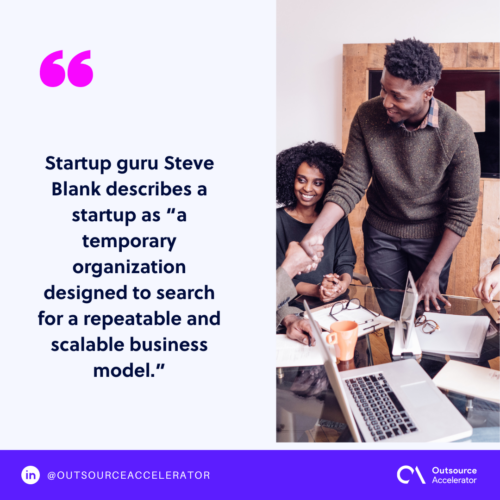
Startup guru Steve Blank calls a startup “a temporary organization designed to search for a repeatable and scalable business model.” In contrast, a small business runs on a fixed, set model. Further, a startup covers these three main jobs:
- Set a product vision with a clear set of traits.
- Build several views of the business model based on customers, finances, and sales.
- Test whether that model fits your industry.
A startup does not have a fixed business model. Instead, its main goal is to make a product for an untapped market. So a startup works to add more value to what already exists.
Common industries for startups
Today, many founders and investors launch startups in these sectors:
- Real estate
- Healthcare
- Retail and e-commerce
- Insurance
- Marketing and advertising
- Blockchain and cryptocurrencies
- Software as a service (SaaS)
- Information technology (IT)
- Environmental and energy
- Education
Most of these sectors sit in tech. Still, you have many non-tech options too. For a wider view of the field, our startup statistics guide shows where new firms tend to grow.
Pros and cons of startups
Startups can be risky, with little security and few sure things. Still, they bring real perks too. So here are some pros and cons of startups.
| Pros | Cons |
| Flexibility and freedom for staff | High costs |
| More chances for quick promotions and training | Uneven revenue streams |
| More room for staff to take risks and follow their passions | Less experience in the field |
| A good setting where staff learn and grow fast | Risk of business failure |
| More excitement than a corporate job |
How a startup is founded
Like a small business, all startup types begin with a pure idea and vision. Your capital can come from bootstrapping, a loan, or your family and friends.
As you earn profit, you may seek more funds. For example, you can turn to angel investors, IPOs, and venture capitalists. Keep in mind that investors become co-owners. As a result, they earn a share of your company for each investment.
Your legal setup matters too. For instance, a Limited Liability Company (LLC) can protect your personal assets and give you more tax flexibility. So it pays to pick the right structure early. To speed up early growth, you can also compare an incubator vs. accelerator.
6 Types of startups in terms of entrepreneurship
There are six startup types that every founder should know. Below, we break down each one and when it fits.
Small business startups
A small business is one of the startup types that value longevity over fast growth. It aims to bring in enough money for steady income. As a result, it serves a small local market.
Small business owners often run their firm to support their families. For example, think of grocery stores, salons, and bakeries.
When to consider a small business startup
So a small business is a good fit if:
- You plan to give back to your community.
- You want to hire locals or family to help run daily work.
- You wish to build a firm that lasts a long time.
Buyable startups
Unlike other startup types, a buyable startup is built to be sold to a bigger firm for a set price. This type has grown popular in tech. For example, many buyable startups build web or mobile application solutions that larger firms later buy.
When to consider a buyable startup
So a buyable startup is a good fit if:
- You are a serial entrepreneur.
- You want to start a company but not stay for the long term.
- You have an idea with strong growth potential.
Lifestyle startups
Lifestyle startups belong to founders who follow their passion. As a rule, they have no wish to work for anyone but themselves.
For example, a travel fan may start a tour guide business. Likewise, a web developer may take freelance work from many clients.
When to consider a lifestyle startup
So a lifestyle startup is your best pick if:
- You want to be your own boss.
- You are self-driven, creative, and well-disciplined.
- You truly want to follow your passion.
Social startups
Unlike other startup types, social startups aim to make the world better, not to build wealth. A passion for social or green change drives them.
You can still earn money from this type. However, you should not expect a big payout from a social startup.
When to consider a social startup
So a social entrepreneurship startup is a great fit if:
- You want to build a firm focused on social or green impact.
- You have an idea that can solve a widespread problem.
- You want to build a startup but not to chase profit.
Scalable startups
Scalable startups aim for great heights. So their founders often hire the brightest, most skilled people they can find.
These startups always try to lead their market with a scalable model. As a result, they seek more venture capital to keep improving. Two well-known scalable startups are Google and Facebook.
When to consider a scalable startup
So a scalable startup is right for you if:
- Your goal is to lead your industry.
- Your startup has wide reach and large growth potential.
- You want to build something new that challenges the status quo.
Large company startups
Large company startups get backing from big, well-set firms. Often, they aim to reach new markets and add to a company’s products.
As a rule, a large company startup starts as a response to change. For example, it may answer new tech, new customer tastes, new laws, or a rival’s move.
When to consider a large company startup
So a large company startup is a good option if:
- You already own and run a thriving firm.
- You want to keep up with fast-changing trends.
- You want to widen your offerings.
- You aim to tap a new market.
Other types of startups in the technology sector
As noted, many big startup names were born in Silicon Valley. That hub leans hard on tech and new ideas. So for those who want to enter this space, here are the common tech startup types. To learn how outside teams can help, see our guide to outsourcing for startups.
E-commerce startups
E-commerce means buying and selling products and services online. As a result, it needs an online exchange of money and data. In fact, an e-commerce startup is one of the simplest startup types to try.
Software startups
Like the other startup types, a software startup builds scalable fixes for real problems through software development services.
Software startups matter more each year in a digital world. Often, firms tap them to build the exact systems they need for daily work. Many of the biggest are SaaS startups that sell tools by subscription.
Cybersecurity startups
A cybersecurity startup is one of the fastest-growing startup types. These firms build fixes that help clients guard their networks and servers.
Strong security is vital for any firm that works online. As a result, it helps companies avoid hackers, identity theft, and data breaches.

Application startups
App development startups are also popular in tech. Today, most firms need an app that people can use on phones, iPads, or tablets. App work is often the most reachable and low-cost tech business. In fact, it is cheaper than running software companies.
The vital ingredient of startup types
Building a startup is only half the battle. In fact, a winning startup also takes effort, grit, and smart choices.
You have many startup types to pick from. Still, make sure you choose one that fits your idea. There are also many broader types of entrepreneurship worth a look before you commit.
Whichever type you pursue, the key ingredient is innovation. Every startup begins with an idea. So how that idea reshapes the market is the real key to success.
Frequently asked questions
What is the difference between a startup and a small business?
A startup searches for a new, scalable model. In contrast, a small business runs on a fixed, proven model. So a startup aims to grow fast, while a small business aims to last.
Which startup type is best for beginners?
For beginners, an e-commerce or app startup is often the easiest to start. In addition, both need low upfront costs. However, a small business startup suits founders who want steady, local income.
How do startups get funding?
First, startups can use savings, loans, or help from family and friends. Later, they may seek angel investors, IPOs, or venture capital. As a result, investors gain a share of the company.
Do startups need to be tech companies?
No, not at all. In fact, many startups work in retail, healthcare, or social causes. Still, tech sectors like SaaS and cybersecurity draw a large share of new firms.
What makes a startup succeed?
Innovation is the top factor. First, you need a strong idea. Next, you need grit, smart choices, and a model that fits your market.
Key takeaways
- The six entrepreneurship-based startup types are small business, buyable, lifestyle, social, scalable, and large company startups.
- Tech startup types include e-commerce, software, cybersecurity, and app businesses.
- A startup differs from a small business because it seeks a scalable model.
- Funding can come from savings, loans, angel investors, or venture capital.
- Innovation is the key ingredient that helps any startup type succeed.






 Independent





