
Ways to hire a medical transcriptionist


How do you hire a medical transcriptionist?
You can hire a medical transcriptionist in three main ways: bring one in-house, use a dedicated transcription firm, or outsource the work to a BPO company.
- In-house hiring keeps the transcriptionist close to your doctors and nurses.
- A dedicated firm suits high volumes of audio files.
- Outsourcing to a BPO lets you scale the team fast and cut costs.
Healthcare providers are on their feet around the clock caring for patients. So their hands are already full with rounds, treatments, and daily tasks. Still, medical reports must get written. Doctors cannot simply trust text-to-speech tools for this. As a result, many hire a medical transcriptionist to keep reports accurate.
So while doctors and nurses observe patients, medical transcriptionists help prepare reports and collate data. Fortunately, there are now several ways to hire one.
Medical transcription: what you need to know
Medical transcription means turning medical audio files into written reports. In addition, it calls for knowledge of terminology, physiology, pharmacology, and patient confidentiality rules.
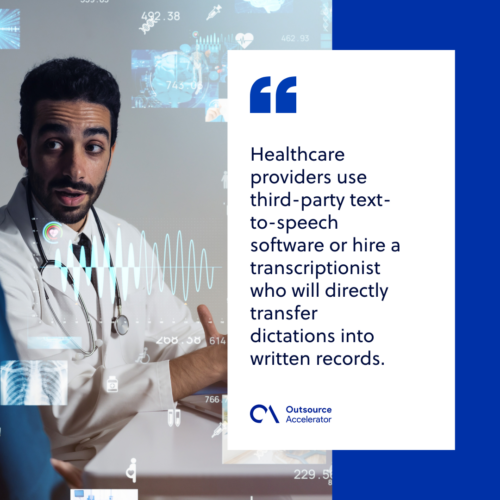
Healthcare providers transcribe audio dictations in different ways. For example, they use third-party text-to-speech software, or they hire a transcriptionist to type the dictations directly into records.
Medical transcription services
Medical fields and related bodies rely on transcription every day. Usually, a medical transcriptionist works in places such as:
- Diagnostic laboratories
- Public and private hospitals and clinics
- Physician offices
- Government’s health department
- Insurance companies, and
- Healthcare BPO companies
Meanwhile, many providers pair transcription with wider healthcare BPO services to cover more back-office work.
Why hire a medical transcriptionist
Healthcare providers spend hours transcribing notes and writing reports. However, they cannot focus on this task alone.
With today’s tech, healthcare providers now use automated text-to-speech and transcription software. Still, these tools have limits.
For example, software cannot always read every dictation correctly. This is a big issue with medical jargon and terms. So providers pass this workload to medical transcriptionists.
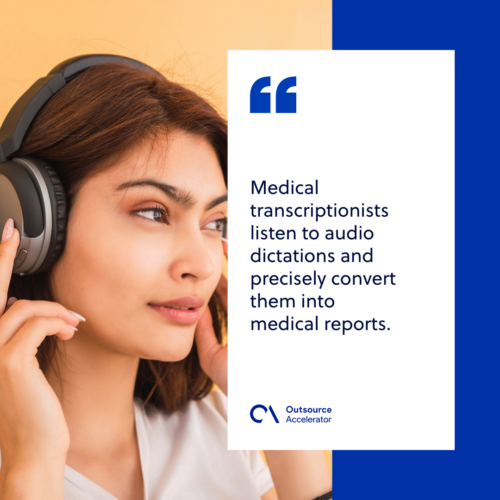
A medical transcriptionist, also called a registered healthcare documentation specialist, listens to audio and turns it into medical reports. In addition, they edit, verify, and proofread the files to collate them well.
Duties and responsibilities
Some duties of a medical transcriptionist include:
- Listening to the doctor’s dictations on the audio file
- Edit and verify drafts saved from text-to-speech software
- Translate medical jargon and abbreviations into long-form
- Identify errors in spelling, grammar, consistency, and syntax
- Follow up with healthcare providers to ensure records are accurate
- Submit written reports to physicians and other healthcare workers
- Enter medical reports into an electronic system
Because the work is detailed, some clinics link it with medical data entry services to keep records complete. In addition, others add support from medical scribe companies for live note-taking.
Skills needed by medical transcriptionists
Nowadays, these roles look beyond a candidate’s school background. So applicants mainly need a registered healthcare documentation specialist (RHDS) certification, transcription training, and the following skills to qualify for the role.
Knowledge of medical terminology
Applicants must know medical terminology well to transcribe documents. In addition, they know how to explain complex jargon in plain terms.
Experience in transcription tools
A certified specialist can operate speech recognition software, audio playback gear, and other tools. As a result, their work is faster and more accurate. At the same time, they protect the integrity of every medical document.
Organization and attention to details
A medical transcriptionist handles many audio files and complex records each day. So they must stay organized and watch small details closely. As a result, their reports stay accurate.
Medical transcriptionist salary
The median pay for a medical transcriptionist was about US$40,410 per year, according to the US Bureau of Labor Statistics (May 2025). However, this varies by experience, skills, field, and location.
In-house transcriptionists in administrative offices tend to earn less. Meanwhile, those in diagnostic laboratories often earn more. Freelance and offshore transcriptionists usually earn less than their in-house peers.
Benefits of hiring a medical transcriptionist
A medical transcriptionist improves the service of a clinic or insurer. As a result, they help healthcare workers in ways such as:
Shorter turnaround time
Doctors, nurses, and insurers need less time to prepare and release patient records. So reports reach the right people faster.
Quality records
Doctors know that a skilled person handles their reports. As a result, medical transcriptionists lift the quality of every report they produce. In turn, clean records also support smoother medical billing management down the line.
High level of security
Providers also protect patient data through medical transcriptionists. In addition, these specialists follow Health Insurance Portability and Accountability Act (HIPAA) rules on confidentiality.
How medical companies can hire a medical transcriptionist
Clinics and insurers can now hire a medical transcriptionist in several ways.
In-house hiring
Hospitals and physician offices hire in-house so staff can work closely with doctors and nurses.
In-house hiring suits large bodies and specialized offices that are building their teams. However, the provider must cover the equipment, tools, office space, and salaries.
Compared with outsourcing, in-house hiring is not ideal for high volumes across many specialties.
Outsourcing to a dedicated firm
Outsourcing to a dedicated medical transcription firm suits high volumes of files. Most of these providers work online and charge per use.
So companies only upload their audio files to the firm’s site. Next, the firm transcribes and returns written reports within a set timeline.
Outsourcing to BPO companies
Business process outsourcing is the best way to move a full transcription project or team offshore. In addition, it pairs well with broader healthcare outsourcing plans.
Compared with in-house hiring, providers can scale teams and work more efficiently through outsourcing.
Outsourcing companies like Connext make sure they hire the best talent for medical transcription roles.
These firms hire strong talent for these roles. As a result, they follow industry rules closely to keep data safe and secure.
Frequently asked questions about hiring a medical transcriptionist
What does a medical transcriptionist do?
A medical transcriptionist listens to a doctor’s audio dictations. Next, they turn the audio into clear, written medical reports. In addition, they edit and proofread each file for accuracy.
Is it cheaper to outsource medical transcription?
Often, yes. Outsourcing removes the cost of equipment, office space, and full-time salaries. As a result, many clinics find it more affordable than in-house hiring.
What qualifications does a medical transcriptionist need?
Most roles ask for a registered healthcare documentation specialist (RHDS) certification and transcription training. In addition, strong terminology skills and sharp attention to detail matter a great deal.
How do medical transcriptionists protect patient data?
They follow HIPAA rules on confidentiality at every step. So audio files and reports stay secure. As a result, patients and providers can trust the process.
Can a BPO handle a full transcription department?
Yes. A BPO can run an entire transcription team offshore. Because of this, providers scale up or down with ease and keep quality high.






 Independent





