• 4,000 firms
  • Independent
  • Trusted
Save up to 70% on staff

Home » Glossary » Shrinkage

Shrinkage

Definition

What is Shrinkage?

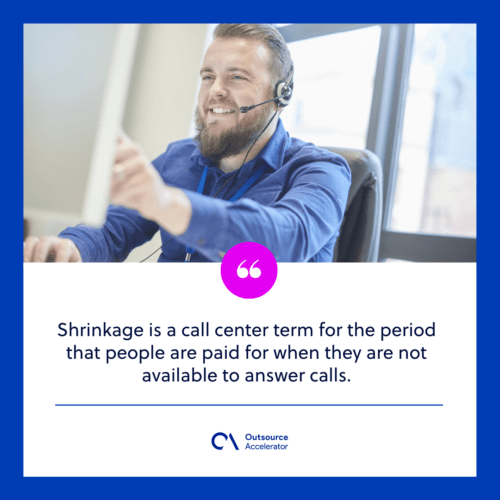
Shrinkage is a call center term for the period that people are paid for when they are not available to answer calls.

Shrinkage is the difference between the actual amount of working employees (budget) and those required to perform the primary duties (work) by which they are employed.

In other words, it refers to the difference between the time you pay your employees to serve customers and the actual time they spend doing it.

Several reasons can induce shrinkage. This includes some unknown ones that are not as apparent as some that are outside your reach.

Make consideration about shrinkage percentage scheduling the number of agents required to manage incoming call volumes.

Call centers that regard shrinkage as a major predictor of workforce management (WFM) while recruiting and scheduling strive to reach a high quality of operation at a lower rate.

Shrinkage can be categorized into two, depending on the factors that cause them.

External shrinkage

External shrinkage refers to factors that are outside the control of a company.

The most common reasons for external shrinkage include:

  • Employee absenteeism
  • Employee tardiness
  • Holidays/Public holidays
  • Employee sickness

Internal shrinkage

In contrast, internal shrinkage is caused by factors well within the control of a company.

These factors include:

  • Team meetings
  • Employee coaching sessions
  • Employee breaks
  • Attrition
  • System downtime
What is Shrinkage

Why is it necessary to measure shrinkage?

Calculating the shrinkage predicts the average number of employees who would not answer calls over the interval. This volume can vary, but the normal range is between 10% and 40%.

For this figure, you should now split your base personnel requirement by the consequence of arriving at the number of employees you should schedule.

Call centers that take shrinkage criteria into account in their planning and scheduling reach higher service levels at lower operational costs. They also do this by incorporating all call-related tasks in the forecasting and scheduling process.

How to calculate call center shrinkage

To calculate shrinkage, add the total hours of external shrinkage to the total hours of internal shrinkage and divide it by the total hours available. Then, multiply the result by 100.

Total Hours External Shrinkage

+

Total Hours Internal Shrinkage

Shrinkage % = ___________________________________________________ x 100

Total Scheduled Hours

During slow times, agents can take longer breaks or spend more time talking with their colleagues.

And if these extended periods of unavailability exist at times when your business does not accept a lot of consumer requests, you will need tests to assess the degree of shrinkage.

How to control shrinkage in the call center

Call centers can track shrinkage manually or by using cloud-based call center software. This helps in examining when and where shrinkage occurs.

In addition, the software can help decrease shrinkage in your call center. It’s important to remember that you cannot control or prevent shrinkage.

However, accurate shrinkage calculation can help businesses refine their operations, identify areas of improvement, and reduce shrinkage.

Here are some tips on how to control shrinkage and maintain a solid strategy for shrinkage reduction and regular monitoring.
How to control shrinkage in the call center

Make use of workforce management (WFM) tools

Workforce management features are now included in almost all call center software. The software can automate the shrinkage monitoring process, making it far easier and more efficient than the traditional spreadsheet method.

You may schedule agents and even allow them to create their schedules within a defined boundary using WFM tools. Skill-based routing is available in a few WFM solutions, which can improve the agent’s job experience.

Measure shrinkage continuously

Rather than being an annual or monthly effort, shrinkage monitoring should be a continuous and regular part of your business operations.

Since shrinkage is a characteristic that adds to your call center’s overall efficiency, you won’t be able to improve performance without keeping a near-constant shrinkage rate.

This is only feasible if you measure it regularly, which new-age call center solutions may help you do. Shrinkage may be measured using various criteria such as call volume, service level objectives, and average handling time.

Variations in these measures have a direct impact on shrinkage. However, tracking fluctuations can help you pinpoint the elements that influence shrinkage.

Address absenteeism

One aspect of shrinkage that you can manage is absences. Managers can recognize agents who take frequent vacations and handle the problem. Managers should interact with agents regularly to learn about their problems and frustrations.

Absenteeism is generally caused by dissatisfaction with the work they’re performing, which you may address by providing them with suggestions on how to improve it.

Keep your agents competitive

Dealing with customers’ repetitive questions might exhaust your employees, so it’s critical to keep them engaged. You may set up a rewards program to recognize them for their efforts in addition to offering training and mentoring.

Another approach to keep them competitive is to offer incentives. Recognition on leaderboards, badges, or actual presents such as trophies are all possible rewards for achieving a goal.

How shrinkage affects call centers

Call centers with high shrinkage rates cannot maximize profits from their business operations. Essentially, call centers are paying agents for work they’re not doing due to different variables.

Aside from directly affecting the bottom line of a company, shrinkage affects the level of customer service that call centers provide. Agent unavailability can have adverse effects on customer satisfaction.

When extraneous reasons keep agents from doing their jobs, customers may face longer call queues or not be answered at all. As a consequence, a call center’s customer experience may suffer.


Outsourcing FAQ

What is What is business process outsourcing??

What is business process outsourcing (BPO)?

Business process outsourcing (BPO) is the practice of contracting a third-party provider to run a defined business function such as customer support, payroll, accounting, or IT helpdesk. The provider takes ownership of the people, process, and technology, and bills you on a per-seat, per-transaction, or fixed-fee basis.

BPO sits at the intersection of labour arbitrage and operational focus. You hand off a non-core function to a specialist that can run it cheaper, faster, or better, and your in-house team gets to concentrate on what actually moves the business.

The category covers everything from a 4-seat phone team in Cebu answering after-hours calls for a US plumbing firm, to a 5,000-seat captive in Manila handling global claims processing for a Fortune 500 insurer. Same idea, very different scale.

If you've used Apple support, ordered from Amazon, or paid with Wells Fargo, you've talked to a BPO provider — you just didn't know it.

How it works

A BPO engagement runs in three layers: contract, transition, and steady state. You scope the function, sign a service level agreement that locks in response times, quality thresholds, and pricing, then transition the work through documented playbooks and parallel runs before the provider takes the keys.

Pricing usually falls into one of four shapes:

Model How you pay Best for Per FTE (seat) Fixed monthly rate per agent Steady-volume work like inbound support Per transaction Set fee per call, ticket, or invoice Variable-volume back-office tasks Outcome-based Tied to a KPI like CSAT or collections Mature processes with clean metrics Hybrid Base FTE rate plus variable bonus Long-term partnerships

Location choice drives most of the savings. Sending work to the Philippines or India (offshoring) typically cuts loaded labour cost by 50–70% versus a US in-house team. Sending it to Mexico or Colombia (nearshoring) trims 30–50% while keeping you in roughly the same timezone. Keeping it domestic (onshoring) protects timezone and language fit but barely moves the cost needle.

The provider absorbs the recruiting, training, real estate, tech stack, and compliance burden. You absorb the vendor-management overhead and the risk that comes with handing a function to an outsider.

Examples

The global BPO market hit roughly USD 347.95 billion in 2025 and is projected to grow at a 10.05% CAGR through 2035, according to Precedence Research. That growth is concentrated in a handful of hubs and a handful of named buyers.

Google has used Philippine and Indian BPO partners since 2016 for content moderation, ads review, and customer support — a quiet workforce that scales with each product launch. Meta contracts Accenture and TaskUs in Manila for content moderation; the work pulled enough scrutiny in the early 2020s that Meta eventually broadened its provider base across multiple regions. Wells Fargo has operated a Manila back-office hub since 2011, handling mortgage processing, AML checks, and treasury operations for the US parent. JPMorgan Chase runs large captive and outsourced operations in India and the Philippines for KYC, trade settlement, and analytics.

The Philippines remains the standout English-language hub. According to the IT and Business Process Association of the Philippines, the country's IT-BPM sector generates roughly USD 40 billion in revenue and employs about 1.9 million people, with growth targets pushing past 2.5 million by 2028.

Related terms Outsourcing: the umbrella term; BPO is the back-office and front-office slice that runs whole processes rather than one-off projects. Offshoring: moving work to a distant country (e.g. US to Philippines). A location choice, not a contracting choice. Nearshoring: moving work to a nearby country (e.g. US to Mexico) to keep timezone and culture closer. Knowledge process outsourcing: KPO handles judgment-heavy work like legal research or equity analysis, not transactional tasks. Call center: one delivery format inside BPO, focused on inbound or outbound voice. Back office: the non-customer-facing operations layer that BPO most commonly absorbs. Service level agreement: the contract clause that defines what "good" looks like in a BPO deal. FAQ What is business process outsourcing in simple terms?

BPO is paying another company to run a piece of your business for you, usually a repeatable function like answering support calls, processing invoices, or managing payroll. You keep the brand and the strategy; they run the operation.

What is the difference between BPO and outsourcing?

Outsourcing is the broad category — anything you contract out, including one-off projects. BPO is the subset where a provider runs an ongoing, defined business process end-to-end, typically with its own staff, systems, and SLAs.

Is BPO only about cost savings?

No. Cost is the entry argument, but mature buyers cite access to specialist talent, 24/7 coverage, faster scaling, and freeing in-house leaders to focus on growth as bigger long-term wins. See the directory of vetted providers on Clutch for how the market positions itself today.

What functions do companies outsource most often?

Customer support, IT helpdesk, finance and accounting, payroll, HR administration, content moderation, and data entry top the list. Higher-judgment work like legal research, equity analysis, and medical coding has shifted to KPO providers over the last decade.

Which countries dominate the BPO industry?

The Philippines leads voice and customer experience, India leads IT and analytics, and Latin America (Mexico, Colombia, Costa Rica) leads nearshore work for North American buyers. Eastern Europe serves Western European clients on similar terms.

How do I choose a BPO provider?

Match scale to your volume, check for relevant compliance (ISO 27001, HIPAA, PCI DSS, SOC 2), ask for two reference clients in your industry, and pilot a small scope before committing to a multi-year contract. Walk away from any provider that won't share agent attrition data.

Ready to scope a BPO partner? Outsource Accelerator lists 4,000+ vetted providers across the top global hubs — use the directory to shortlist, compare pricing, and book intro calls without paying a referral fee.

What is Idle Time?

What is Idle Time?

Idle time, sometimes comparable to waiting time, is the period of time when an employee, machine, or commodity is ready and available but is unproductive. Minimizing idle time is crucial if a company wishes to optimize productivity and efficiency over a long time.

Companies should learn and track down idle time to figure out the difference between the current productivity levels. Simply put, any minute the computer or employee is idle is a minute of wasted productivity. Idle time is costly because the company needs to pay its staff, who are at that point, did not make any profit or income for the company.

Types of Idle Time

There are two major types of idle time, Normal Idle Time and Abnormal Idle Time.

Normal idle time.  Normal idle time is the gradual shortage of productive working hours in the course of business. In any job setting, it is inherent and can not be removed. Normal idle time is inevitable, and the company must also pay the labor expense of this time. Yet, there should be every attempt to minimize it to the lowest extent possible. Abnormal idle time. Abnormal idle time is the time loss that is possible to reduce by using precautionary measures. For example, the time wasted as a result of excessive waiting for instructions.

What is Agent Occupancy?

What is Agent Occupancy?

Agent occupancy means that the percentage of time spent on answering inbound calls by a call center agent is against the available or idle time. It can be measured by dividing the workload time by staff time. It is a statistic used to measure the efficiency of a call center agent.

The agent occupancy is sometimes confused with the utilization of agents. Both metrics have the same numerator but they have different denominators. The agent occupancy denominator is the cumulative time the speech, text, or chat agent logs into the framework, far different from agent utilization. Meanwhile, agent utilization indicates the overall time consumed by an agent through chat, voice, and email.

How to calculate the agent occupancy?

Agent occupancy is a standard and significant service desk indicator for monitoring and trends. This is because it gives an example of how active agents are when logging into the system. However, for the reasons outlined. The Occupancy Rate and the Service Level will inform you whether the personnel level is set correctly for any given period.

Here is the formula for agent occupancy rate:

Agent Occupancy Rate = Handle time (talk time + after call work time) / time signed into a queue.

What is Staff Leasing?

What is staff leasing?

Staff leasing is where companies partner with a 3rd-party that will handle the administrative aspects of employment, such that the 3rd-party is the legal entity that employs the staff. This is similar to seat leasing where a company that already has the infrastructure in place, will lease the use of that infrastructure to other companies. In the case of staff leasing, that infrastructure is the HR, payroll, and other employment-related processes; in the case of seat leasing, the infrastructure is the IT and telecommunications equipment only.

Depending on the need of the client, staff leasing companies can either provide the employees using their pre-existing pool of candidates, or the client company can handle the recruitment efforts while the staff leasing company handles the compensation and other sundries. Thanks to the scale of staff leasing outsourcing companies, they are in a position to offer more competitive benefits, such as lower-cost healthcare plans, to which smaller companies would not have access to. In turn, clients not only save on administrative costs, but the cost of an employee turns into a single line-item for easier accounting.

Staff leasing in the Philippines

Staff leasing is arguably the most popular type of business process outsourcing, where both employee and infrastructure is provided by the outsourcing company. Lessening the financial risk to the client should they decide to scale their outsourced team in the Philippines.

Outsource Accelerator's directory lists over 700+ outsourcing companies in the Philippines. All of these are carefully selected for innovation, expertise, and technology that will benefit our clients. We also provide you with guidance on the best staff leasing options you can get in the Philippines for your business.

Companies you might be interested in

Get Inside Outsourcing

An insider's view on why remote and offshore staffing is radically changing the future of work.

Order now

Start your
journey today

  • Independent
  • Secure
  • Transparent

About OA

Outsource Accelerator is the trusted source of independent information, advisory and expert implementation of Business Process Outsourcing (BPO).

The #1 outsourcing authority

Outsource Accelerator offers the world’s leading aggregator marketplace for outsourcing. It specifically provides the conduit between world-leading outsourcing suppliers and the businesses – clients – across the globe.

The Outsource Accelerator website has over 5,000 articles, 450+ podcast episodes, and a comprehensive directory with 4,700+ BPO companies… all designed to make it easier for clients to learn about – and engage with – outsourcing.

About Derek Gallimore

Derek Gallimore has been in business for 20 years, outsourcing for over eight years, and has been living in Manila (the heart of global outsourcing) since 2014. Derek is the founder and CEO of Outsource Accelerator, and is regarded as a leading expert on all things outsourcing.

“Excellent service for outsourcing advice and expertise for my business.”

Learn more
Banner Image
Get 3 Free Quotes Verified Outsourcing Suppliers
4,000 firms.Just 2 minutes to complete.
SAVE UP TO
70% ON STAFF COSTS
Learn more

Connect with over 4,000 outsourcing services providers.

Banner Image

Transform your business with skilled offshore talent.

  • 4,000 firms
  • Simple
  • Transparent
Banner Image