
20 website development services you should know

Are you looking to establish a strong name for your brand online?
The key to success lies in having a well-designed, user-friendly website.
With the rapid growth of the internet, website development services have become crucial for businesses of all sizes. Businesses need a clear understanding of the different types available to navigate the online world effectively.
This article will explore 20 types of website development services that you should know to make your mark online.
What are web development services?
Website development services refer to the range of professional offerings aimed at creating, enhancing, and maintaining websites for businesses. The goal of these services is to create a visually appealing and functionally optimized website that meets the client’s needs.
To do so, businesses frequently enlist the aid of web developers, designers, and other specialists. These professionals ensure the establishment of a brand’s online presence.
Importance of web development services
Web development services play a crucial role in today’s digital landscape due to their significant importance in several key areas:
Online presence
The internet serves as a main resource of information and interaction. Having a well-developed website is essential for businesses to establish and maintain a foothold in their markets.
Many small businesses don’t have the know-how to do this on their own, so they enlist the help of offshore developers from firms like Outsourced.
Website development services enable the creation of professional and appealing websites. These serve as digital storefronts that attract and engage customers, showcase products and services, and improve visibility.
User experience
Website development services focus on creating websites that provide a positive and user-friendly experience.
Websites that are easier to navigate encourage visitors to stay longer and explore more of the content and services offered.
Brand image and credibility
Professional-looking websites enhance the credibility of a brand. It instills trust and conveys a positive image.
Website development services ensure that websites reflect the brand’s identity, values, and offerings effectively. This helps improve their reputation in the eyes of the audience.
Business growth and conversion
Well-optimized websites are powerful marketing tools, helping attract and convert visitors into customers.
Website development services focus on incorporating elements like:
- Call-to-action buttons
- Intuitive navigation
- Persuasive content
- Conversion optimization techniques
- Seamless checkout processes
They effectively guide visitors through the sales funnel.
Mobile responsiveness
There’s an increasing use of mobile devices, so a mobile-responsive website is also a crucial feature.
Website development services cater to this audience preference, ensuring that websites adapt and display correctly across various screen sizes and devices.
Efficiency and scalability
Professional website development services focus on building scalable and efficient websites that can handle increasing traffic and adapt to business growth.
A website performs well under heavy loads, ensuring a smooth user experience and avoiding performance bottlenecks.
Security and data protection
Part of these services is implementing robust security measures to protect websites and user data from cyber threats. This includes using secure protocols and encryption techniques and applying best practices for data privacy and protection.
Expanding reach and accessibility
Websites developed through web development services are accessible 24/7 from anywhere in the world, allowing businesses to reach a broader audience beyond their physical location.
Responsive design and optimization techniques ensure that websites are accessible across various devices, further expanding their reach and accessibility.
Facilitating customer engagement
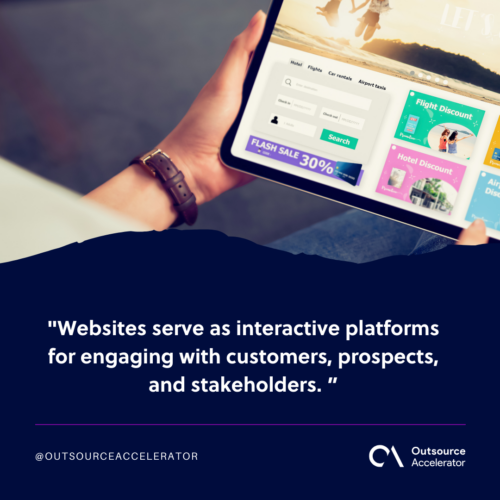
Websites serve as interactive platforms for engaging with customers, prospects, and stakeholders.
Website development services use features like contact forms and social media integration to foster meaningful interactions and build relationships with their audience.
Adapting to technological advancements
Website development services are essential for keeping websites up-to-date with the latest technological advancements and industry standards. This includes adopting new designs, features, and even security measures.
20 types of web development services
Here are 20 common website development services that you can take advantage of:
1. Website design
Website design is a foundational aspect of website development services. It encompasses the visual and aesthetic elements that define a website’s appearance and user interface.
It involves creating layouts, color schemes, typography, and graphical elements that collectively shape the look and feel of a website.
For surefire web design that helps firms achieve their digital transformation goals, a lot of business today turn to leading outsourcing providers like Sourcefit.
2. Front-end development
Front-end development is responsible for crafting the client side of a website. Developers use tools like HTML, CSS, and JavaScript.
Front-end developers contribute to the creation of visually appealing, device-responsive websites with intuitive user interfaces.
3. Back-end development
Back-end development, meanwhile, builds the server side of a website, which are all the behind-the-scenes components. This website development service ensures the website’s functionality and data management.
4. Content management system integration (CMS)
CMS development focuses on building and customizing content management systems. These allow businesses to create and publish digital content on their websites.
CMS developers leverage platforms like WordPress, Joomla, and Drupal to provide user-friendly interfaces for content editing and curation.
5. E-commerce development
E-commerce development is dedicated to creating online stores and digital marketplaces that facilitate the buying and selling of goods.
E-commerce developers may integrate the following features to provide a smooth shopping experience:
- Product catalogs
- Shopping carts
- Secure payment gateways
- Order management systems
6. Mobile app development
This website development service focuses on creating native or hybrid mobile applications. Developers utilize programming languages to build applications that run on different software operating systems or cross-platform environments.
Mobile apps offer businesses an additional channel to engage their audience and expand their reach.
7. Responsive web development
Responsive web development ensures that a website adapts and displays properly across different devices and screen sizes. This service aims to provide an optimal user experience for mobile, tablet, and desktop users.
8. Search engine optimization (SEO)
SEO services include fine-tuning a website’s code, content, and structure to increase search engine visibility and ranking. This website development service increases organic traffic and conversions.
Some developer tasks include:
- Keyword research
- On-page optimization
- Link building
- Content creation
9. Website maintenance and support
Web maintenance and support services are essential for ensuring the ongoing health, security, and performance of a website.
This includes the following responsibilities:
- Website updates
- Server monitoring
- Bug fixes
- Security patches
- Troubleshooting
- Technical support
10. Web hosting
Web hosting provides server space to make websites accessible online. This website development service ensures that websites are accessible to users 24/7 and provides help to any issues that arise.
11. UI/UX design
User interface (UI) and user experience (UX) services aim to enhance the website’s overall usability, accessibility, and satisfaction.
UI/UX designers focus on user-centric design principles to optimize navigation, layout, and interactions of websites to deliver intuitive and engaging experiences.

12. Custom web application development
These website development services create bespoke software solutions tailored to address specific business needs and challenges. Custom web applications can range from CRM systems and project management tools to inventory systems and booking platforms.
Developers work closely with clients to understand their requirements and deliver scalable, feature-rich applications that drive innovation.
13. API development and integration
Application programming interfaces (APIs) enable data sharing and communication across various software systems.
The creation and integration of APIs to provide seamless data flow across various systems or applications is the main emphasis of API development and integration services.
14. Database development and management
Database development and management services involve designing, creating, and managing databases that store and organize website data.
This includes:
- Data modeling
- Database optimization
- Data integrity and security
15. Web analytics and tracking
This website development service focuses on tracking and analyzing performance metrics, user behavior, and traffic patterns. The data from this will provide actionable insights for optimization.
16. Performance optimization
Performance optimization services focus on improving website speed, efficiency, and overall performance. This includes:
- Optimizing code
- Minimizing file sizes
- Using caching techniques
- Implementing content delivery networks (CDNs)
17. Social media integration
This website development service integrates client websites with popular social media platforms. It involves embedding social media widgets, including sharing buttons and feeds on web pages.
Additionally, organizations may have social login options, allowing users to access their websites using their social media accounts. This helps businesses extend their reach and drive traffic through social channels.
18. Website migration
Website migration services involve transferring an existing website from one hosting environment to another or upgrading to a new version. This process ensures a smooth transition while preserving website functionality, data, and SEO value.
19. Quality assurance and testing
Quality assurance and testing services involve rigorous testing of a website’s functionality, compatibility, performance, and security. This includes conducting automated and manual tests, which identify and fix bugs or issues before deployment.
20. Accessibility compliance testing
Accessibility compliance testing involves ensuring that websites are accessible to users with disabilities, including those with visual, auditory, motor, or cognitive impairments.
This service ensures that websites comply with accessibility standards such as the Web Content Accessibility Guidelines (WCAG). As a result, all users will have equal access and usability.
Trends and innovations in website development
Web development is a dynamic field that constantly evolves to embrace new technologies, methodologies, and trends. Developers and businesses must stay informed about the latest news to create modern designs and features.
Here are some prominent trends and innovations shaping the future of web development:
Progressive Web Apps (PWAs)
PWAs are websites that are designed to provide a native app-like experience. They combine the best features of both web and mobile applications to deliver a fast and reliable user experience.
Voice User Interface (VUI)
Voice assistants like Siri, Alexa, and Google Assistant are becoming more commonplace. Similarly, websites with voice-controlled interfaces are also being developed.
VUI technology allows users to interact with websites using voice commands, offering hands-free and intuitive navigation.

Motion UI and microinteractions
Motion UI utilizes a library of pre-built animations and transitions that can be used to create visually engaging websites. You can make your website more dynamic by communicating information better and highlighting important elements.
Microinteractions are small animations or interactions that provide feedback and enhance the user experience.
They include actions like:
- Button hover effects
- Loading animations
- Form validation messages
Single-Page Applications (SPAs)
SPAs offer seamless user experiences by loading content dynamically without requiring navigating across multiple pages. They update the website in real-time without page refreshes.
Artificial intelligence (AI) and machine learning (ML)
AI and ML technologies are increasingly being integrated into website development services. They’re used to personalize user experiences, automate tasks, and analyze data.
Chatbots, recommendation engines, and predictive analytics are examples of AI-powered features that improve functionality and performance.
Blockchain integration
Blockchain integration is being explored for website development services with the aim of enhancing security, transparency, and decentralization. This is particularly true for the e-commerce and finance sectors.
Outsource website development services to a team of skilled developers offshore. You can browse our BPO directory for a partner who can professionally assist you in this effort.






 Independent





