
10 strategies to streamline medical billing process and maximize revenue


This article is a submission by Armored Medical Billing Solutions LLC . Armored Medical Billing Solutions LLC is a top-tier medical billing company in the United States that offers secure, cost-effective, and reliable services.
How do you streamline the medical billing process?
You streamline the medical billing process by cleaning up coding, using smart billing software, and following up on every claim, so payments arrive faster and denials drop.
- Accurate coding and claim scrubbing cut errors before claims go out.
- Clear patient communication and insurance checks reduce disputes and denials.
- Tracking key metrics and, when it fits, outsourcing can lift revenue.
Efficient billing is key to strong revenue in any healthcare practice. A clean billing process helps you code services right, file claims fast, and collect payments on time. So this guide walks through proven ways to streamline medical billing process and boost revenue.
10 proven techniques to streamline medical billing process
Healthcare moves fast. So efficient medical billing matters for both smooth operations and happy patients. Still, many practices struggle with clunky billing that delays payments and adds admin work.
The good news is simple. There are proven strategies that can reshape how you handle billing. As a result, the whole process gets faster and more accurate.
1. Understand the importance of streamlined medical billing
Medical billing is a complex process. It pulls together patient details, insurance data, coding, and claims. So small gaps can lead to denied claims, late payments, and lost revenue.
A streamlined billing process fixes this. It improves cash flow and cuts admin costs. As a result, your practice stays financially healthy.
2. Implement advanced billing software
Choosing the right software
Good medical billing software is a core part of a smooth process. So look for features such as:
- Automated coding: Cuts manual entry errors and speeds up coding.
- Claim scrubbing: Finds and fixes errors before you submit, so denials drop.
- Integrated EHR: Moves data cleanly between health records and billing.
- Analytics and reporting: Shows billing performance and where to improve.
Training and integration
Once you pick the right tool, train your staff well. Also, make sure it fits your current systems and workflows. As a result, you get the full value from the new software.
3. Ensure accurate coding
Importance of accurate coding
Accurate coding keeps claims correct and payments full. However, coding errors can trigger denials or underpayment. So this step is worth close attention.
Regular training and updates
Train your coding staff often. The medical coding field changes with new CPT, ICD-10, and HCPCS codes. So keeping your team current supports both compliance and accuracy. To spot risks early, review these common medical billing errors.
Implementing coding audits
Run coding audits on a regular basis. You can do them in-house or hire third-party auditors. As a result, you catch errors early and improve billing accuracy over time.
4. Optimize claims submission
Claim scrubbing
Before you submit, use claim scrubbing tools. They flag missing details, wrong codes, and record mismatches. So fewer claims bounce back.
Timely submission
Send claims soon after you provide the service. Quick filing cuts errors and speeds up payment. In addition, a standard submission process keeps things consistent.
Follow-up on denied claims
Set up a clear process to review denied claims. Often, a quick fix or extra document resolves them. As a result, you avoid losing revenue to simple admin slips.
5. Enhance patient communication
Clear financial policies
Share your financial policies clearly with patients. Explain payment terms, insurance coverage, and billing steps. So you prevent confusion and cut down on disputes.
Patient portal
Add a patient portal for statements, payments, and claim tracking. A simple portal keeps patients happy. In addition, it speeds up the payment process.
Proactive collection strategies
Handle unpaid balances early. For example, send regular reminders and offer flexible payment options. So patients can pay in a way that suits them.
6. Improve insurance verification
Verification process
Accurate insurance verification cuts denials and confirms coverage. So verify patient insurance at each visit and update records as needed.
Automated verification tools
Use automated tools to speed this up. They confirm coverage and benefits fast. As a result, staff do less manual work and make fewer errors.
7. Monitor and analyze billing performance
Key performance indicators (KPIs)
Track KPIs to see how well your billing runs. This ties closely to strong revenue cycle management. Common KPIs include:
- Days in accounts receivable (AR): The average time it takes to collect payment.
- Claim denial rate: The share of claims that get denied.
- Net collection rate: The share of expected revenue you actually collect.
For a closer look at receivables, see this guide to AR in medical billing.
Regular reporting
Build regular reports to watch trends. Then use them to make smart calls. As a result, you can improve the process step by step.
8. Invest in staff training and development
Continuous education
Give your billing team ongoing training. Cover coding changes, billing rules, and software updates. So well-trained staff work faster and make fewer mistakes. Strong medical billing management starts here.
Staff incentives
Reward staff for hitting goals, such as reducing claim denials or improving collections. Incentives keep standards high. As a result, billing performance improves overall.
9. Compliance and regulatory considerations
Staying compliant
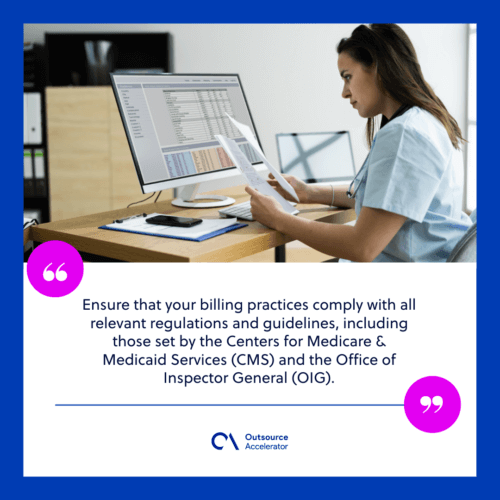
Keep your billing in line with all rules. This includes the Centers for Medicare & Medicaid Services (CMS) and the Office of Inspector General (OIG). However, non-compliance can bring penalties and legal trouble.
Regular audits
Run internal audits often to check compliance. Then fix any issue right away. So you lower risk and stay on the right side of the rules.
10. Explore outsourcing options
Benefits of outsourcing
Outsourcing medical billing can bring several gains. Many practices pair it with wider healthcare BPO support. Key benefits include:
- Expertise: Access to deep billing knowledge and experience.
- Cost savings: Lower overhead than an in-house billing team.
- Scalability: The ability to scale billing with your practice.
Choosing a billing partner
If you outsource, vet partners with care. Look for a strong track record and solid compliance. Also, make sure they can plug into your current systems.
Successfully streamline medical billing process
A streamlined billing process protects your revenue and your practice’s health. So it is worth the effort.
Start with the basics. Use smart billing software, code accurately, tighten claims submission, and talk clearly with patients. As a result, you work faster and make fewer errors.
Then go further. Train your staff, watch billing performance, and try exploring outsourcing options. Because of this, your billing gets stronger and your team can focus on patient care.
Frequently asked questions
What does it mean to streamline the medical billing process?
It means cutting waste and errors from each billing step. So claims go out clean, denials drop, and payments arrive faster. The goal is steady cash flow with less admin work.
How does billing software help?
Good software automates coding and scrubs claims before submission. It also links to your health records. As a result, staff spend less time on manual entry and fixes.
Why do claims get denied?
Most denials come from coding errors, missing details, or bad insurance data. However, a clear follow-up process can fix many of them. So tracking your denial rate really helps.
Should a practice outsource medical billing?
It depends on your size and goals. Outsourcing brings expertise, lower overhead, and easy scaling. Still, you should vet each partner for track record and compliance first.
Which metrics show billing health?
Watch days in accounts receivable, claim denial rate, and net collection rate. Together, they show how fast and how fully you collect. So review them on a regular basis.
Key takeaways
- Streamlining billing protects revenue and keeps cash flow steady.
- Accurate coding and claim scrubbing stop errors before claims go out.
- Clear patient communication and insurance checks cut denials and disputes.
- Tracking KPIs like AR days and denial rate shows where to improve.
- Outsourcing can add expertise and cut costs when you vet the partner well.






 Independent





