
Surefire ways to become a medical transcriptionist


How do you become a medical transcriptionist?
To become a medical transcriptionist, you need at least a high school diploma, training in medical terms, strong typing skills, and often a certification. In short, the path mixes study, practice, and the right gear. So this guide walks you through each step.
- Start with a diploma, then add training or a certificate program.
- Build fast, accurate typing and solid medical knowledge.
- Earn a certification to open more medical transcription jobs.
Every day, doctors, nurses, and healthcare workers save lives. They improve their patients’ conditions, do rounds, and sharpen their skills. Still, they need help to keep accurate health reports. This is where medical transcriptionists come in.
Medical transcriptionists work closely, or remotely, with healthcare staff. So they give strong support to workers and patients alike.
You can become a medical transcriptionist at home or through business process outsourcing (BPO) companies. As a result, it can be a good work opportunity.
Do you have great typing skills, sharp focus, and medical knowledge? Then you can become a medical transcriptionist. In addition, this job pays well, especially for experienced staff at home.
Below, you will learn the surefire ways to become a medical transcriptionist. So you will see the qualifications you need and the places that hire them.
What does a medical transcriptionist do?
A medical transcriptionist is also called a healthcare documentation specialist. In short, they listen to medical audio and turn it into document files.
They can transfer data straight from the audio file. In addition, they may use special text-to-speech software. Today, most rely on these tools to transcribe audio with ease.
After they render the file, they review it for errors in grammar, spelling, and punctuation. So they then collate the data into clean reports. Some staff move on to related work like medical coding later in their careers.
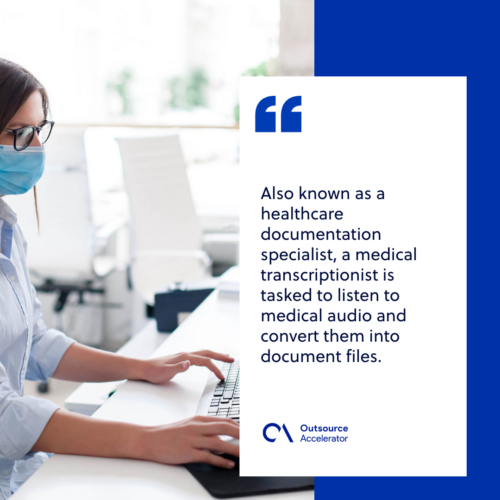
Their tasks also include listening to dictation and reading medical data. In addition, they describe each patient’s medical background.
They translate medical jargon into long form. So they create and proofread reports, then submit them for approval.
A medical transcriptionist must follow strict confidentiality rules. As a result, they keep sensitive data, such as patient information, fully secure.
The average salary of a medical transcriptionist
The average salary of a medical transcriptionist varies. So it depends on factors like experience, specialty, and location.
An average transcriptionist in the US earns a median annual wage of about US$35,270. In addition, they can earn up to US$37 per hour, based on the specialty.
Medical transcriptionists work in hospitals, labs, doctors’ offices, clinics, and admin offices. Meanwhile, remote and outsourced staff can earn as much as US$12 per hour or at least US$24,000 per year.
How to become a medical transcriptionist
Any qualified applicant can become a medical transcriptionist. So you can start from home or through formal education.
However, it takes training and practice to turn pro. To qualify, applicants must meet the following requirements.
Educational attainment
You need at least a General Education Diploma (GED) or high school diploma. However, most companies also want extra training.
You can get this through a community college, a distance-learning program, or a vocational school. In short, a one or two-year certificate or associate degree is the best way to qualify. So a postsecondary program can boost your skills and your odds.
Training
Today’s transcriptionists are either self-taught through online courses or have formal education. In addition, online programs let you study at your own pace.
Applicants with formal training complete courses in anatomy, medical terms, grammar, and medical-legal issues. Others do on-the-job training under direct supervision. Meanwhile, self-taught learners improve over time. Still, they often seek internships first to gain experience.
Licensures
Most US locations require certifications and licensures to work as a medical transcriptionist. So this step matters.
The Association for Healthcare Documentation Integrity (AHDI) offers credentials for the field. These include the registered healthcare documentation specialist and the certified healthcare documentation specialist.
The entry credential suits recent graduates or those with under two years of experience. In addition, single-specialty transcriptionists need it. The higher credential suits staff with the entry certification or at least two years of experience.
To qualify, applicants must have experience in acute or multi-specialty cases. As with any credential, they must pass national exams. In addition, both require ongoing education and recertification every few years.
Necessary equipment
Some health institutions still use handy audio devices to play files. For example, these include audio recorders, MP3 players, or cassette tapes.
Nowadays, most use digital files through the cloud or a hard drive. So applicants should have the following.
Laptop or desktop
A working laptop or desktop is vital for the virtual tasks a transcriptionist does. In short, you need it for audio playback and document work.
Word processing software
You can use web apps like Google Workspace for documents. However, an offline tool like Microsoft Word is best for highly sensitive files.
Foot pedal
A foot pedal saves time during audio playback. So pros use it instead of mouse clicks.
Medical dictionary
A handy medical dictionary helps a lot. As a result, you can look up hard or new terms fast.
Transcription software
Medical institutions usually name their preferred transcription software. So the choice depends on the field, the doctors, and the file format.
Quality headset
Invest in a good headset. This helps most when a doctor or nurse speaks fast or mumbles.

Skills needed to become a medical transcriptionist
Skills from both formal school and self-paced study can help you become a medical transcriptionist. So here are the key ones.
Computer literacy
You should be at ease with a computer and word processing software. In addition, you need basic formatting and simple troubleshooting skills. In short, the work demands care, speed, and a firm grasp of medical terms.
Typing speed
Most transcriptionists type at least 65 words per minute with few errors. So speed helps you capture data quickly and well.
Medical knowledge
You need enough medical knowledge to read terms, abbreviations, and jargon. As a result, your reports stay accurate.
Writing skills
A good transcriptionist knows grammar, spelling, and syntax. So the final report reads clean and clear.
Attention to detail
A small mistake can cause big harm in a medical setting. This is why pros check each audio file and report with care.
Listening skills
A good transcriptionist listens closely to the dictation. As a result, they capture the true meaning of the report.
Time management
Reports must be done fast to meet deadlines. So transcriptionists must manage their schedules and work under pressure.
Ability to focus
Transcriptionists handle many audio files each day. So they must stay focused to finish reports on time.
Qualifications companies look for in a medical transcriptionist
To become a medical transcriptionist, you must stay dedicated and keep learning. So here are the key qualifications companies want.
Degree
A degree signals a level of education. In short, it shows you can handle complex tasks. So the best route is a certificate or an associate degree. You can earn one online or in person through universities, colleges, and vocational schools.
Certifications
Certifications are optional but highly valued in the medical field. In short, they show you meet a recognized standard. As a result, employers trust that you are skilled and reliable. In addition, transcription programs give you the medical knowledge to succeed.
Skills and competencies
Companies want the right skills to meet business goals. So there are many typing and listening drills online. As a result, you can hone your accuracy over time. A strong, skilled team gives firms real confidence.
Experience
It pays to gain experience before the real work. So companies often prefer experienced staff. In short, they understand the industry and processes better. In addition, internships in clinics and doctors’ offices help you jumpstart your career.
Where to find medical transcription jobs
Companies and medical institutions hire medical transcriptionists. So they offer both in-house and remote roles. Many now run online using remote work tools and services.
You can find medical transcription jobs through the following.
Local health facilities
Most transcriptionists work at local health facilities. For example, they work in hospitals and physicians’ offices.
They read medical data straight from doctors’ audio dictations. So they create written reports in hard copies. As a result, they work closely with doctors and providers on site.
Offshoring
Offshore health institutions hire transcriptionists through freelancing. So they usually pay per project. In short, employers send audio files to work on within a set timeline. Freelance transcriptionists are often self-employed. You can also outsource medical transcription to a specialist team.
Medical transcriptionist outsourcing
Outsourcing companies also hire transcriptionists for local and offshore clients. So a medical firm hands transcription and support to a partner. In turn, that partner is part of the wider healthcare BPO sector.
The BPO company then hires a team to run these projects for a set period. So the client saves time and effort.
Speech recognition technology keeps improving. As a result, accuracy and speed in transcribing records have risen. Still, trained staff review the work to ensure quality.
Most transcriptionists know medical terms and rules well. So they transcribe records with care and confidentiality. To weigh the upside, read the advantages of medical transcription outsourcing.
Through outsourcing, transcriptionists count as staff of the medical company. However, the partner handles their pay, gear, benefits, and training.
Frequently asked questions about becoming a medical transcriptionist
Do you need a degree to become a medical transcriptionist?
Not always. You need at least a high school diploma. However, most employers want extra training or a certificate. So a program in medical transcription helps a lot.
How much does a medical transcriptionist earn?
In the US, the median wage is about US$35,270 per year. In addition, some earn up to US$37 per hour. Remote staff may earn around US$12 per hour.
Can you work as a medical transcriptionist from home?
Yes. Many transcriptionists work remotely. So they use digital files, remote tools, and secure software to do the job.
How long does it take to become a medical transcriptionist?
Most certificate programs take one to two years. However, self-taught learners can vary. In short, training plus practice sets your timeline.
Key takeaways
- Start with a diploma, then add training or a certificate program.
- Build fast typing, sharp focus, and solid medical knowledge.
- A certification can open more medical transcription jobs.
- The right gear includes a good headset, foot pedal, and software.
- You can work in local facilities, offshore, or through a BPO partner.






 Independent





