
10 applications of VR in healthcare

What is VR in healthcare used for?
VR in healthcare is used to train medical staff, treat patients, and improve care through safe, lifelike simulations.
- It helps students and surgeons practice without risk to real patients.
- It supports therapy, pain relief, and mental health care.
- It also aids telemedicine, empathy training, fitness, and marketing.
Virtual reality (VR) has the potential to become one of the most powerful tools in healthcare. In fact, it is already changing how people manage their health.
The use of VR in healthcare is still in its infancy,[1] but there are many ways to use it. For example, it can improve patient care and help doctors make better diagnoses. Many of these gains also link to broader healthcare outsourcing trends.
How does VR in healthcare work?
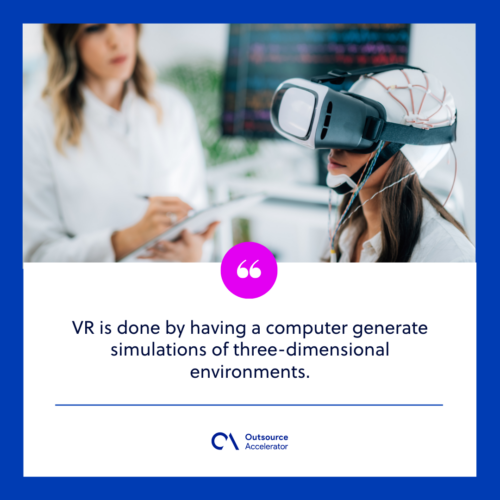
VR works by having a computer build 3D environments. People then interact with these scenes in a lifelike way using special equipment.[2]
The goal of VR is immersion. It creates a feeling of presence through realistic images, even though nothing is really there.
VR in healthcare aims to give patients these immersive experiences. The idea is to make the scene feel real enough to trigger the brain’s response. So the more realistic the graphics, the better VR in healthcare will work.
Applications of VR in healthcare
VR in healthcare has many uses. Some are already in place, while others are still being studied.
Here are ten of the most promising ways to use VR in healthcare.
1. Medical education
The use of VR in healthcare has grown fast in recent years. This is thanks to cheaper, high-quality hardware and software.
Virtual reality can teach medical students about anatomy, physiology, biochemistry, and more. As a result, it is a big step up from books and videos.
VR in healthcare can also teach students without live-animal tests or long hours of watching procedures. Instead, students can practice on simulated patients set with specific conditions. Modern healthcare software often powers these training tools.
2. Telemedicine and conferencing
Similar to how communication platforms like Zoom and Google Meet allow virtual meetings, VR in healthcare opens new telemedicine paths.
Telemedicine is medical care over long distances. With virtual reality, patients can connect to specialists who may be far away. As a result, this is very helpful for people in rural areas. The right telemedicine software makes these links easier to set up.
Doctors can also use virtual reality to work together. For example, they can share data in shared virtual rooms.
3. Surgery
VR in healthcare can improve how surgeons build their skills. Often, this means using simulations to practice before real operations.
The use of VR in surgery has grown a lot over the years. It gives both surgeons and patients a safe, immersive experience.
4. Physical therapy
Physical therapists can use virtual reality exercises to help patients recover from orthopedic (bone and muscle) surgery.
Patients enter a simulated setting where they perform set movements. Meanwhile, therapists watch and guide them.
This helps improve motor skills and speeds up recovery. It also lowers the risk of re-injury, since therapists can adjust the exercises with ease.
5. Rehabilitation
The image-heavy nature of VR in healthcare can help patients with neurological conditions. For example, it helps after a stroke or a traumatic brain injury.
These injuries often cause movement problems. So VR can rebuild scenes that help the person regain mobility. As a result, they can practice without risking more harm.
6. Pain management
VR in healthcare has also been used for pain relief. It has not replaced painkillers. Still, virtual reality can cut recovery time.
The idea is simple. The brain can be tricked into feeling less pain than it would. The body then releases chemicals that help relieve pain.
When paired with normal pain relief, a hospital stay can feel much better.
7. Mental health
VR in healthcare is now a popular tool for mental health. The immersion can ease anxiety, lift mood, and treat phobias and PTSD.
A common method is exposure therapy. In a safe, controlled way, doctors expose people to the thing they fear. So they slowly get used to it.
For example, someone with a strong fear of spiders might wear a VR headset placed in a pit of spiders.
The goal is simple. As they face their fear and see nothing bad happens, the phobia fades over time.
VR in healthcare can also create calm scenes for people with addiction or depression. It can even let patients revisit hard events without feeling overwhelmed.
8. Empathy
VR in healthcare is not only for the sick. Virtual reality can also build empathy in doctors.
Empathy is one of a doctor’s most important traits. Still, it is not always easy to build.
VR in healthcare can close that gap. It lets doctors feel what patients feel, such as losing a limb or a sense. As a result, better empathy leads to more caring, accurate treatment. A trained virtual medical assistant can then support that patient care at scale.
9. Fitness
VR in healthcare also helps on the preventive side. The technology is now popular with athletes who want an edge or simply want to improve.
Virtual reality can simulate many types of exercise. This is already common in gaming. So it can grow into a full fitness use case too.
10. Healthcare marketing
Marketers need new ways to reach bigger audiences as tech advances. Virtual reality is one of the latest trends for this goal.
The use of VR in healthcare marketing goes beyond ads. For example, firms can let people see how a facility looks and how procedures work. Many providers pair this with healthcare BPO support to handle the added demand.
VR in healthcare: A game changer
VR in healthcare offers clear gains over old teaching, learning, and care methods.
Virtual reality gives hands-on training that beats videos or text. Through immersion, VR also helps people grasp complex information.
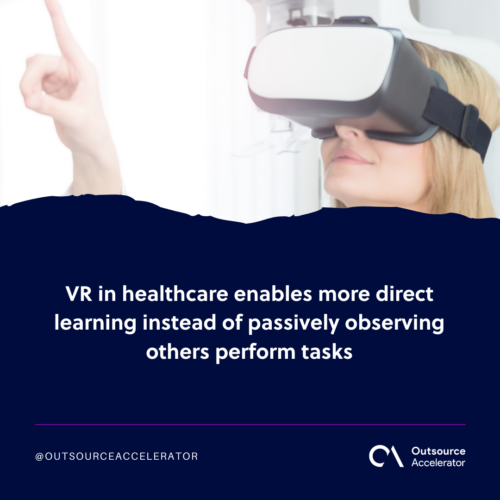
VR in healthcare enables direct learning, not passive watching. As a result, it helps medical students learn procedures before they are tested.
Practicing in virtual reality also cuts lab costs. Because of this, budgets stretch further.
Thanks to its many uses, VR in healthcare can treat many kinds of patients. This includes those who find it hard to communicate.
The door of virtual reality keeps opening. So VR in healthcare is a strong way for some of the most vulnerable people to benefit from new technology.
Frequently asked questions
What is VR in healthcare?
VR in healthcare uses computer-built 3D scenes for training and care. Patients and staff interact with these scenes using special headsets. The goal is a lifelike, immersive experience.
How is VR used to train doctors?
Doctors and students use VR to practice procedures on simulated patients. As a result, they build skills without risk to real people. It also replaces some live-animal tests.
Can VR help treat mental health conditions?
Yes. VR supports exposure therapy for phobias and PTSD. It can also ease anxiety and lift mood. Doctors guide patients through safe, controlled scenes.
Is VR in healthcare expensive?
Costs have dropped as hardware and software improve. VR can also cut lab and training costs over time. So many providers now see it as a smart investment.
What are the main uses of VR in healthcare?
Key uses include education, telemedicine, surgery, and therapy. It also supports pain relief, mental health, empathy training, fitness, and marketing.
Key takeaways
- VR in healthcare uses lifelike 3D scenes for training and patient care.
- It helps staff practice safely and speeds up patient recovery.
- Top uses span education, telemedicine, surgery, therapy, and mental health.
- Lower costs and better graphics keep pushing adoption forward.
- The technology is still young, but its impact keeps growing.
References:
[2.] Special equipment. Xiong, J., Hsiang, E.L., He, Z., Zhan, T. and Wu, S.T., 2021. Augmented reality and virtual reality displays: emerging technologies and future perspectives. Light: Science & Applications, 10(1), p.216.






 Independent





