
Top 12 healthcare software in 2026


What is the best healthcare software for your practice?
The best healthcare software depends on your needs, but trusted picks include Doxy.me for telehealth, RXNT and Kareo for billing, and AlayaCare and CareSmartz360 for home care.
- Some tools focus on one job, like booking or video visits.
- Others cover records, billing, and patient care in one place.
- The right pick depends on your size, budget, and specialty.
List of healthcare software in 2026
Healthcare firms gain a lot from modern technology. For example, big data, telemedicine, and digital assistants now shape daily care.
The right healthcare software helps clinics run better. So these tools serve both providers and patients.
Each one is built for medical work. In this guide, we explain how healthcare software helps and how to pick the right one. We also list the top 12 tools to know.
Top healthcare software companies
Healthcare software covers a wide range of tools. Each one supports set tasks for clinics and medical staff.
Some automate repeat, admin-heavy jobs. Others help manage core duties day to day.
In the main, these tools ease daily operations. For example, they help medical providers keep track of patient information like appointments, histories, and records.
Many also handle billing and payment, including insurance management. So the tools on our list all aim to improve the patient experience. In short, they:
- Smooth the link between patients, clinics, and suppliers.
- Digitize patient records, such as appointments, history, and prescriptions.
- Improve hospital management tasks, like CRM and logistics.

Different types of healthcare software
There are many kinds of healthcare software. Some pack broad features to cover a wide range of tasks. Others are built for one set job. Here are the main types:
Healthcare management information system (HMIS)
HMIS tools aim to boost patient satisfaction. They gather and track each service a patient gets. As a result, staff can give better care with current, correct data. They can also compare records across facilities.
Health and safety software
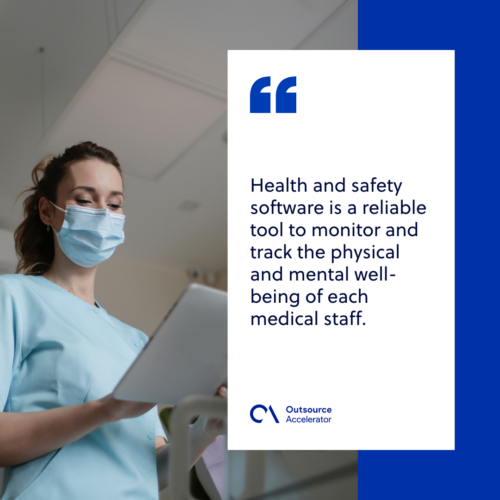
This type is used inside the organization. It tracks the physical and mental well-being of each staff member. For example, it handles risk checks, incident logs, and action tracking. So it helps firms avoid the same problems again.
Patient communication software
Patients and providers must be able to talk with ease. Still, medical work leaves little time for calls. So this software helps both sides connect smoothly. For example, patients can book, cancel, ask, or share feedback with a few clicks.
Electronic health record management
Providers handle many patients each day. So strong record tools keep files safe and current in one place. Many also process billing, payments, onboarding, and setup. This type often comes with customer support services too.
Imaging and visualization software
Imaging is a key part of medical work. This software is not built for admin tasks. Instead, it stores and sorts imaging data. So staff can access and share CT scans, X-rays, and MRIs with ease. As a result, it cuts errors and lost files. 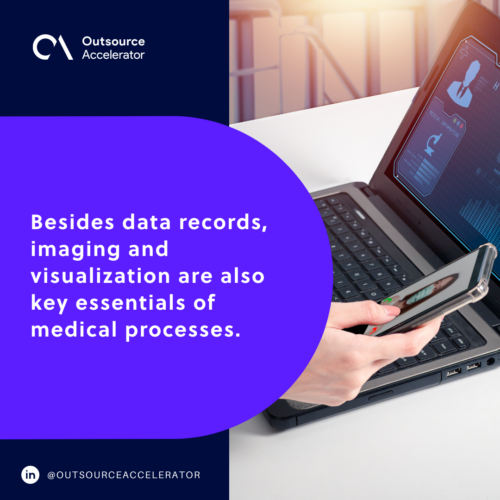
Top healthcare software: Tips for choosing the right provider
There are many healthcare software tools to choose from. So it is best to pick one that fits your practice well. When you compare our list, weigh these three factors:
- Users. Who will use the tool? Think about staff needs, research goals, and your medical field.
- Technology requirements. Know your needs first. Then pick a tool whose setup meets them. Also weigh the size of data you handle each day.
- Regulatory requirements. Check that the vendor meets rules like HIPAA.
Orangesoft is a trusted healthcare software developer. Its skilled team is ready to take on all your healthcare software needs.
Top 12 healthcare software in 2026
Below is the list of the top 12 healthcare software to know:
1. Doxy.me
Doxy.me makes telemedicine simple. So doctors can meet patients online with ease. It works on any device, and clinicians worldwide trust it.
Doctors just share a personal link to start a visit. Patients do not need to sign up or log in. In addition, it offers waiting rooms, chat, and a patient queue.
Pricing:
- Free
- Professional: $35 monthly
- Clinic: $50 monthly
- Enterprise: Available upon request
2. AlayaCare
AlayaCare is a home healthcare tool. It offers back-office, family portals, clinical notes, records, and mobile care. So it fits small and mid-sized care providers best. It also adapts to each provider’s needs.
Pricing:
- Available upon request
3. Skedda
Skedda focuses on booking and scheduling. Besides a flexible calendar, it has an interactive map. So patients can check open dates and book right there. It also takes payments for each booking, now or later.
Pricing:
- Core: Free plan
- Pro: $41.67 monthly
- Premium: Available upon request
4. Therapy Notes
Therapy Notes is built for mental health pros. For example, it suits psychiatry, behavioral health, and social work. Its features include booking, reminders, notes, billing, card processing, ePrescribe, and a client portal. It is also free for the first 30 days.
Pricing:
- Solo: $49/one user monthly
- Group: $59 for the first clinician, monthly ($30 per added clinician)
- Enterprise: $59 for the first clinician monthly ($30 per added clinician)
5. RXNT
RXNT is a cloud-based tool that lifts the patient experience. It also boosts practice efficiency. For example, it offers a patient portal and full record keeping. In addition, it works with telehealth and handles billing with automated claims scrubbing.
Pricing:
- Full Suite: $160 monthly
- PM Solutions: from $65 monthly
- EHR Solutions: $100 monthly
- eRx Solutions: $650 yearly
6. Clearwave
Clearwave offers all-in-one tools for providers and patients. For example, its features include:
- Zero-contact patient check-in
- Scheduling via chatbot, website, portal, IVR, or call center
- Real-time patient-provider match
- Early eligibility checks
- POS balance and co-pay collection
- Financial transparency
- Smoother staff workflows
It also tailors patient engagement by specialty. So it fits oncology, ophthalmology, neurology, dermatology, and more.
Pricing:
- Available upon request
7. MocDoc
MocDoc serves small and multi-chain hospitals, labs, and clinics. It meets HIPAA and HL7 standards. So it is a safe, one-stop choice. Its features cover hospital management for OP, IP, labs, pharmacies, and therapy rooms.
Pricing:
- Available upon request
8. Kareo
Kareo suits small clinics and physician centers. Its goal is to improve the whole revenue cycle. For example, it offers scheduling, practice management, records, and billing. Patients can also track records, visits, and lab results with ease.
Pricing:
- Available upon request
9. CareCloud
CareCloud is another cloud-based tool. It centers on:
- Electronic health records
- Patient engagement and management
- Patient experience
- Revenue cycle management
It supports small practices, large groups, and new clinicians. So many types of providers can use it.
Pricing:
- Available upon request
10. LigoLab
LigoLab offers full lab systems. For example, it has modules for:
- Clinical Pathology (CP)
- Anatomic Pathology (AP)
- Molecular Diagnostics (MDx)
- Revenue cycle management (RCM)
- Direct-to-consumer (D2C)
It links all departments in one setup. As a result, it keeps data secure end to end.
Pricing:
- Available upon request
11. Lively
Lively offers a smooth health savings account (HSA) platform. It serves both employers and staff. So firms can manage health savings without paper. The steps are simple: sign up, sync payroll, and see clear pricing.
Pricing:
- Free for every individual
- Employers: $2.95 per employee monthly
12. CareSmartz360
CareSmartz360 offers cloud-based tools for home care agencies. For example, it covers caregiver scheduling, client management, billing, accounting, CRM, and telephony.
Pricing:
- Startups (available upon request)
- Independent Agency (available upon request)
- Franchisor (available upon request)
Frequently asked questions about healthcare software
What is healthcare software?
It is a set of digital tools built for medical work. For example, it handles records, billing, booking, and video visits. So clinics can run better each day.
What is the best healthcare software for telemedicine?
Doxy.me is a top pick for video visits. It works on any device with no patient login. As a result, both doctors and patients find it easy to use.
Is healthcare software HIPAA compliant?
Many tools are, but not all. So always check before you buy. For example, MocDoc meets both HIPAA and HL7 standards.
How much does healthcare software cost?
Prices vary a lot by tool and features. Some, like Doxy.me, have a free plan. Others charge a monthly fee or quote on request.
What should I look for in healthcare software?
Start with your users, your tech needs, and the rules you must meet. Then match a tool to your size and specialty. So the software fits your daily work.
Key takeaways
- Healthcare software helps clinics manage records, billing, and care.
- Types include HMIS, safety, communication, records, and imaging tools.
- Top picks range from Doxy.me and RXNT to AlayaCare and CareSmartz360.
- Always check that a tool meets rules like HIPAA before you buy.
- The right choice depends on your size, budget, and specialty.






 Independent





