
Offshoring for startups: How can full-time remote teams help your business grow?


How does offshoring for startups help your business grow?
Offshoring for startups lets a young company hire skilled remote staff abroad at a lower cost, so it can scale faster without the overhead of local hiring.
- It opens access to a global talent pool, not just the people near your office.
- It cuts salary and overhead costs, which stretches a startup’s limited runway.
- It lets small teams grow output quickly, so they can keep up with demand.
Work has changed, and much of it has changed for good. Remote tools made it normal to build a team across borders. As a result, more founders now ask a simple question. Why hire only in your home city when you manage people over video calls anyway? For many startups, the answer is offshoring.
These days, companies lean on project management apps and video conferencing to work from anywhere. Because of this, many have not just kept remote work, they have grown their remote workforce. So remote work is no longer a perk. Instead, it is a practical way to scale.
Remote work is the future.
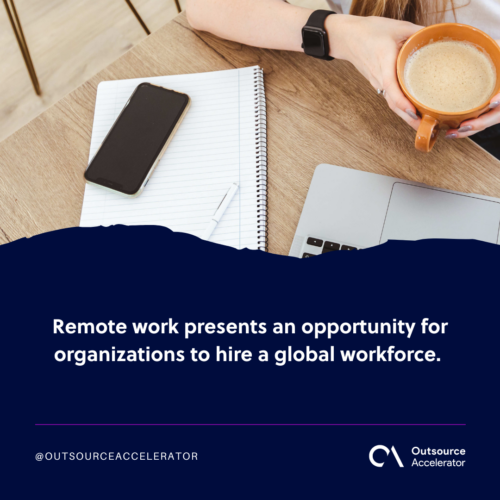
Remote work gives startups the chance to hire a global team. In addition, it lowers salary costs and helps you reach talent far beyond your own HQ. So remote work is no longer just a lifestyle or a policy. Today, it is a global industry. For founders, that shift makes global talent acquisition far easier than it was a few years ago.
It improves work-life balance.
According to the LinkedIn Global Talent Trends 2019 report, work flexibility matters a lot to hiring teams. In fact, 72% of talent professionals said flexibility is very important to the future of recruiting and HR. Meanwhile, 77% named a better work-life balance as a top benefit of flexible work.
It encourages retention.
The same report found that 54% of talent professionals believe flexibility helps keep staff on board. Still, many workers miss out. For example, the 2019 Zapier Remote Work Report showed that 31% of knowledge workers did not work remotely because their company would not allow it.
It expands the available talent pool.
A global team widens who you can hire. Some countries have deep pools of developers, marketers, and designers. As a result, startups can pick from the best people available, not just the ones nearby. This is one clear reason offshore staffing appeals to lean teams. For a closer look at the trade-offs, it helps to weigh onshore versus offshore staffing early on.
It increases productivity.
Remote staff can be just as productive as office staff. For example, a widely cited Stanford study found that remote workers were about 13% more productive than their in-office peers. Today’s tools help people do great work from home. On top of that, they skip the long daily commute.
Remote staff also tend to feel more comfortable, since they can shape their own routine. So those factors help explain the lift in output. Still, the job is not done for employers. They must make sure staff are well equipped, trained, and ready for remote work.
Why offshoring for startups works
At this point, the case for global remote teams is clear. You can grow your team by building offshore. First, pick the roles you want to fill. Next, set clear goals and simple workflows. Finally, find a partner to help you plan and run your expansion. A good partner helps you capture the benefits of offshoring sooner. Strong offshore team practices keep that growth steady as you scale.
Setup matters too. For example, a clear startup team structure makes it easy to add offshore roles without confusion. In addition, cloud staffing gives smaller firms a fast way to add skilled people. So offshoring for startups is less about cost alone and more about building a team that can scale.
How startups can start offshoring the right way
Offshoring for startups works best with a clear plan. First, list the tasks that slow your team down. For example, support, bookkeeping, or software testing often top the list. Next, decide which roles have clear, repeatable work, since those are the easiest to hand off.
After that, pick a location and a partner that fit your needs. For example, the Philippines offers a large pool of English-speaking talent. Meanwhile, other markets may suit niche skills better. So it helps to match the role to the right talent pool.
Then set up simple systems from day one. For example, agree on overlap hours, shared tools, and clear goals. As a result, your new team members know what to do and when. In short, good planning turns a small startup into a global one. This is where Penbrothers comes in.
About Penbrothers
Penbrothers helps companies grow their remote teams in a smooth, simple way. They recruit, hire, and employ staff through their all-in-one platform called The HUB. So you get support at every step. Learn more about Penbrothers here.
Frequently asked questions about offshoring for startups
What is offshoring for startups?
It means hiring staff in another country to handle work your startup needs. For example, you might offshore development, design, or support. As a result, you get skilled help at a lower cost than local hiring. So it is a practical way to grow a small team.
Is offshoring for startups cost-effective?
Yes, in most cases. Salaries and overhead are often lower abroad. Because of this, your runway lasts longer. Still, you should plan for clear onboarding and good tools, so the savings do not come at the cost of quality.
Which roles can startups offshore first?
Many startups start with roles that have clear tasks. For example, software development, customer support, bookkeeping, and marketing all work well. Next, as trust grows, you can offshore more complex work. So it helps to start small and build from there.
How do I manage an offshore team well?
First, set clear goals and simple workflows. Next, agree on overlap hours and use shared tools for updates. In addition, give regular feedback and check in often. As a result, your offshore team stays aligned with your startup’s goals.






 Independent






