
Offshore vs. onshore staffing: What’s better for your growth strategy?


Offshore vs. onshore staffing: which is better for growth?
Offshore vs. onshore staffing comes down to trade-offs: offshore staffing scales faster and costs less, while onshore staffing offers closer control and simpler compliance.
- Offshore staffing gives you lower costs and a wider talent pool.
- Onshore staffing gives you proximity, cultural fit, and easy oversight.
- A hybrid model can blend the best of both.
When you build a team to scale, offshore vs. onshore staffing is one of the biggest choices you face. Each model brings clear perks and a few drawbacks. As more firms adopt hybrid and remote teams, a careful look at both matters for long-term growth. This article lays out how each one works, so you can decide what fits your needs.
What is offshore staffing?
In short, offshore staffing means hiring talent from other countries. These regions, often in Southeast Asia or Latin America, tend to have lower costs and ready skills.
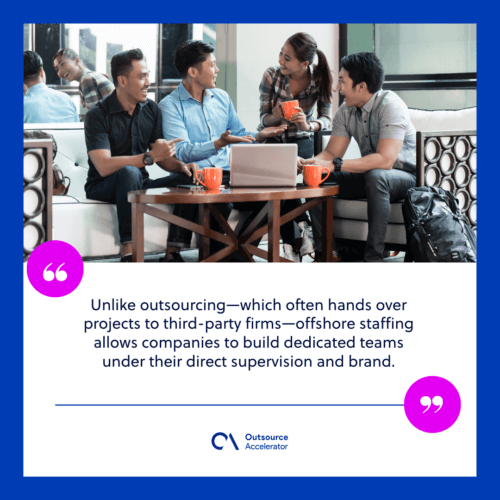
Unlike outsourcing, which hands projects to a third-party firm, offshore staffing lets you build dedicated offshore teams under your own brand and supervision.
So it lets you tap global talent while you keep control and culture in place. Offshore staffing helps most when you want cost savings, round-the-clock work, or hard-to-find skills.
However, offshore staffing is not without risk. This is true when work runs through unmanaged freelancers or loose contracts. For example, unsecured devices and weak compliance can expose you to legal and money risks.
What is onshore staffing?
By contrast, onshore staffing means hiring workers within your home country or region. It offers proximity, cultural fit, and often smoother talk.
So this model suits roles that need direct oversight, in-person work, or local rule knowledge. Many firms also use staff leasing to hire locally without the full setup burden.
However, relying only on onshore staffing brings limits. For example, firms face higher labor costs, including salaries, benefits, and heavy overhead.
The average recruiting cost per hire in the US is around $4,700. It can run higher based on industry and experience. Training also eats a big share of the budget. In fact, one industry report put training spend at reaching $98 billion, after a peak of $101.8 billion the year before.
Local talent pools can be small too. As a result, hiring in crowded markets may slow your time-to-hire. It can also push up pay demands. So fast, low-cost scaling gets harder.
Key differences between offshore and onshore staffing
Here is a quick rundown of how the two compare.
Cost and scalability
Offshore staffing usually cuts overhead. So it lets you allowing businesses to scale faster without a drop in quality. Onshore staffing offers consistency, yet it costs more and scales slower.
Talent availability
Offshore markets open up niche talent, mainly in tech, design, and customer support. Onshore hiring stays limited to local candidates. As a result, it can narrow your range of skills and ideas.
Compliance and risk
Without the right partner, offshore staffing can bring compliance risks. These often touch data security and labor law. So many firms lean on global compliance support to stay safe. Onshore teams face fewer such risks, but they often lack the cost edge.
Communication and time zones
Meanwhile, onshore staffing supports real-time work in the same hours. Offshore teams can span time zones instead. With the right tools, they can keep work going around the clock.
Security and infrastructure
Freelance-based offshore setups can pose real security threats. These include data breaches and idea theft. So strong cybersecurity in outsourcing matters here. This is where managed offshore staffing solutions like DOXA® Talent become essential.
Choosing what’s right for your growth strategy
Your choice between offshore vs. onshore staffing should track your goals. Weigh the pros and cons of offshore outsourcing as you plan.
- If speed and cost matter most, offshore staffing scales faster at lower cost.
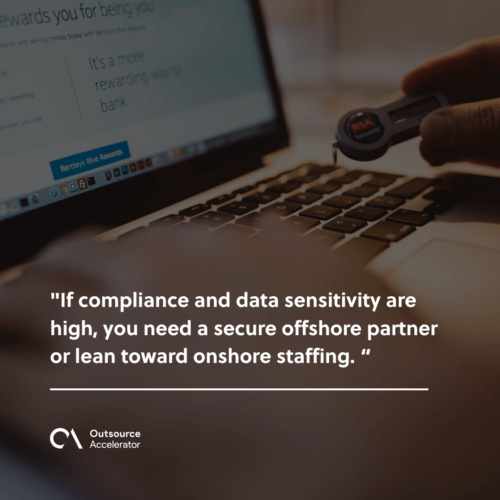
- If compliance and data are sensitive, use a secure offshore partner or lean onshore.
- If you need niche skills, offshore markets can supply what you lack locally.
- If real-time work is key, a hybrid model may strike the best balance.
In the end, the goal is not just to save money or hire fast. Rather, it is to build a stable, productive team that fits your values and long-term vision.
How DOXA® Talent supports your staffing strategy
DOXA® Talent delivers secure, fully managed offshore staffing for US firms that want growth without compromise. Its model removes the risks of hiring freelancers. Instead, you get dedicated teams with DOXA-issued laptops, full support, and 24/7 IT oversight.
With DOXA® Talent, you get:
- Enterprise-grade security: All devices use MFA, encryption, and remote wipe. External storage is limited and watched. The company is also SOC Type 1 Certified.
- Global compliance: DOXA follows US, Philippine, and Colombian labor and data rules.
- Fully managed teams: Every staff member is a full-time worker under DOXA’s employer-of-record model. So your legal load drops.
- Integrated IT and HR support: From onboarding to performance checks, DOXA handles it all. As a result, your team stays focused on growth.
- Flexible scaling: Whether you need one expert or a full team, DOXA grows with your business.
Your growth strategy deserves more than a quick fix. With DOXA® Talent, you gain a partner that helps you scale securely and with confidence.
Ready to build a smarter workforce? Contact DOXA to learn how its secure offshore staffing solutions can move your business forward.
Frequently asked questions about offshore vs. onshore staffing
What is the main difference between offshore and onshore staffing?
Offshore staffing hires talent abroad for lower cost and wider skills. By contrast, onshore staffing hires locally for closer control and simpler compliance.
Is offshore staffing cheaper than onshore staffing?
Yes, in most cases. Offshore staffing cuts labor and overhead costs. Still, you need a good partner to manage risk and quality.
Is offshore staffing safe?
It can be, with the right setup. For example, managed teams with secure devices and clear compliance lower the risk of data breaches.
What is a hybrid staffing model?
A hybrid model blends offshore and onshore teams. As a result, you gain cost savings and real-time work at the same time.
Which model is best for a growing company?
It depends on your goals. For fast, low-cost growth, offshore staffing helps most. For tight control, onshore or a hybrid setup may fit better.
Key takeaways
- Offshore staffing scales faster and costs less than onshore staffing.
- Onshore staffing offers proximity, cultural fit, and simpler compliance.
- Offshore work needs a secure partner to manage data and legal risk.
- A hybrid model can blend cost savings with real-time collaboration.
- Match your choice to your goals, not just to short-term savings.






 Independent





