
How to avoid scams on Fiverr, Upwork, and Freelancer


How do you avoid Upwork and Fiverr scams?
You avoid Upwork and Fiverr scams by checking a freelancer’s reviews, keeping all work on-platform, verifying deliverables, and never sharing sensitive personal information.
- Most scams start when someone pushes you to pay or chat off the platform.
- Red flags include a weak profile, deals that seem too good, and requests for private data.
- For steady work, an outsourced provider can be a safer choice than a freelancer.
The internet and mobile tools have made it easy to do business online. As a result, more people now work as freelancers from home.
This model challenges the old idea of office-based work. Instead, people take on freelancing or contract work on their own. So they can work from almost anywhere.
These days, you just need skills, some training, and basic tools. This means a laptop, a headset, and a good internet link. With those in hand, you can seek work as a true freelancer.
The freelance model helps both freelancers and clients. For example, it gives many young professionals real perks. These include flexible hours, creative control, many clients, and room to grow.
On the other side, clients also gain a lot. Most are small-to-medium firms (SMEs). Now they can hire freelancers at a fair cost, talk around the clock, and scale work project by project.
Because of this demand, sites like Upwork, Fiverr, and Freelancer grew fast. These three are among the top platforms that link freelancers to clients worldwide.
However, users also face Upwork and Fiverr scams, along with fraud on other sites. So let us look at these platforms and how to use them safely.
About Upwork
Once known as Elance-oDesk, Upwork re-launched in 2015. Today, it is one of the biggest freelance marketplaces on the web.
The site now hosts more than 18 million registered freelancers. It connects them with a large base of active clients around the world.
The process is simple. First, clients search for a role or post a project. Then they browse freelancer profiles, interview people, share files, and pay online.
Freelancers can also apply to job posts. Usually, they join a pool of candidates that the client screens later.
Many roles are in high demand on Upwork. For example, these include developers, bookkeepers, data scientists, and content writers.
About Fiverr

Upwork’s closest rival is Fiverr, a Tel Aviv-based platform founded in 2010.
The site hosts millions of job listings, or “gigs.” As a result, it is a key player in today’s gig economy. A Fiverr account is free, and freelancers there are called “sellers.”
Fiverr’s sellers offer many services. These include graphics and design, writing, programming, web development, and video work. The most popular requests are logos, WordPress work, voiceovers, and social media help.
About Freelancer
Freelancer.com claims to be the biggest freelance network by users and projects. In fact, it reports more than 60 million registered users worldwide.
Freelancer uses a bidding system. So candidates pitch themselves and name their asking price to win a job. Clients pay only when the work is 100% done. Popular areas include SEO, web development, app development, writing, and data entry.
If you are weighing your options, our guide to how freelancing works explains the basics in plain terms.
Top 6 Upwork, Fiverr, and Freelancer scams
The freelance system is handy and fair in many ways. Still, it has faults. Sadly, there is a darker side to contracting freelance work.
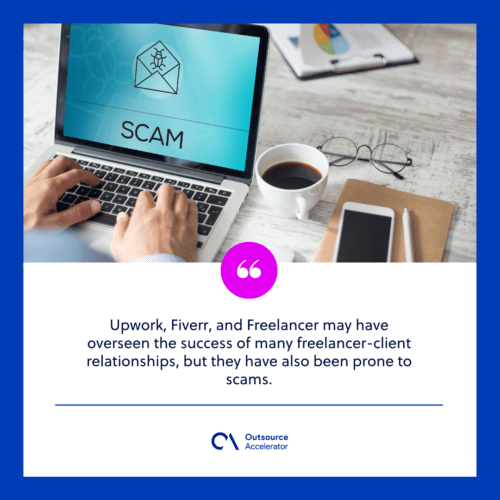
Upwork, Fiverr, and Freelancer have built many good freelancer-client bonds. However, they have also seen their share of scams. For years now, some clients have run into the most common Upwork and Fiverr scams. So here are the top six to watch.
Duplicate accounts
These sites hold huge user databases. So it is hard to screen every user. It is even harder to spot people who make dummy accounts, prey on clients, and then start over.
This scam works in a simple way. A freelancer asks to be paid upfront. Then they deactivate the account and vanish with the money before work even starts.
Copyright infringement
Copyright infringement is another common scam. Here, a client may face legal risk. This can happen because a freelancer used plagiarized text or stolen images.
Demanding for transactions to be done offsite
In this scam, freelancers push for contact and payment outside the platform. As a result, the client loses key protection. Any bad action then falls outside the site’s rules. So the freelancer is not held to account.
Sudden changes in agreed terms
It is a tricky spot when terms change without warning. For example, a freelancer may demand more money than agreed. They may also threaten delays if you refuse. So this scam can be scary and costly.
Gaming the system
One of the worst scams is abuse of the Hourly Protection System. In short, scammers game the site’s work-hour logging.
They log in, run the counter, and rack up hours for little real work. This happens because the system pays for logged hours, not finished output.
Money laundering or phishing
Finally, some freelancers take part in outright crime. This includes money laundering and phishing. These scams pull private data from would-be employers. As a result, the client learns the truth only after the money is gone.
Upwork, Fiverr, and Freelancer scams: Red flags to look out for
These platforms say they watch for scams and odd activity. Even so, the problem still lingers. So it is smart to know the warning signs.
Here are some red flags to watch if you hire through these sites.
- The freelancer doesn’t have a strong presence. It is a red flag if they share few work details or hide their portfolio. In the worst case, they have something to hide.
- Deals are too good to be true. Both sides want savings. Still, beware of anyone who agrees to be paid far too little. The real cost could be your time or security.
- Unrealistic expectations are set. Avoid people who overpromise or act like the work is easy. Often, you get half-baked results or nothing at all.
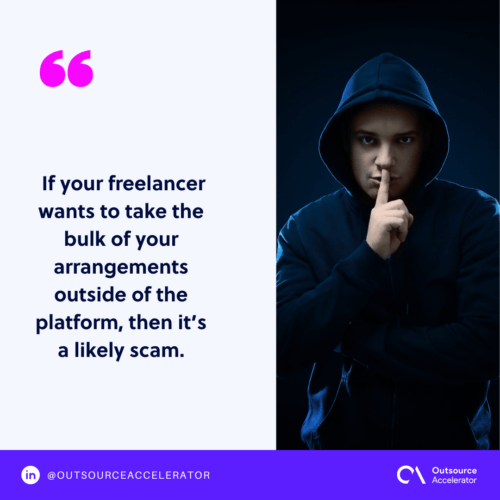
- The freelancer wants to engage offsite. If they push most work off the platform, it is likely a scam. So do not trust anyone who skips the site’s safeguards.
- The freelancer asks for sensitive information. Finally, stay away from anyone who asks for passwords, your mobile number, or your home address.
Upwork, Fiverr, and Freelancer scams: How to avoid them
You can protect yourself from Upwork and Fiverr scams. So follow the steps below.
Verify a freelancer’s identity and reviews
First, run a quick Google search on the candidate. Try to match their credentials to past work on other sites. Also, note if they are blacklisted or face any legal cases.
Next, check their profile ratings. Look for real feedback from past clients. All three sites let clients rate freelancers. So do not consider anyone who cannot meet your standards.
Cross-check the content you receive
In some cases, you should check that the work is original. For example, this applies to logos and written content.
Run the articles through a plagiarism checker. There are a lot of reliable free and paid tools in the market, such as Copyscape, that can do a quick plagiarism and comparison check across thousands of websites.
For images like logos and photos, use a reverse image search on Google. So you can track similar images and confirm original work.
Keep your personal info safe
Be careful about who gets your files, e-signature, and photos. As the saying goes, better safe than sorry. Many scammers and hackers now pose well on these sites.
As much as you can, keep work inside the platform. The site gives basic protection for both sides in case of bad actions.
Once you hire someone, agree on a fair payment plan. The best option is milestone-based payment. This way, you pay for each stage as it is cleared.

Payment solutions for Upwork, Fiverr, and Freelancer users
Online payments are also easier now for clients and freelancers. Tools such as Payoneer help ease the task of sending payment for work done.
Clients must always take care when sending money to anyone. However, tools like Payoneer add real safety, clarity, and security.
Payoneer is a global payment platform. It links easily to your Upwork, Fiverr, or Freelancer account. Unlike some tools, Payoneer accepts USD, GBP, and EUR. So it also makes payments in Europe simpler for both sides.
Common client problems and complaints with Upwork, Fiverr, and Freelancer
Reviews of these networks are mixed. For example, sites like Sitejabber and Trustpilot show both praise and complaints.
Freelance sites can be hit-and-miss for convenience. As a result, a few common problems keep coming up.
Common complaints on Upwork, Fiverr, and Freelancer are:
- Weak client protection from unprofessional freelancers
- Sudden account suspensions, even with business pending
- Poor quality control, even when profiles are screened
- Slow or unhelpful customer support
Of the three, Freelancer often scores highest. Still, it is not immune to fake users, scammers, or costly errors. So where should you go from here? If none of the three fit, you can also explore other Fiverr alternatives.
Outsourcing with confidence
Luckily, there are strong alternatives. Instead of hiring freelancers, you can work with an outsourced service provider. This can still bring savings and ease, but with fewer worries. To see how the models differ, read our take on outsourcing versus insourcing.
How to avoid outsourcing scams
There are good reasons to hire an outsourced agency. For example:
- It is cost-effective and scalable. So you choose the work, the staff, and the timeline that fit your budget.
- It is easier to set clear terms and paperwork with an agency.
- You skip many complaints tied to large freelancer networks. These include slow support and payment issues.
- Agencies are held to stricter standards. As a result, their work stays more consistent.
- They also carry more accountability, both to you and to local trade and labor laws.
This does not mean fewer options. On the contrary, you can source talent from top firms in the BPO industry. Many hold strong reputations at home and offshore. So you have a better shot at quality work and a solid return.
How to start outsourcing
Consider outsourcing as an alternative to freelancing. This way, you can reach the best people from a global talent pool. To compare setups, our guide on freelance, full-time, and contractor roles can help you decide.
If you are curious and want to start, complete this form and get 3 free quotes from Outsource Accelerator. We feature a wide directory of BPOs. These cover customer service, digital marketing, finance, accounting, and much more.
Frequently asked questions
Are Upwork and Fiverr safe to use?
Yes, both are generally safe when you follow the rules. Keep all work and payments on the platform. So you stay covered by the site’s protection tools.
What is the most common Upwork or Fiverr scam?
The most common scam is a push to work off-platform. Scammers ask for upfront payment or offsite chat. As a result, you lose the site’s safeguards.
How can I tell if a freelancer is a scammer?
Watch for red flags first. These include a weak profile, deals that seem too good, and requests for private data. In short, trust the warning signs.
What should I do if I get scammed on a freelance site?
First, report the user to the platform right away. Then gather your chat logs and payment records. Finally, contact support to ask about a refund or dispute.
Is outsourcing safer than hiring a freelancer?
Often, yes. An agency offers set terms, stricter standards, and clear accountability. So it can be a safer choice for steady, long-term work.
Key takeaways
- Most Upwork and Fiverr scams start when someone pushes work off the platform.
- Verify reviews, check credentials, and confirm that deliverables are original.
- Never share passwords or personal details, and use milestone-based payments.
- Tools like Payoneer add safety when you send payment across borders.
- For steady work, an outsourced provider can be a safer, more consistent option.






 Independent





