
Why is Nepal the right destination for outsourcers?


This article is a submission by Kantipur Management. Kantipur Management is a certified ISO 9001:2015 company specializing in Contact Center and Business Process Outsourcing.
Why is Nepal a strong outsourcing destination?
Nepal is a strong outsourcing destination because it pairs low labor costs with a skilled, English-speaking workforce, growing government support, and a fast-improving ICT sector.
- Wages are well below Western and many South Asian rates.
- Talent spans IT, finance, customer support, and content work.
- Better internet and night-shift rules now support 24/7 delivery.
Over the past few years, Nepal has grown into a strong choice for offshore outsourcers. The country offers skilled talent in science and technology, finance and accounting, human resources, and more.
Its labor cost is also low. So firms can offer services at a lower price. As a result, the number of outsourcing businesses in Nepal keeps rising. The US, Canada, Australia, and several European countries are the main markets that Nepal serves.
Nepalese firms deliver outsourcing across many sectors. For example, they support banking, finance, healthcare, and research and development. Over time, Nepal has become a competitive outsourcing destination that is still expanding.
10 reasons why Nepal is a smart choice for outsourcers
Here are ten reasons why Nepal can be an ideal outsourcing destination:
1. Cost-effectiveness
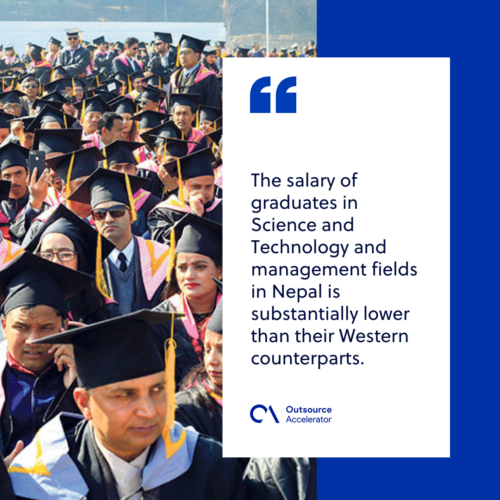
Salaries for science, technology, and management graduates in Nepal sit well below Western levels. The minimum wage is about NRs. 15,000 (around USD 114) per month. That is much lower than in many other South Asian countries. Still, minimum pay does vary with the skills a job needs.
So the country appeals to outsourcers that want quality services at a good price. In fact, Nepal is growing into a major hub alongside other South Asian markets like outsourcing to India.
2. Skilled workforce
Nepal has a deep pool of skilled talent across many fields, including:
- Information technology
- Software development
- Content writing
- Customer support
- Graphics design
- Finance and accounting
- Human resources
- Administrative tasks
- Sales and marketing
This depth means outsourcers can tap specialized skills at competitive rates. For finance work, many firms follow a clear offshore accounting playbook. In addition, the government has made university courses more IT-focused. So the workforce is better prepared for BPO and IT roles.
3. English proficiency
English is used in formal education, from schools to universities. It is also widely spoken, especially among younger people. Corporate communication at private firms runs in English too. As a result, about 35.8% of the population speaks English. Programs in English for specific purposes make it easier to attract a large talent pool.
4. Government support
The government has taken steps to promote outsourcing. For example, it has set rules to attract foreign investment and support new firms. Its Nepal Trade Integration Strategy 2023 widened the list of priority exports from 12 to 32. IT and BPO are among them.
5. Cultural affinity
Nepal shares cultural ties with nearby South Asian regions. Tourism is a key draw, so the people value hospitality. This helps create a friendly, collaborative work culture. Known worldwide for famous Sherpas and fearless Gurkhas, the people hold integrity in high regard. So Nepalese firms take a truthful, client-first approach.
6. Flexible time zone
Outsourcing firms in Nepal offer 24/7 service to meet client needs. To support IT and BPO, the government also plans to allow night shifts. These sectors will be treated as essential services, which helps keep women in the industry safe.
This lets outsourcers worry less about the time zones. It works whether the client’s customers are in the United States, Australia, or elsewhere. As a result, teams communicate in real time and reduce delays. So firms save time and get work back on schedule.
7. Flexible workforce
Another reason to outsource in Nepal is the flexible workforce. You can set up an offshore team with limited capital and infrastructure. Then you can grow or shrink it as needs change. Firms can start with a one-time agreement and no extra liabilities. Because of this, many companies find it easy to test the market and scale, much like the wider benefits of offshore teams.
8. Scalability and flexibility
Nepal’s outsourcing industry is still growing. So there is room to scale and customize. Outsourcers can build long-term partnerships with local providers. In addition, they can tailor services to their exact needs. This is a big help when you are building a remote team for the first time.
9. Improved connectivity
The internet penetration rate of Nepal stood at 51.6% of the population at the start of 2023. According to the Nepal Telecommunication Authority, 33% of individuals use fixed broadband at home, and 98.46% use mobile broadband.
The telecom sector keeps growing fast, with strong broadband development. As a result, offshoring options have widened. Now skilled workers can serve clients from across the country. So the internet reach is no longer limited to the capital. Instead, it now covers other urban cities too.
10. Growing ICT sector
Nepal’s ICT sector is expanding. Political and economic reforms aim to widen internet and technology access. The government is also improving the sector in several ways. For example, it enhances the curriculum, builds infrastructure like the IT Park, and runs training programs. So the country creates more skilled staff for BPO and IT.
To protect client data, Nepal has also adopted a broad legal framework for privacy. This helps meet the needs of IT and BPO clients overseas.
Nepal’s outsourcing sector moving forward
Nepal has become a strong offshore destination for many reasons. These include cost-effectiveness, a skilled workforce, English proficiency, and a flexible time zone.
Challenges around political instability still remain, as they do for other markets. Even so, growth in outsourcing and IT points to bigger opportunities ahead. As outsourcers look to improve operations, Nepal’s industry is set to play a larger role in the global market.
FAQs
What services can you outsource to Nepal?
Nepal handles a wide range of work. For example, firms outsource IT, software development, finance, customer support, and content writing. Many also send graphics design and back-office tasks there.
Is Nepal cheaper than India for outsourcing?
Often, yes. Nepal’s wages sit below many South Asian rates. Still, the best fit depends on the skills, scale, and support you need.
Do outsourcing teams in Nepal speak English?
Yes. English is used in schools, universities, and private firms. As a result, teams communicate well with clients in the US, UK, and Australia.
Can Nepalese teams work in Western time zones?
Yes. Many firms already run 24/7 service. In addition, new rules support night shifts, which makes real-time work easier.
How do you start outsourcing to Nepal?
First, define your tasks and goals. Next, pick a certified local provider and start small. Then scale the team as trust and results grow.
Pareshor Kharel is a customer service enthusiast and the managing director at Kantipur Management Private Limited. He can be reached at [email protected]






 Independent






