
A comprehensive guide for effective SEO forecasting


What is SEO forecasting and why does it matter?
SEO forecasting is the practice of using data and trends to predict your future search traffic and rankings. It helps you plan smarter and spend your budget where it counts. As a result, you can grow your organic search over the long run.
- It estimates the traffic you may get from search over time.
- It guides where to put your time, effort, and budget.
- It helps you spot risks and act before they hurt you.
The world of search engine optimization (SEO) keeps changing fast. So staying ahead takes more than keywords and backlinks. To truly thrive, businesses should use the power of SEO forecasting.
This approach means you study data, weigh trends, and make smart guesses about future results. As a result, you can fine-tune your strategy and use resources well. In short, it paves the way for lasting growth in organic rankings.
This article covers SEO forecasting, why it matters, its key steps, and its benefits. So it can help you navigate the field and drive steady growth online.
What is SEO forecasting?
SEO forecasting is a method for predicting changes in search results. So it lets firms plan around shifts that may affect their rankings and, in turn, their revenue.
The main goal is to estimate how much traffic you will get from search over time. As a result, you can plan your marketing around that outlook. Many teams work with an SEO expert to make these forecasts more accurate.
SEO forecasting often uses machine learning. It reads current events to predict future traffic. Still, it is a tough task, since so many variables can change a site’s rankings.
The main reason it matters is simple. It lets you make strategic decisions to get the most from your site. However, it is not an exact science. There are no promises that it will work for every business. Even so, it gives a good read on how your rankings may shift and how to use that data.
Types of SEO forecasting
Here are a few ways teams run SEO forecasting.
Keyword tracking
Keyword tracking shows how well your keywords perform in a campaign. So it is a handy SEO forecasting method to learn what people search for.
With it, you can see which keywords matter most and how often people search them. As a result, you can decide where to focus or how to widen your reach.
Analytics analysis
Analytics analysis is a common SEO forecasting method. It looks at your site’s past data and traffic and compares it with today. So historical data can hint at what comes next.
You can also use this info to improve your site’s user experience. For example, you can repeat changes that worked well before. Many tools can help, such as Google Analytics, Moz, and Semrush. Broader web analytics data can add even more context.
Competitor research
It also helps to know your rivals’ SEO plans. So competitor research means you study what similar sites do, then use that to predict the future.
In short, you use a competitor as a model. You watch what works and what does not. As a result, you make better calls for your own strategy.
For example, imagine a rival built a traffic spike with new content on one topic. You can treat that topic as a clue to where your site could go next. Then you can plan around topics that were not on your radar before.
Metrics to track during SEO forecasting
Keep an eye on your SEO forecasting with these core metrics.
Organic traffic
Organic traffic is a key sign of SEO success. It is the total number of people who reach your site through search, not paid ads.
It is one of the most vital metrics to track. So it shows how well your content performs and whether you reach your target audience. As a rule, more organic traffic is better. It means people find your site useful and keep coming back.
However, if traffic does not rise, you may not be doing enough to improve your rankings. When you measure it, look for gains in these areas:
- Traffic from search engines
- Traffic from direct visits
- Traffic from social media
Keyword rankings
Keyword rankings show how you fare in search and which keywords to target. So they are a good metric, since they reveal shifts in search volume.
However, this method is not perfect. It does not weigh content quality or site authority. Still, keywords can also serve as a benchmark for future success.
Tools like Google Analytics or Ahrefs can track the keywords that bring visitors. For each keyword, you can see:
- How many clicks it earned
- How much traffic it produced
- Its average spot on Google’s search results page (SERP)
It also lists related keywords that brought visitors. As a result, you can get ideas for new content topics from this list. The right SEO software tools make this tracking much simpler.
Backlinks
Backlinks are the links that point to your site. More backlinks mean more people link to you, which can lift both traffic and rankings.
Backlinks are another key metric to track. So the number you have can signal how well you rank. If you have more than your rivals, your rankings may sit higher than theirs. This is because search engines, and Google in particular, rely heavily on backlinks to decide who ranks first.
The count also shows how popular a site is. So if you wonder how much traffic a site gets, its backlink count can help. The types of backlinks you want to track include:
- Topical or contextual links. These come from other sites on the same topic. They point right at your niche or industry.
- Authority links. These come from trusted, high-quality sites. As a result, they can boost your rankings a lot.
- Inbound links from social media sites like Facebook and X. When these sites link to you, it shows people talk about you online.
Bounce rate
The bounce rate is the share of visits that leave from the entrance page without going deeper. When users bounce, they either found what they needed or left let down.
Digital marketing site Siege Media treats 50% as the average bounce rate. So during SEO forecasting, aim for a low bounce rate and keep visitors on your site. You can also compare your rate with rivals to see if your content needs work.
Using data in SEO forecasting
Data is the key ingredient in SEO forecasting. So this section shows how to use it to get the most from your efforts.
Data collection
The first step is data collection. You can start by using analytics tools to watch your site traffic. Next, set up goals and conversions so you can see which pages draw the most interest. Also, track all your best content on a regular basis.
Consider outside factors
For SEO forecasting, your own actions are not enough. So weigh outside factors that may affect search volume, such as seasons or news trends. These include:
- Competitive landscape. Who are your rivals? What are their rankings? What is their overall plan?
- Industry trends. Are there new rules that could affect your field? Are there any upcoming technologies or trends that make it easier for customers to find you?
- Previous traffic patterns. If you have tracked traffic for a while, you should spot seasonal trends and peak times.
Using forecasting tools
To read your data, you can use SEO forecasting tools. So these tools let you study past data, compare it with similar sites, and predict future results. They can also spot traffic patterns and flag issues with user experience or content. Many predictive analytics tools add extra power to this step.
Data analysis
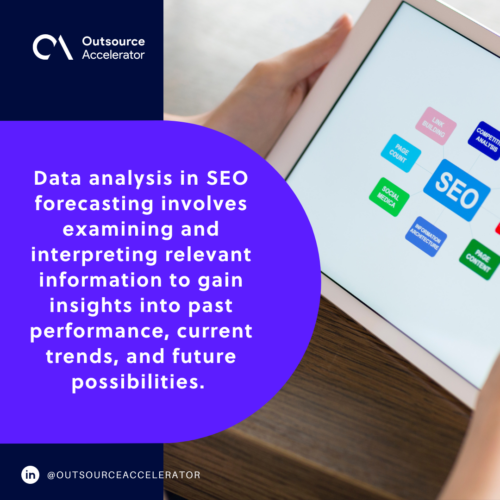
Data analysis reveals what works and what does not. It means you examine and interpret key info to learn about past results, current trends, and future odds.
After that, you can start the actual forecasting of future trends. As a result, you make smart choices about where to send your time, energy, and budget next.
Benefits of SEO forecasting
Effective SEO forecasting gives you the advantages below.
Improved decision-making
The main benefit is better decisions. With data on your site’s performance, you can make smarter calls about your marketing plan.
It also helps you set realistic goals and decide how much to spend on rankings. So it is a big help when you work with limited resources.
Effective resource allocation
It is easy to focus when you have one site and one budget. However, with many sites and products, it gets much harder. So SEO forecasting helps you decide where to focus for the biggest payoff. Some firms use white label SEO tools to stretch their resources even further.
Identifying growth opportunities
SEO forecasting helps you spot growth openings, such as new markets, products, and services. It also shows how these new offers may affect your business model.
For example, say you plan to launch a new product soon. Then forecasting can show which keywords you may rank for. As a result, it helps you pick the tactics that reach the top spot.
Mitigating risks and adapting to changes
SEO forecasting is also vital for managing risk. So it lets you see issues early, then prepare and limit their impact. Because of this, you can adapt faster than your rivals and protect your business.
Achieving long-term SEO goals
Good SEO forecasting helps you set realistic goals for growth. It gives you a clear roadmap to make the right changes. As a result, you can see where your business is headed and match your efforts to the market.
Frequently asked questions
What is SEO forecasting in simple terms?
It is a way to predict your future search traffic and rankings. It uses past data, trends, and tools to make smart guesses. So it helps you plan ahead with more confidence.
Is SEO forecasting accurate?
It is not an exact science. However, it gives a solid read on likely trends. As a result, it guides better choices even without firm promises.
Which metrics matter most in SEO forecasting?
Track organic traffic, keyword rankings, backlinks, and bounce rate. Together, they show your health and direction. So they form a strong base for any forecast.
What tools help with SEO forecasting?
Popular options include Google Analytics, Ahrefs, Moz, and Semrush. They track traffic, keywords, and links. Many predictive analytics tools also add deeper insight.
Why is SEO forecasting important for business?
It helps you spend your budget where it works best. It also flags risks before they grow. In short, it supports steady, long-term growth.
Key takeaways
- SEO forecasting predicts future search traffic and rankings from data and trends.
- Common methods include keyword tracking, analytics analysis, and competitor research.
- Track organic traffic, keyword rankings, backlinks, and bounce rate.
- Good data collection and analysis drive accurate forecasts.
- It improves decisions, resource use, and long-term SEO growth.






 Independent





