
Building a real estate business: All you need to know


How do you build a successful real estate business?
You build a real estate business by choosing a focus, using the right tools and team, and planning carefully for a market that shifts often.
- A real estate business buys, sells, manages, or invests in property.
- It spans development, sales, brokerage, and property management.
- Many firms now use global teams to keep costs low and scale up.
More tourists, expats, and investors keep pushing demand for property. As a result, the real estate industry stays busy and strong.
Real estate is also a key driver of the economy. For example, the Australian real estate sector generated $50.8 billion in revenue in 2021, and the market has kept growing since.
It is not a steady market, though. There can be challenges from higher interest rates and pricey properties. Still, the Australian market has shown real resilience.
“Australia is probably the most popular in the property management space. So [are] investment management of residential properties, shops, commercial, that type of thing,” said Stephen Atcheler, CEO of ShoreAgents, on the 436th episode of the Outsource Accelerator podcast.
“We do real estate businesses, we started with me in traditional kind of offices in Australia,” he added. ShoreAgents also offers virtual real estate help and outsourcing services. So here is what you need to know before you enter the sector.
What is a real estate business?
A real estate business is a company that buys, sells, manages, or invests in property.
Building a real estate business is challenging. However, with good planning and the right tools to manage the team, the effort pays off.
It also helps to use updated real estate tools. As a result, daily work gets quicker and more efficient.
4 types of real estate
According to The Balance article, real estate covers land, buildings, air rights above the land, and rights below the ground.
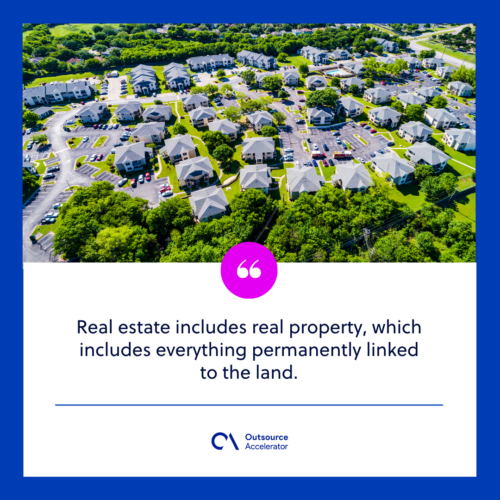
Real estate also includes real property, which is everything permanently linked to the land. So it differs from personal property, such as cars, jewelry, and farm gear. Here are the four main types.
1. Residential real estate
Residential real estate covers new and resale homes. Single-family homes are the most common type.
Other residential properties include the following:
- Condominiums
- Co-ops
- Townhouses
- Triple deckers
- High-value homes
- Vacation
- Multi-generational homes
2. Commercial real estate
This type covers offices, hotels, malls, shops, and medical and school facilities. Apartments count as residential, but many see them as commercial too. That is because owners hold them to earn income.
3. Industrial real estate
Industrial real estate serves many uses. For example, it supports manufacturing, distribution, and storage of goods.
However, as noted, buildings used to distribute goods and earn income count as commercial real estate.
4. Land real estate
This type breaks into subgroups. For example, it can be undeveloped land, early development, or subdivisions.
How does the real estate business work?
As noted, starting a real estate business takes a lot of work. “Whether it be residential real estate, property management, it doesn’t really matter, it’s all the same, you’ve got to be ready,” Stephen said.
“You got to understand what your requirements are, what your responsibilities are, [and] how to manage your team,” the ShoreAgents CEO added. So here are the six areas in which the business operates.
Development
This area covers buying raw land, rezoning, building, and refurbishing. It also covers selling or leasing the final product to end users.
Developers add value by improving or rezoning the property. In return, they take on the risk of funding the project.
Development firms create new stock, known as the “primary market.” So this is where fresh inventory comes from. Growing firms often add capacity through real estate staffing support.
Sales and marketing
Sales and marketing teams help developers sell the units they build.
As a real estate business, the ShoreAgents CEO noted that they “generally deal with the business owners that have teams of salespeople.”
In return, the business earns fees for creating marketing materials and using salespeople to sell finished units. Implementing advanced tools such as CRM tools for real estate is a common practice, empowering businesses to effectively manage customer relationships and optimize their sales and marketing strategies for increased efficiency.
Brokerage
A real estate brokerage employs a team of agents or realtors. So they help arrange deals between buyers and sellers.
Property management
Property management firms help owners rent out their units. Their duties include:
- Collecting rent
- Exhibiting flats
- Repairing flaws
- Supervising tenants
In addition, owners pay a fee, often a set share of the rent. Many owners now hire a property management virtual assistant to handle these tasks.
Professional services
Here are the professionals who serve the real estate sector and add to its success:
- Accountants
- Attorneys
- Interior designers
- Stagers
- General contractors
- Construction workers
- Craftsmen
Some agents also handle legal documentation software for property deals. In addition, many teams bring on a real estate VA to keep the paperwork moving.
Outsourcing in the real estate industry
Stephen is sure that outsourcing in the real estate industry is “going to become more and more popular that almost every real estate business will have a global team.”
A solid plan and having the right team “[who’s] a little more green to the real estate industry itself” will help you start well. Many owners also lean on real estate outsourcing to grow without heavy overhead.
Keeping your team motivated also matters. As a result, you can reach your goals and secure your financial future.
Do you want to know more about how a real estate business can help you succeed? Then connect with Stephen Atcheler on LinkedIn.
Or head over to their official website and listen to episode 436 of the OA podcast here.
Frequently asked questions
What is a real estate business?
A real estate business buys, sells, manages, or invests in property. It can focus on homes, offices, industrial sites, or land. So the scope depends on the owner’s chosen niche.
What are the main types of real estate?
The four main types are residential, commercial, industrial, and land. Each type serves a different use and buyer. As a result, many firms pick one or two to focus on.
How do you start a real estate business?
Start with a clear focus, a good plan, and the right tools. Then build a skilled team to run daily work. So readiness and strong management drive early success.
Why do real estate firms outsource?
Outsourcing cuts overhead and adds skilled support fast. For example, firms hire virtual assistants for admin and marketing tasks. As a result, owners can scale without a big local team.
What roles can a real estate business outsource?
Firms often outsource admin, data entry, marketing, and property management support. A real estate consultant can also guide strategy. So owners keep control while experts handle the load.
Key takeaways
- A real estate business buys, sells, manages, or invests in property.
- The four main types are residential, commercial, industrial, and land.
- The sector runs on development, sales, brokerage, and property management.
- Good planning, the right tools, and a strong team drive success.
- Outsourcing helps firms cut costs and build global teams.






 Independent





