
Outsource network support the right way in 2026


What is network outsourcing and why do companies use it?
Network outsourcing means hiring a third-party BPO to run your IT network tasks, from setup and security to daily support.
- It gives you expert IT skills without a large in-house team.
- It cuts costs, with savings that can reach up to 70%.
- It frees your staff to focus on core, revenue-driving work.
Modern IT firms focus on building their internal processes. In today’s market, growth means holding a real edge over rivals. However, most IT firms cannot do their best alone. Complex tasks pile up fast. Many companies simply lack deep, specialized back-office skills.
So support becomes necessary. This is where outsource network services come in. IT firms worldwide have found that third-party support is an advantageous path. In fact, it opens a clear route to growth at home and abroad.
Outsource network support and services
Many companies lack the in-house skills for certain tasks. With outsourcing firms around, though, they have a choice. They can solve staffing and other problems with these external teams, or handle it all alone.
In-house administration means skipping the chance to outsource network services. Firms that pick this path build and run everything themselves. As a result, this can lead to heavy workloads. Staff must then support and do everything on their own. So firms with a traditional mindset often get overloaded and slowed down.

Defining the outsource network support niche
In-house administration can be costly, slow, and hard. By nature, admin tasks eat up a lot of managerial time. Firms that rely on in-house admin often lose agility. They struggle to keep up with changing market and regulatory needs. As a result, they get distracted from their main goals. A strong IT infrastructure plan helps avoid this trap.
Why do we outsource network support and services?
These firms often have little funding, room, or time to face tough competition. On top of that, focusing on innovation gets hard. Analysts point to several risks that plague IT firms:
- Their computer systems may lack the space and power to run supercomputers.
- Firewalls that guard web browsing, email, and apps can cause packet losses in TCP/IP networks. This can slow networks and cost important data. Weak routers and switches make these losses worse.
- In-house IT network support makes it hard to simplify tasks like automation and virtualization. Outsourcing, by contrast, gives the department room to grow fast. These processes matter for handling the large data sets we see today.
- Data storage problems arise when systems are too small or missing. Good storage supports many apps, and cloud storage now matters more than ever.
- Sorting quality data from huge data groups is also tough. Many firms cannot spot patterns on their own. In addition, they may lack the staff to review data and make sound calls.
Finally, reliable network connections are a must for any digital business. Managers may struggle with IT infrastructure on their own. They may need the newest network design and software techniques for data. Because of these gaps, business process outsourcing (BPO) took hold. A good network management service can close many of them.
Outsource network support the right way
These providers exist to deliver a wide range of support. BPOs handle work that is not “core” to a firm. These are back-office tasks, or jobs that do not face clients. Today’s firms usually outsource activities like:
- Marketing
- Information technology (IT)
- Design services
- Customer support
- Sales
In addition, firms contract out human resources, manufacturing, accounting, payroll, finance, transport, logistics, and security.
Benefits of having to outsource network support and other jobs
Companies keep going digital and moving to cloud-based models. So outsourcing firms help them adopt these advances. Owners and managers have found that external teams often work faster and better. This comes down to their focused skills.

Because of this, more firms use BPO companies for projects that need special skills. Security also improves when you weigh the role of cybersecurity in outsourcing. Here are 12 advantages of outsourcing network support jobs:
- Up to 70% savings
- Tech Support Agents
- English Proficient
- Network System Experts
- PBX Setup Specialists
- Remote Network Specialists
- Warranty and Returns Handling
- Desktop and Application Support
- Cloud Network Setup
- B2B Tech Support Agents
- System Administrators
- Installation and Troubleshooting Agents
- Site Hosting Experts
Information technology jobs that are well-handled by BPO providers
Outsourcing firms help with a wide range of support tasks. Here are 12 jobs that BPO companies offer to clients.
1. Site hosting specialist
IT firms need to share files to one or more websites. They also need a fast internet link. So site hosting specialists step in. Also called web hosting specialists, they help customers with many issues. For example, they upload client files through a web interface or FTP.
They also help with software settings and website migration. Good candidates know web-hosting platforms and tools like Joomla and WordPress. Finally, strong people skills help them relate to clients.
2. PBX management specialist
A Private Branch eXchange or (PBX) is a corporate phone system. It offers voice mail, many phone lines, call management, and call routing. This hardware handles switching and routing of calls between the phone network and a business.
IT firms may need PBX management specialists to run this system. They receive incoming calls and route each one to the right person or department. In addition, they answer basic queries about contact numbers, directions, and hours.
Like phone operators, they work with fast automated systems. Call center and customer service experience help them qualify. In addition, they need some knowledge of information technology. On top of that, they should know how modern PBX or circuit boards work.
3. Computer programmer
Computer programmers debug and code programs. They solve issues by designing logical structures. They are skilled in languages like Java, C, PHP, and C++. As architects or developers create program designs, programmers turn them into instructions a computer can follow.
These pros may work with experts from many fields to build software. For example, they can create desktop publishing tools or video game software. Using programming editors, they write source code for testing, coding, and debugging.
4. Installation support agent
Customers may need help installing a software app. In addition, buyers of new systems may need help with new hardware. So installation support agents step in. They usually work in BPO firms. They are trained to provide software support and setup.
These agents install systems and software on a customer’s site or computer. They also configure systems integration and software links. In addition, they need strong analytical and problem-solving skills. Given these skills, they may even supervise computer programmers.
5. Remote network specialist
When users need fast help, they can reach a remote network specialist.
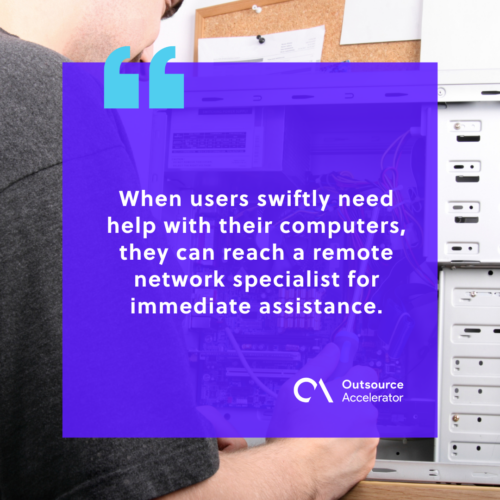
Reachable through live-chat support, phone, or email, these pros can control a device from anywhere. They use a remote access app installed on both computers. Then they connect to the customer’s device and fix problems. One example is TeamViewer, built by a German tech firm. It also offers desktop sharing, guest access, and file transfer.
These specialists may ask for full control of the device. After that, the technician can open files or run apps to fix the issue.
6. Office network specialist
Modern companies rely on their networks to stay connected. So office IT network support specialists play a vital role. They keep the network running smoothly. They configure network security, local area networks, and routers. They also know systems integration, security, and network management.
In addition, they troubleshoot and maintain networks. They spot problems early, do routine upkeep, and help users. Overall, they ward off threats that could bring the network down.
7. Warranty and returns agent
Customers may not be happy with a product or service. In addition, they may have questions about the warranty period. So a warranty and returns agent handles these concerns. This person may work in an outsourcing firm. They answer phone, live-chat, and email inquiries. Their main job is to process and respond to product returns.
These agents learn the specs of the products and services they support. As a result, they act fast on product and service issues. This helps make sure customers get 100 percent satisfaction from their transactions.
8. Desktop and application support agent
Complex issues hit computer and mobile users at home and at work. For example, viruses, app setup, and system errors can occur anytime. So users may need help at any hour. Desktop and application support agents step in with strong diagnostic skills.
They help customers fix common programming and network security problems. As a result, business processes keep running. They often know software engineering and database management. In addition, they have strong IT, problem-solving, and multitasking skills.
9. System administrator
System administrators keep computer systems running at their best. They maintain configuration and upkeep across a broad scope. So they make sure support systems and IT services run smoothly. In large firms, they manage the systems that support servers. You can read more about the system administrator role and its skills.
They can support almost everything. This includes a firm’s LAN, WLAN, cloud storage, VoIP phone system, or a user’s desktop. In addition, they need to know programming, scripting, and many operating systems. Today, they also need cloud computing and virtualization skills.
10. Cloud network specialist
E-commerce is now everywhere. So people transact through the “cloud,” or the wider internet. The term “cloud” can also mean online services known as cloud computing. Given this, cloud network specialists have become key go-to people. You can learn the basics in this guide to cloud computing.
They need strong tech knowledge and sharp analytical skills. They help firms move physical IT work, like on-site servers, to the cloud. As a result, they build and maintain secure virtual environments. They also help firms pick the right cloud technology.
11. B2B technical support agent
Business-to-business, or B2B, involves firms that serve other firms. These are partnerships that B2B technical support agents help run smoothly.
In the B2B setup, client firms are vital lifelines, and profits matter. So B2B agents speak with both individual clients and whole organizations.

They are trained to be detail-oriented to prevent costly mishaps. They also know the products and services one firm offers another. So they handle complex, technical issues with ease. In addition, they treat clients as business partners, not just customers.
12. Technical support engineer
IT problems bother customers all the time. So they always need a pro to fix their concerns. Technical support engineers diagnose software and hardware problems. Skilled in troubleshooting and setup, they work on many programs and apps.
Using chat and email, they address network issues. They may also use remote desktop apps for instant fixes. In addition, they can configure operating systems fast. Most hold degrees in IT or software engineering. Certifications in Linux, Cisco, and Microsoft are pluses. This role connects closely to broad technical support.
Network outsourcing can lead to strong operational best practices. Outsourcing firms act as catalysts. They help client firms gain an edge and perform at their best. This comes from the natural division of labor in any business.
BPO firms also help modern companies focus on their core work. Moreover, they become an extension of the client’s team. As a result, they are now a key part of nearly every IT business worldwide.
Frequently asked questions
What is network outsourcing?
Network outsourcing means hiring a third-party firm to run your IT network tasks. This covers setup, security, monitoring, and daily support.
How much can network outsourcing save?
Savings vary by provider and location. Still, many firms report savings of up to 70% versus a full in-house team.
Which IT jobs can you outsource?
You can outsource many roles. For example, these include system administrators, cloud network specialists, and technical support engineers.
Is offshore network outsourcing secure?
Yes, when you pick a trusted partner. Good providers follow strong security practices and keep clear communication with your team.
Key takeaways
- Network outsourcing gives you expert IT support without a large in-house team.
- It can cut costs sharply, with savings of up to 70%.
- BPO providers cover roles from PBX and cloud to system admin and B2B support.
- Outsourcing frees your staff to focus on core, high-value work.
- A trusted partner keeps your network secure and running smoothly.






 Independent





