
What healthcare businesses are really prioritizing in 2026 (beyond patient care)


This article is a submission by VirtualStaff.ph, a structured offshore staffing platform that helps businesses increase team capacity without increasing fixed payroll costs. VirtualStaff supplies dedicated staff in the Philippines who plug directly into your business operations, while they handle all the structure and support behind the scenes. It is designed for companies that want a simple, predictable way to scale their team.
Healthcare businesses in 2026 are under pressure from every direction.
Patient demand is rising. Billing is getting more complicated. Admin keeps stacking up. And local hiring is slower and more expensive than it used to be.
For many healthcare operators, the problem is no longer just delivering care.
It is keeping the business running without the entire team getting overwhelmed.
That pressure is changing how healthcare businesses think about growth.
Instead of asking:
“How do we hire more people locally?”
They are asking:
“How do we handle more work without breaking the business?”
That shift is pushing more healthcare groups toward structured offshore staffing models that help them add capacity without adding chaos.
And increasingly, some are looking at models like VirtualStaff.ph.
The real bottleneck in healthcare right now
Most healthcare businesses do not struggle because they lack patients.
They struggle because everything behind patient care starts falling behind.
Claims pile up. Billing slows down. Admin backlogs grow. Front desk teams stay stuck in catch-up mode.
It shows up in practical ways every day:
- Insurance verification takes too long
- Patient calls are missed
- Claims processing falls behind
- Scheduling becomes messy
- Staff burn out trying to keep up
None of these issues are small.
Because when the back office struggles, the entire business feels it.
Patients get frustrated. Revenue slows down. Internal pressure builds.
That is why healthcare operators are focusing heavily on the operational side of the business in 2026, not just the clinical side.
The big shift: More capacity without more payroll pressure
For years, the default answer was simple: Hire more local staff.
But that model is becoming harder to sustain.
Healthcare businesses across the US are dealing with:
- Rising payroll costs
- Hiring delays
- Staff shortages
- Increasing overhead
At the same time, the workload keeps growing.
More patients.
More admin.
More billing.
More follow-up work.
So the conversation is changing.
Healthcare operators are not necessarily looking for “outsourcing.”
And they are definitely not looking for random freelancers or disconnected support.
What they want is simpler than that.
They want:
- More claims processed
- More admin handled
- More patient support coverage
- More work getting done consistently
Without adding another layer of stress to the business.
That is the real driver behind the shift toward structured offshore staffing.
The work that keeps falling behind
Ask almost any healthcare operator where the pressure builds first, and the answer is usually the same:
The back office.
Not because the work is unimportant.
Because there is simply too much of it.
Tasks like:
- Medical billing
- Coding support
- Insurance verification
- Appointment scheduling
- Patient coordination
- Records management
- Claims follow-up
All require constant attention.
And when those tasks fall behind, the business slows down with them.
That is why more healthcare firms are building dedicated support teams around these areas instead of expecting already-stretched local teams to absorb everything.
Common support roles include:
- Medical billing support
- Patient support representatives
- Scheduling coordinators
- Admin support staff
- Operations support
- Bookkeeping and accounting support
- Customer support staff
These are the kinds of roles healthcare businesses increasingly need to keep operations moving consistently.
Why healthcare businesses are moving away from “outsourcing chaos”
A lot of healthcare operators already know offshore staffing exists.
The problem is that many associate it with:
- Freelancers
- Communication problems
- Low visibility
- Inconsistent work
- Disconnected teams
That is the baggage attached to the category.
And in healthcare, that kind of chaos creates risk fast.
Healthcare businesses need:
- Control
- Consistency
- Reliability
- Visibility into daily work
That is why the model itself matters.
The shift now is toward staff who plug directly into the business instead of sitting outside it.
In practice, that means support staff who:
- Work inside the company’s systems
- Follow the company’s processes
- Communicate directly with the internal team
- Become part of day-to-day operations
That structure is what many healthcare businesses are actually looking for now.
Not outsourced tasks.
Integrated support capacity.
Where VirtualStaff.ph fits in
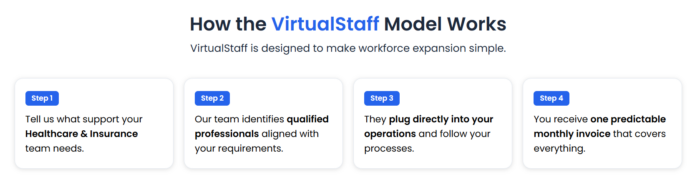
This is where some healthcare businesses are starting to explore models like VirtualStaff.ph.
VirtualStaff.ph is used by businesses that need more operational capacity but do not want the complexity that usually comes with scaling.
Instead of functioning like a freelance marketplace or gig platform, the model is built around adding dedicated support staff directly into a company’s operations.
Healthcare businesses commonly use VirtualStaff.ph for roles such as:
- Medical billing support
- Customer support
- Patient coordination
- Admin support
- Bookkeeping
- Operations support
The setup is intentionally simple:
The healthcare business manages the day-to-day work.
The staff plug directly into the business.
VirtualStaff.ph handles the structure behind the scenes while the business receives one predictable monthly invoice.
That predictability matters in healthcare, where unexpected staffing costs and operational disruptions can create serious pressure.
Why many healthcare businesses start small
One thing that stands out with this model is that most businesses do not start with a huge offshore team.
They usually begin with a few healthcare support staff.
Maybe:
- Two billing support staff
- A patient coordinator
- An admin assistant
Then they build from there.
That gradual approach matters because it allows the business to:
- Stay in control
- Test workflows
- Reduce pressure quickly
- Scale at a manageable pace
As systems improve and confidence grows, businesses often expand one role at a time.
For many healthcare operators, this feels far more realistic than trying to solve everything with aggressive local hiring.
A real-world example of how this looks
Imagine a growing healthcare group in Florida.
Patient demand is increasing, but internally the team is overloaded.
Claims are starting to stack up.
Billing follow-ups are delayed.
The front desk spends most of the day catching up.
Hiring locally would mean:
- Higher payroll
- Longer hiring cycles
- More overhead
- More management pressure
So instead, the business adds a few dedicated offshore support staff focused on:
- Billing support
- Patient coordination
- Admin processing
Those staff work directly inside the company’s systems and workflows.
Over time:
- Billing turnaround improves
- Admin backlog shrinks
- Patient communication becomes more consistent
- The internal team gets breathing room again
Then the business adds more support staff as needed.
Not all at once.
One role at a time.
That is increasingly how healthcare operators are scaling now.
Healthcare growth is becoming more operations-driven
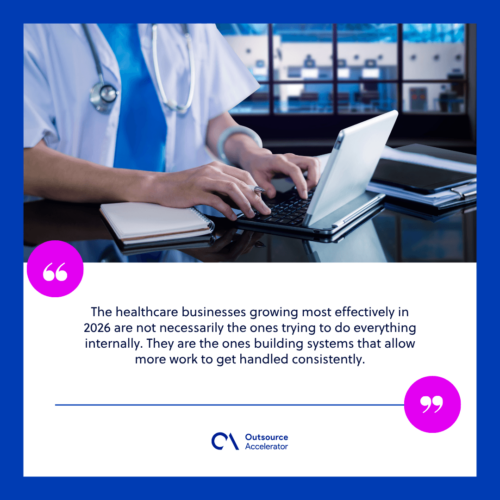
The healthcare businesses growing most effectively in 2026 are not necessarily the ones trying to do everything internally.
They are the ones building systems that allow more work to get handled consistently.
That includes:
- Billing
- Patient communication
- Records management
- Admin coordination
- Operational support
Because patient care may drive the business.
But the back office is what keeps it moving.
And for many healthcare operators, the real challenge now is not demand.
It is handling that demand without exhausting the team or creating operational chaos.
The path forward for healthcare operations
Healthcare businesses are under more operational pressure than ever.
Not because they lack patients.
Because there is more work happening around patient care than most teams can comfortably absorb.
Billing.
Admin.
Scheduling.
Claims.
Patient support.
All of it has to keep moving every single day.
That is why more healthcare operators are rethinking how they build their teams.
Not to chase cheap labor.
Not to outsource blindly.
But to add reliable support capacity in a way that keeps the business stable, organized, and in control.
Models like VirtualStaff.ph are gaining attention because they align with what healthcare businesses actually want right now:
More work handled.
Less pressure internally.
Steady growth without added complexity.






 Independent





