
Freelancing statistics: Uncovering fresh insights on the gig economy


What do the latest freelancing statistics show?
The latest freelancing statistics show that freelancing is now a core part of the global workforce, not a passing side trend.
- Close to half of the global workforce now does some freelance work.
- The freelance market is worth over $1 trillion, and it keeps growing fast.
- Younger workers, in particular, are driving the shift.
More workers are moving into freelancing, and the freelancing statistics behind this trend are striking. Many full-time employees now freelance for better work-life balance or better pay. As a result, years of layoffs and resignations have pushed the industry to grow even faster.
According to studies, almost half of the global workforce are freelancers, or about 1.57 billion people. Meanwhile, more businesses hire freelancers for short-term and project-based work.
This is a huge shift away from the traditional 9 to 5 job. So this article explores the key freelancing statistics and how they shape the future of work.
Freelancing statistics at a glance
“Around 1.57 billion people around the world are freelancers.”
– Source: International Labour Organization
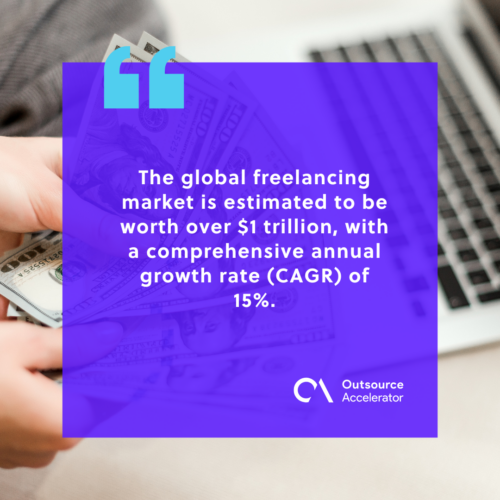
“The global freelancing market is estimated to be worth over $1 trillion, with a comprehensive annual growth rate (CAGR) of 15%.”
– Source: Orbis Research
“73% of workers in the US alone want to either start freelancing or continue their freelance work.”
– Source: Fiverr
“There are around 26.9 million freelancers in Europe.”
– Source: Statista
“60% of Asian freelancers engage in traditional work on a per-project or contract basis with employers.”
– Source: Payoneer
“Accounting is one of the most sought-out skills (45%) among freelancers today.”
– Source: Upwork
“The demand for freelance designers is projected to grow much faster than average.”
-Source: US Bureau of Labor Statistics
“50% of Gen Z respondents in the US alone participate in freelancing, while 44% are millennials.”
– Source: Statista
“More than 50% of freelancers in the US are female.”
– Source: Zippia
“The website Freelancer.com has as many as 800,000 registered Filipino users.”
-Source: Outsource Accelerator
An overview of global freelancing
The global freelancing market is worth over $1 trillion. It also grows at a compound annual growth rate (CAGR) of about 15%. Most freelancers come from the United States, India, Brazil, and the United Kingdom.
A few clear factors drive this growth. Here are the main ones.
- The rise of the gig economy. It made it easier to find freelance work through online platforms. In fact, many workers now compare the best gig economy platforms before they start.
- The demand for special skills. After waves of resignations, businesses turned to freelancers to fill skill gaps and staff projects.
- The need for cost-effective help. With global inflation, many firms look for cheaper ways to run their work. So they hire freelancers.
Freelancing statistics you need to know
Demand for freelancers keeps growing. So it helps to know the current state of the industry. Here are some of the freelancing statistics and insights everyone should know.
Global freelancing statistics: Regional differences in freelancing
Freelancing looks different from one region to the next. These gaps come from many factors. For example, they include the tools freelancers use, the cost of living, and local views on freelancing.
The Americas
Freelancing is rising in both North and South America. Still, the two regions differ in demand and pay.
In North America, demand for freelance work is higher. Also, the jobs tend to be more specialized and better paid. Recent data from Fiverr found that 73% of US workers want to start or keep freelancing.
Canada works a bit differently. There, freelancers often need work permits and certifications for their field and role.
Meanwhile, South America’s freelance roles are more general and lower paid. As a result, this is a good chance for firms to try nearshoring short-term projects at lower cost.
Europe
Freelancing in Europe is also on the rise. However, personal choice drives it more than money worries. Freelancers there count as self-employed residents.
Based on reports by Statista, there are around 26.9 million freelancers in Europe. In addition, more European firms and workers now see freelancing as part of the new ways of work.
Asia
Freelancing in Asia keeps growing as the region builds up its digital economy. Alongside outsourcing, freelancing gives businesses another way to hire. Most Asian freelancers come from India and the Philippines.
Payoneer released a report on the Philippine freelance market with local FinTech firm GCash. It found that 60% of freelancers do traditional per-project or contract work. Meanwhile, 35% now focus more on content creation.
India has one of the highest freelance workforces in the world, next to the US. It has over 15 million freelancers. Its strength in infrastructure and tech roles makes it a strong base for freelance work. This growth also feeds a wave of digital nomad jobs across the region.
Freelancing by industry: the most in-demand roles
Per the latest data by Upwork, the top roles sit in technology, marketing, customer service, accounting, and creative work. If you weigh your options, this guide on freelancers versus outsourcing agencies can help you decide.
Technology
Demand for developers and designers keeps rising. So the tech sector stays hot for freelance work. Per a recent survey, demand for software developers is set to grow much faster than most jobs.
Marketing
Marketing is also in strong demand. This is due to the need for digital marketing pros, such as SEO specialists, content writers, and social media managers. Even with AI-generated content, firms still want people to check and manage that work.
Customer service
Hiring freelance customer service reps is a smart way to help customers without the cost of full-time employees. You can hire them per project. As a result, you can scale support up or down as needed. Another option is to hire a virtual customer support assistant to run these tasks.
Accounting
Freelance accountants are in high demand. They offer a cost-effective way to get special accounting help. For example, they handle bookkeeping, tax prep, financial analysis, and consulting. In addition, accounting is one of the most sought-out skills (45%) among freelancers, per a survey by Upwork.
Creative
The creative field stays popular with both freelancers and clients. Like in tech, the demand for designers is set to grow faster than most roles. With social media and content everywhere, video editors and videographers may see demand spike worldwide.

Benefits of freelancing
Recent findings show that many workers no longer feel a traditional job “is a safe bet anymore.” In fact, 68% of independent workers felt more secure working on their own. These independent workers include the:
- Freelance workforce
- Independent contractors from various platforms
- Self-employed people who started their own businesses
Freelancing offers real perks. For example, you can work from anywhere, pick your own hours, and often earn more than a regular job. Here are the main benefits freelancers enjoy.
Flexibility
Flexibility is a top reason people choose freelancing. Workers can work from anywhere. So they skip the commute and stay close to family. The rise of remote setups helps too, as the latest work-from-home statistics make clear.
Increased income
Freelancing also helps people earn more, whether full-time or part-time. In fact, around 45% of US workers have side gigs for extra income. As a result, many use freelancing to stay ahead of inflation.
Professional development
More platforms now invest in freelancer success. Because of this, freelancers can use one platform to manage work, track progress, and build skills.
Other benefits for employers
Freelancing does not just help workers. Employers gain too, in these ways.
- Cost savings. Firms save by hiring freelancers, especially from lower-cost countries like the Philippines, India, and Latin America.
- On-demand help. Clients hire freelancers based on the workload they need to hand off.
- Wide range of skills. More skilled, educated workers now freelance. So employers can tap a broad mix of talent with more flexibility.
How the freelancing statistics reflect the future of freelancing
The freelancing statistics show that freelancing is on the rise and here to stay. So this trend will likely continue as more people learn its benefits. Many also weigh the choice between a virtual assistant and a freelancer before they hire.
However, the gig economy is only one of the new ways of work. It has drawbacks too. For example, most freelancers do not get the same benefits as full-time staff. Quality can also vary. Because of this, many businesses outsource work to BPOs or small firms for steadier support.
Frequently asked questions about freelancing statistics
How many freelancers are there in the world?
Studies suggest that close to half of the global workforce does freelance work. That points to well over a billion people. Still, exact counts vary because each report defines freelancing in its own way.
How big is the global freelance market?
Reports put the global freelance market at over $1 trillion. It also grows at a compound annual growth rate of about 15%. So it remains one of the fastest-growing parts of the labor market.
Which industries hire the most freelancers?
Technology, marketing, customer service, accounting, and creative work lead the way. Demand for developers and designers is especially strong. As a result, skilled freelancers in these fields rarely run short of work.
Is freelancing better than outsourcing to a BPO?
It depends on your needs. Freelancing works well for short, flexible tasks. Meanwhile, a BPO gives steadier quality, backup staff, and stronger support for ongoing work.
Key takeaways
- Freelancing is now a core part of the global workforce, not a side trend.
- The market is worth over $1 trillion and grows at about 15% each year.
- Tech, marketing, customer service, accounting, and creative roles see the most demand.
- Younger workers, plus a wish for flexibility and higher pay, drive the shift.
- For steady, ongoing work, many firms still prefer a BPO over solo freelancers.






 Independent





