
Demand economy: How it’s changing the way we do business


Consumers and businesses both want to spend smarter. So many now focus on what people truly need and want. They no longer push a fixed supply. The demand economy is built on that idea.
This guide explains what the demand economy is. In addition, it shows how your business can use its potential.
What is the demand economy?
The demand economy is an economic model that shapes products and services around what consumers need and want, and delivers them right when they are wanted.
It is also called the on-demand economy or access economy. In short, businesses must stay alert and respond fast to changing customer needs.
- It puts consumer demand first, not fixed supply.
- It relies on technology platforms that connect people fast.
- It rewards speed, flexibility, and a smooth customer experience.
Key characteristics of the demand economy
The demand economy rests on a few key traits. Here are the main ones.
Flexibility and convenience
Flexibility and convenience matter most here. Modern consumers want fast access to products and services. They also expect flexible delivery options. On top of that, they want offers shaped around their own schedule. As a result, a frictionless experience is now a must.
Peer-to-peer (P2P) interactions
The demand economy also enables P2P interactions. In this setup, one person can be both a buyer and a seller. Because of this, people share resources and use them more wisely.
Personalization
Personalization is another key part. Businesses collect and study data to learn how customers behave. Then they use those insights to tailor products and services. So each offer feels more relevant to the buyer.
Technology-driven platforms
Technology platforms drive the whole model. They link consumers and providers in seconds. Meanwhile, they act as the middle layer for each deal. As a result, transactions and user experiences stay smooth.
Demand economy vs. Traditional supply-side economics
So how does the demand economy compare to old supply-side economics? The gap is clear. The demand economy starts with consumer preferences. Traditional supply-side economics starts with production, ownership, and business-to-consumer sales.
Supply-side theory says growth comes from making more goods and services. The demand economy sees it another way. It says a better economy makes and delivers things only when people need or want them.
How the demand economy is changing business
The demand economy is reshaping business in several ways. First, it pushes companies to be more customer-centric. Firms that meet needs fast tend to win.
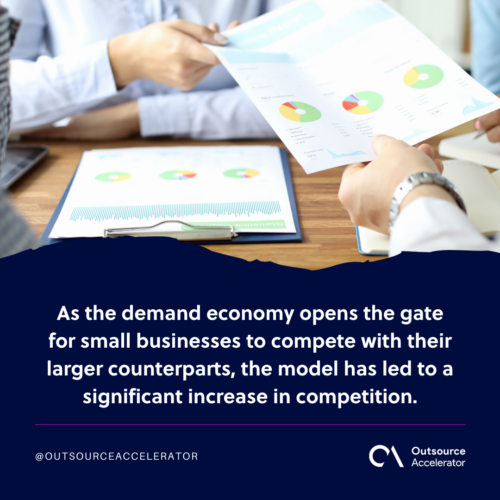
Next, it helps small firms take on bigger ones. In fact, it gives small businesses a fair shot when they offer something unique. Because of this, size matters less than speed and value.
Finally, it is changing how people work. The rise of the gig economy has opened many doors for freelance workers. Now they can serve businesses on a project-by-project basis. Many even build a full career through freelancing.
Examples of businesses that use the demand economy model
Many companies now run on the demand economy model. Here are some clear examples.
- Uber and Lyft – these ride-sharing apps offer on-demand transport. They connect passengers with nearby drivers in minutes.
- Airbnb – its platform lets travelers rent homes or spare rooms. So they find affordable stays with ease.
- Postmates – this delivery service brings food, groceries, and other items to your door. As a result, errands take far less time.
- TaskRabbit – this marketplace pairs users with local skilled workers for tasks and errands.
- WeWork – this company offers shared workspaces. So freelancers, startups, and remote workers get flexible offices on demand.
Benefits of the demand economy
The demand economy brings real gains for both sides. Here are the main ones.
Increased efficiency
The model helps businesses cut waste. They make goods and services only when needed. So they save both money and resources.
Greater customer satisfaction
This model centers on what customers want. As a result, businesses can lift sales and customer loyalty. Happy buyers also come back more often. Strong customer experience makes that much easier.
More flexible work arrangements
The gig economy is closely tied to the demand economy. Because of this, more people can work freelance or on contract. Many find steady work through gig economy platforms.
Challenges of the demand economy
The model has limits too. Here are the main challenges.
Troubles in predicting demand
Predicting demand is hard. Customer needs shift all the time. Trends also move fast and must be watched. So businesses must stay agile and read signals early.
Increased competition
The model lets small firms fight bigger rivals. As a result, competition has grown sharply. To stand out, businesses must find a clear point of difference.
Potential for exploitation
The model can also exploit workers. Some firms pay low wages and skip benefits. Because of this, fair treatment must stay a priority.
Harnessing the demand economy’s potential
Here are simple tips to make the most of it.
- Embrace technology platforms. Optimize your assets for mobile, and use data to know your customers better.
- Improve the buyer journey. Build easy interfaces, offer fast support, and keep transactions simple.
- Find complementary businesses. Then form partnerships to reach new customer groups.
- Use data analytics well. It helps you refine offers, set smart prices, and target campaigns.
- Stay ahead of change. Watch trends, invest in new ideas, and keep testing what works.
Frequently asked questions about the demand economy
Is the demand economy the same as the sharing economy?
They overlap, but they are not the same. The sharing economy is about renting or sharing assets that already exist, like a spare room. The demand economy is broader. It covers any model that supplies goods, services, or labor the moment people ask for them.
Which industries benefit most from the demand economy?
Transport, food delivery, travel, and staffing gain the most. Retail and professional services also do well. In general, any sector with variable demand and fast fulfillment tends to thrive here.
How can a small business start selling on demand?
Start small and simple. First, pick one product or service people want quickly. Next, list it on a platform your buyers already use. Then track orders and reviews. Finally, scale up once you see steady demand.
What is the most common mistake in the demand economy?
The biggest mistake is over-committing on supply. Many firms build capacity for demand that never shows up. So it is smarter to test first, watch the data, and grow in steps.
Will the demand economy keep growing?
Most signs point to steady growth. Mobile use, faster delivery, and smarter data all support it. Because of this, more businesses will likely shift toward on-demand models in the coming years.






 Independent





