
How Cybersecurity as a Service protects your business from online threats

What is Cybersecurity as a Service (CaaS), and how does it protect your business?
Cybersecurity as a Service (CaaS) is an outsourced, cloud-based model that protects a business from online threats through constant monitoring, fast response, and expert support.
- It runs in the cloud, so you skip heavy hardware and upfront costs.
- It is proactive, with real-time threat detection and quick response.
- It scales as your business and risks grow.
Technology keeps evolving, and it brings huge chances for businesses to grow. However, it also brings the threat of cyber-attacks and online gaps that can put a company at risk.
Cybersecurity as a Service (CaaS) gives businesses a tailored set of protective measures. As a result, they can stay ahead of cybercriminals.
In this article, we explore what CaaS is, how it works, and why it is now an essential safeguard for firms of all sizes. For a quick primer, review these cybersecurity best practices.
What is Cybersecurity as a Service (CaaS)?
Cybersecurity as a Service (CaaS) is an outsourced way to manage a company’s security needs. It uses cloud technology and outside experts to give ongoing protection against threats.
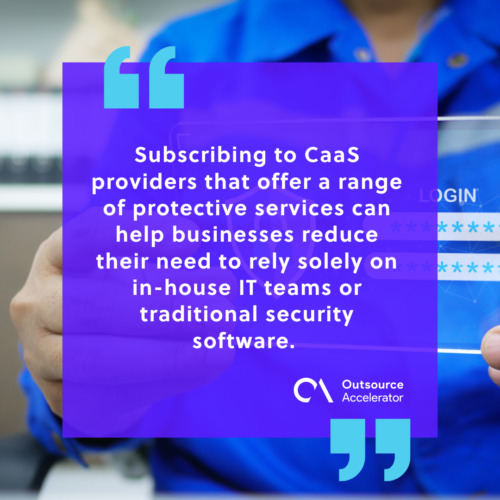
By subscribing to a CaaS provider, businesses lean less on in-house IT teams or old security software. So they gain a wide range of protective services in one plan.
CaaS is flexible and scalable by design. As a result, businesses can tailor their security to their own needs and risks.
This model also keeps companies current with the latest security technologies and practices. Best of all, it does so without a big upfront cost.
By partnering with a CaaS provider, businesses can focus on core work. Meanwhile, experts safeguard their digital assets.
How does CaaS differ from traditional security services?
Cybersecurity as a Service differs from traditional security in a few key ways:
Cloud-based vs. On-premises
Traditional security often relies on on-site hardware and software. As a result, it needs a big upfront spend, steady upkeep, and manual updates.
In contrast, CaaS runs mostly in the cloud. So businesses reach the newest tools without physical infrastructure.
This cloud-based model keeps security current with little effort from the business.
Proactive vs. Reactive
Traditional security tends to be reactive. In other words, it responds to threats after they hit.
CaaS takes a proactive path instead. For example, it offers constant monitoring, real-time detection, and automated responses. As a result, it helps stop attacks before they cause real harm.
Comprehensive service offering
Traditional security may cover only one part, such as firewalls or antivirus. CaaS providers offer far more.
For example, they add threat intelligence, incident response, and compliance help. As a result, this holistic approach protects a business on all fronts, from network security to data privacy.
7 common online threats faced by businesses
Businesses face many online threats that can harm security and operations. In addition, many of these threats keep getting more advanced.
The most common online threats include:
1. Malware
Malware is harmful software built to damage computer systems. It can take many forms, such as:
- Viruses
- Worms
- Spyware
- Trojans
In short, malware can steal data, spy on users, or disrupt work.
2. Phishing
Phishing means posing as a trusted brand to trick people. The goal is to steal sensitive data, such as login or financial details.
These attacks often use fake emails, messages, or websites that look real.
3. Distributed Denial of Service (DDoS) attacks
DDoS attacks flood a website or network with heavy traffic. As a result, the system slows or crashes. This can cause downtime, lost revenue, and a hit to reputation.
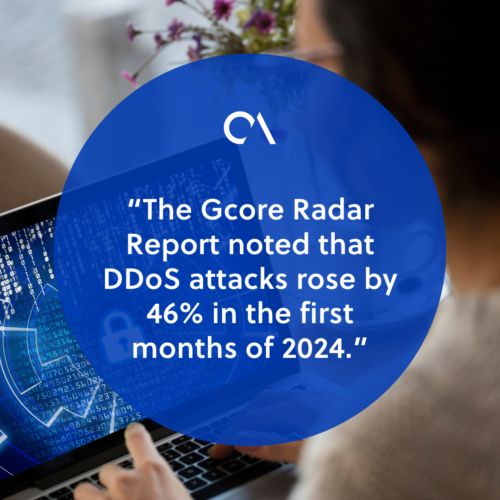
The Gcore Radar Report noted that attacks of this kind rose by 46% in the first half of 2024.
4. Insider threats
Insider threats come from staff, contractors, or partners. Sometimes they act on purpose. Other times, they cause harm by mistake.
For example, they may leak data, misuse access, or open a gap by accident.
5. Zero-day exploits
Zero-day exploits target flaws that the vendor does not yet know about. So there are no patches or fixes ready. Hackers use these flaws to break in without permission.
These attacks can be very dangerous. This is because no immediate defense exists.
6. Social engineering
Social engineering tricks people into sharing private data or taking risky actions. For example, it can involve pretexting, baiting, or impersonation.
7. Man in the Middle (MitM) attacks
MitM attacks involve the intercepting and possible alteration of messages between two parties. As a result, criminals can grab sensitive data, such as login details or payments.
So MitM attacks show why strong measures like Cybersecurity as a Service (CaaS) matter. A layered strong cyber defense reduces this risk.
The role of Cybersecurity as a Service in business protection
Cybersecurity as a Service protects businesses through the cloud. In short, it delivers a suite of security tools and services to guard against online threats.
Here are some ways that CaaS protects businesses online:
Continuous monitoring and real-time threat detection
CaaS providers watch a business’s digital space around the clock. This covers networks, endpoints, and apps. As a result, they can spot suspicious activity in real time.
Automated systems flag odd behavior, such as:
- Unauthorized access attempts
- Known attack patterns
- Unusual data transfers
Then IT security teams can investigate and respond right away.
Incident response and management
When a breach happens, CaaS provides a clear response plan.
First, it finds the scope and impact. Next, it contains the threat and removes the root cause. Finally, it restores the affected system.
CaaS providers often have expert teams on standby. As a result, they mobilize fast to cut downtime and damage.
Data encryption and protection
CaaS keeps sensitive data safe through strong encryption.
Encryption turns data into unreadable code. Only the right key can decode it. So unauthorized parties find it far harder to access.
CaaS also manages encryption for data at rest and in transit. As a result, critical assets stay safe across every channel. Firms often pair this with data security in outsourcing practices.
Vulnerability and patch management
Regular vulnerability checks are a key part of CaaS. These checks find weak spots that criminals could exploit.
Once found, providers deploy patches and updates to fix them. As a result, systems stay secure against known threats. In addition, automated patching cuts human error and keeps protection timely.
Access control and identity management
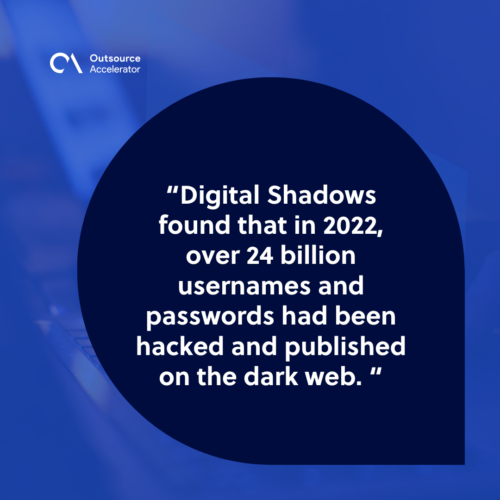
Simple passwords are no longer enough. Digital Shadows found that in 2022, over 24 billion usernames and passwords had been hacked and published on the dark web.
So CaaS enforces strict access controls. As a result, only approved users reach sensitive data and systems. This includes:
- Multi-factor authentication (MFA)
- Role-based access controls (RBAC)
- Identity management solutions
By tightly controlling access, CaaS lowers the risk of insider threats and break-ins. Strong ransomware protection builds on the same controls.
Security awareness training
Human error is a top cause of security incidents. Often, it comes through phishing or accidental leaks.
So CaaS includes security awareness training. These programs teach staff best practices, how to spot threats, and how to respond. In turn, regular sessions help create a culture of security, which lowers the chance of a successful attack.
Benefits of implementing Cybersecurity as a Service
Cybersecurity as a Service brings many benefits for businesses that want stronger protection.
Here is a closer look at these advantages:
Expertise and guidance
Cybersecurity is complex and changes fast. So it takes special skill to stay ahead of threats. CaaS providers employ experts in security, threat intelligence, and incident response.
As a result, Businesses can benefit from protection that is hard to match with in-house resources alone.
Cost-effectiveness
Traditional security needs big spends on hardware, software, and skilled staff. CaaS uses a subscription model instead. So it spreads costs over time and cuts large capital outlays.
Firms pay only for what they need. As a result, CaaS is a more affordable option, especially for small and medium-sized enterprises (SMEs) with tight budgets.
Scalability
Scalability is a major strength of CaaS. As a business grows or its needs shift, CaaS adjusts with ease.
For example, you can add users, secure new devices, or expand into new markets. So CaaS can scale up or down without disruption. This lets businesses match security to their exact needs.
Enhanced regulatory compliance
Many industries face strict cybersecurity regulations and standards, such as GDPR, HIPAA, or PCI-DSS. CaaS providers offer tools and skills to help firms stay compliant.
For example, this includes safe data handling, regular audits, and clear reporting. As a result, compliance keeps you within the law and builds trust with partners and clients.
These are all achievable by working with a reputable third-party solutions provider such as Outsourced. Managed IT security services can extend this support even further.
Access to advanced technologies
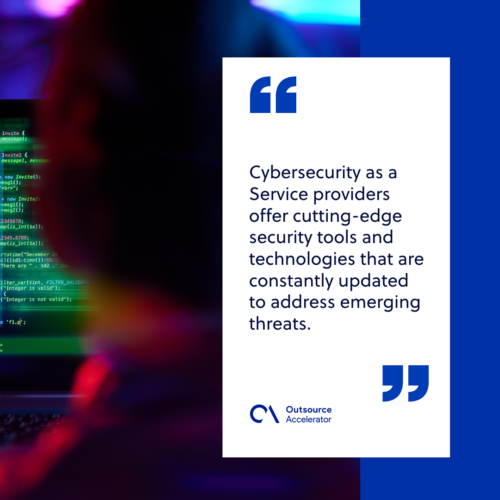
CaaS providers offer cutting-edge tools that update often to meet new threats.
As a result, businesses gain access to smart solutions like AI-driven detection, real-time monitoring, and strong encryption. These would be costly and complex to build in-house. So the latest measures stay in place at all times.
Simplified security management
Managing security in-house can be complex and draining. It needs constant updates, monitoring, and fixes. CaaS simplifies all of this.
For example, it handles everything from threat detection to compliance reporting. As a result, internal IT teams can focus on other key tasks while experts guard security.
Peace of mind
With CaaS, businesses operate with more confidence. This is because top-tier measures protect their digital assets.
So leaders can focus on growth and new ideas. Meanwhile, they worry less about cyber threats.
Frequently asked questions (FAQs)
What does CaaS stand for?
CaaS stands for Cybersecurity as a Service. In short, it is an outsourced, cloud-based way to protect a business from online threats.
How is CaaS different from traditional security?
Traditional security relies on on-site hardware and reacts after threats hit. Meanwhile, CaaS runs in the cloud and stays proactive. As a result, it detects and stops threats in real time.
Is CaaS suitable for small businesses?
Yes. The subscription model spreads out costs and needs no big upfront spend. So small and medium firms can access strong protection on a tight budget.
What threats does CaaS help prevent?
CaaS helps guard against malware, phishing, DDoS attacks, insider threats, and more. In addition, it covers zero-day exploits and Man in the Middle attacks.
Key takeaways
- Cybersecurity as a Service (CaaS) is an outsourced, cloud-based security model.
- It is proactive, with real-time detection and fast response.
- It costs less upfront and scales as your business grows.
- It guards against common threats like malware, phishing, and DDoS attacks.
- A trusted provider like Outsourced brings expert support and compliance help.






 Independent





