
How to choose the right call management system that suits your business


What is a call management system?
A call management system is technology that routes, tracks, and records incoming and outgoing calls, so agents reach the right callers fast and managers can measure performance.
- It routes calls, queues them, and logs key data.
- It boosts customer service and cuts wait times.
- It often runs on a VOIP phone service.
For strong call center operations, you should not rely on agent skills alone. A good call management system also plays a vital role. So it augments your whole setup and streamlines your work.
There are many tools you can add to your business. However, a call management system is one that every phone-based company should have. This article explains the basics, the benefits, and how to pick the right one.
A quick overview of call management
Call management covers the processes and systems used to handle calls well. So it includes routing calls to the right agents, managing queues, and tracking metrics.
Good call management drives quick response and shorter wait times. As a result, customer satisfaction goes up. In short, it makes phone handling more effective and improves service.
How a call management system works
A call management system is technology built to handle calls in call centers. So it works for both inbound and outbound calls.
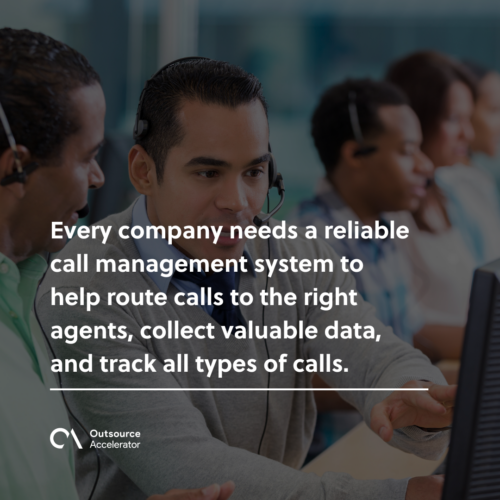
Contact centers need reliable call management software to:
- Help route calls to the right agents
- Collect valuable data
- Track all types of customer calls
It is usually part of a voice-over Internet Protocol (VOIP) service. So this lets you control, manage, and improve each caller’s experience. For a deeper look, compare the top VOIP call center solutions on the market.
The system uses set rules to route inbound and outbound calls through your business phone. In addition, it has a call recording feature. This lets you monitor your call center agents‘ performance. As a result, you can spot which processes or services need work.
Call management system features
A call management system has a wide range of features. So it is essential for modern contact centers that want great customer interactions.
- Call routing. Sends calls to the right department or person based on set rules, so callers reach the right agent quickly.
- Interactive voice response (IVR). Offers automated menus that respond to voice or keypad inputs, so callers get self-service options and reach the right place.
- Call queuing. Places calls in a queue when all agents are busy. As a result, no calls get lost, and callers see an estimated wait time.
- Call recording. Records calls for quality, training, and legal needs, so you can review each interaction.
- Caller ID and call screening. Identifies callers and shows their details, so agents can screen and prioritize calls.
- Voicemail and voicemail to email. Stores missed-call messages and can forward them to email for easy access.
- Call analytics and reporting. Shares insights on call volume, duration, wait times, and agent performance, so you can optimize call handling.
- Automated callbacks. Lets callers get a callback instead of waiting on hold, so satisfaction rises and wait times drop.
- CRM integration. Connects with CRM systems to give agents caller history, so each interaction feels personal.
- Call monitoring and whispering. Lets managers listen to live calls and coach agents in real time without the caller hearing.
- Multi-channel support. Supports phone, email, chat, and social media in one place, so service stays unified.
- Conference calling. Enables multi-party calls, so teams and clients can meet with ease.
- Call transfer and hold. Lets agents transfer calls or place callers on hold while they check information.
Benefits of utilizing call management software
For call centers with high daily call volumes, a call management system is a smart solution. So it boosts both efficiency and productivity.
On top of that, call management can also help you in the ways below.
Improve customer service
With call routing, customers reach the right agent right away. So the agent can handle their concern with ease.
The system also lets agents see past call records and picked-up details. As a result, they give the right answers fast. In turn, customers get quick, proper help, which drives a positive customer experience. A smart customer service queue keeps this flow smooth at busy times.
Save on costs
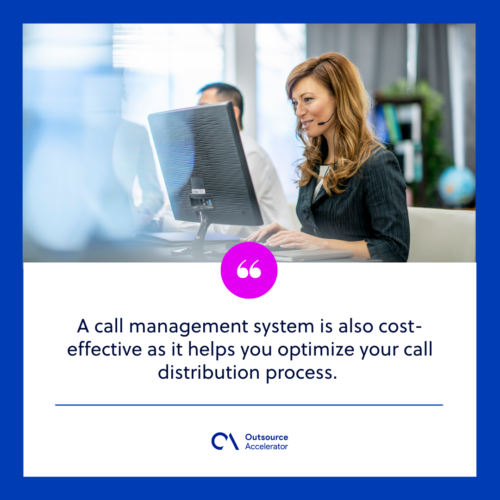
A call management system is cost-effective. So it helps you optimize your call distribution. With a better system, your agents spend less extra time on customer service inquiries.
Manage staffing levels more effectively
The system collects useful stats, especially on your peak and off-peak hours. So your managers can plan staffing better.
As a result, no customer waits in a long queue at peak times. In addition, no agent sits idle during quiet periods. To track this, watch your call center metrics closely.
What to look for in a call management systems provider
A call management system is good to have. Still, you must pick the best provider for your business needs. So here are the things to weigh before you choose.
Reliability
A good provider should have a reliable phone carrier presence. This includes automated call distribution. So ask clear questions about how reliable their service is. A strong provider will answer client concerns with no fuss.
Onboarding process and better customer service
Your provider should have a dedicated support team for the setup phase. So a good rep can guide your team through the process.
This help matters most when you learn to read your data. Note that your data is useless unless you turn it into clear, reachable goals.
Industry knowledge
Choose a vendor that knows your industry. So pick one that can share proprietary data to compare you with your rivals. As a result, you get benchmarks and confidence that your agents grasp your goals.
Pricing
Every provider sets its own prices. So look for a vendor whose pricing fits your needs and your call management processes.
Integrations
Do you use marketing software or a CRM platform? Then make sure your provider can integrate or push data into it. For larger setups, review the top contact center platforms too. Lastly, your solution should boost your call processes, not complicate them. Modern call center software should make that easy.
Frequently asked questions
What does a call management system do?
It routes, queues, records, and tracks calls. So agents reach the right callers fast. In addition, managers can measure performance and cut wait times.
Is a call management system the same as VOIP?
No, but they work together. A call management system usually runs on a VOIP service. So VOIP carries the calls while the system routes and tracks them.
What features matter most in a call management system?
Key features include call routing, IVR, queuing, recording, and analytics. For example, CRM integration also helps agents give personal service.
How do I choose the right provider?
Weigh reliability, onboarding support, industry knowledge, pricing, and integrations. So the best fit matches your needs and your existing tools.
Key takeaways
- A call management system routes, tracks, and records calls for better service.
- It cuts wait times and lifts customer satisfaction.
- Core features include routing, IVR, queuing, recording, and analytics.
- It usually runs on a VOIP phone service.
- Pick a provider by reliability, support, pricing, and integrations.






 Independent





