
Call barging: Definition and advantages


Good communication drives customer satisfaction and business growth. Still, not every call ends well with only the agent’s help.
Sometimes, a manager needs to step in. Call barging lets you do this. You join a live call to coach an agent and solve the issue in real time.
Many people think this feels invasive. However, there is a smart way to use it. In this article, we explain call barging and when to use it well.
What is call barging?
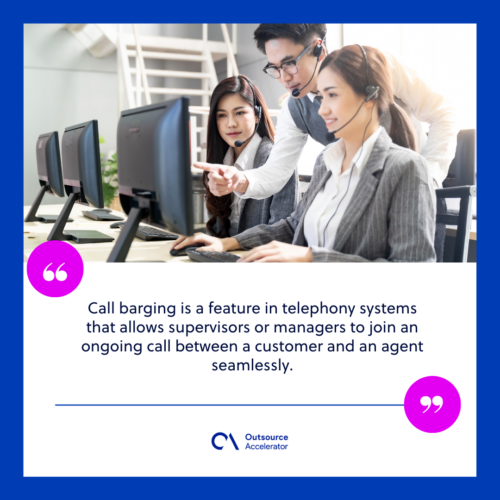
Call barging is a phone system feature that lets a supervisor join a live call between a customer and an agent.
- The supervisor can listen in and, if needed, speak on the call.
- It solves escalation calls without transferring them.
- As a result, help arrives fast and service stays consistent.
This kind of live support keeps quality high. So customers get quick, reliable answers every time.
How does call barging work?
You can find call barging in many call center software and VoIP tools. It is a common feature for teams that use call center outsourcing as well.
Here is how it works. First, an agent talks with a customer. Then you start call barging with a button or command in your software.
Next, you join the call with no disruption. The customer does not even know you are there. So you can listen to both sides in real time.
From there, you can guide the agent, judge their work, or take over the call if needed.
Advantages of call barging
Call barging can boost both agent and process efficiency. Here are the main benefits you can expect:
Improved agent performance
Call barging works as a strong training tool. In practice, you act as a live coach for the growth of each contact center agent.
You watch live calls and give quick feedback. As a result, agents learn to resolve customer inquiries better. Over time, this lifts their overall performance.
Enhanced customer experience
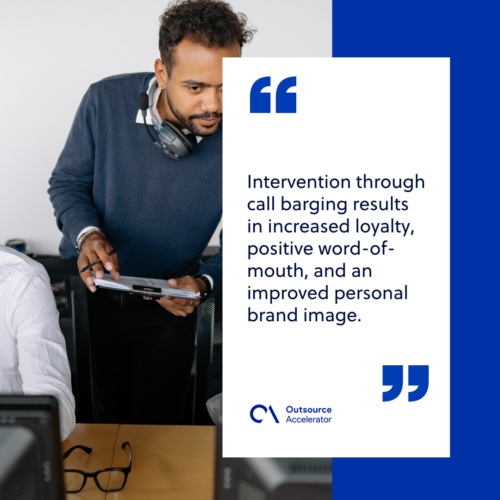
Call barging also improves the customer experience. Customers feel heard and get smooth support. So they stay loyal, share good reviews, and boost your personal brand image.
On top of that, you can fix concerns fast. As a result, customers get accurate and timely answers.
Quality control and compliance
Call barging helps in fields with strict rules. Supervisors can check that agents follow set protocols. So they keep compliance high and service strong.
You can also spot and fix any slip fast. As a result, you lower risk and protect your reputation.
Efficient conflict resolution
Call barging helps when a call gets tense. As a supervisor, you can step in, calm both sides, and guide the agent. So you settle disputes with less stress.
When to use call barging
Use call barging with care to avoid a bad impression. In general, it works best in these cases:
Training new agents
Call barging is a great tool when you onboard new agents. You watch their calls and give quick tips. As a result, they gain confidence and handle hard cases better.
Handling critical calls
Call barging acts as a safety net on complex calls. A supervisor can jump in and share expert help. So the call ends on the best note.
This helps most with high-value customers or tricky issues at a higher support level. In short, no customer is left without expert help.
Ensuring consistent service quality
Call barging keeps service quality even across the team. Supervisors can listen in at random to evaluate agent performance. It also helps you track the right call center metrics.
As a result, every customer gets a strong experience, no matter which agent they reach.
The power of call barging
Call barging marks a real shift in call center work. It gives supervisors more control and better results.
Businesses can revolutionize customer support with this feature. It also helps agents reach faster first call resolution. So call barging helps you refine your process and deliver:
- Improved customer experiences
- Increased agent performance
- Enhanced compliance measures
In short, it acts like a guiding hand. So each call becomes a chance to make a good, lasting impression.
Overall, call barging is a game-changing tool for great customer service. So learn to use it well, and it can transform your operations. As a result, your team can lead on service quality.
Frequently asked questions
What is call barging in a call center?
Call barging lets a supervisor join a live call between an agent and a customer. The supervisor can listen in and speak if needed. So they can coach the agent and solve the issue in real time.
How is call barging different from call whisper?
With call whisper, the customer cannot hear the supervisor’s advice to the agent. With call barging, the supervisor can speak to both sides. So barging allows more direct help on the call.
Is call barging legal?
In most cases, yes. Still, many regions require you to inform callers that calls may be monitored. So always check local rules and add the right notice.
When should supervisors use call barging?
Use it to train new agents, guide critical calls, and keep service quality even. In short, use it when live help will lead to a better outcome.
What tools offer call barging?
Many call center platforms and VoIP systems include it. Look for the feature in your software settings. Then set clear rules for when your team can use it.






 Independent





