
Exploring the role of an application support analyst


What is an application support analyst?
An application support analyst is an IT professional who keeps business software running, fixes technical issues, supports users, and works with developers to improve apps.
- They resolve app errors and answer user questions.
- They monitor systems and apply updates to prevent downtime.
- They share feedback with developers to make apps better.
Modern businesses know that technology is the backbone of efficiency. If your company runs on apps, you need those apps to stay reliable.
Today, firms depend on more software each year to run daily operations. So an application support analyst has become a key link in keeping systems stable.
Let’s look at this role’s duties. We will also cover the skills and qualifications to seek when you hire one.
What does an application support analyst do?
An application support analyst is a specialized IT professional. They make sure business apps and software systems stay stable and work well.
Application support specialists help keep IT running by:
- Resolving technical issues
- Providing user support
- Keeping key apps running smoothly

Qualifications needed for an application support analyst
Most application support analysts hold a bachelor’s degree in computer science, IT, or a related field. In addition, certifications like the Information Technology Infrastructure Library (ITIL) Foundation boost their credentials.
Responsibilities of an application support analyst
The role covers a wide range of tasks. Here are the key duties of an application support analyst.
Technical support
A key duty is to give technical support to users. So they fix software issues, answer questions, and show people how to use apps well.
For complex cases, they may work alongside a technical support engineer to solve the problem.
Troubleshooting
Application support analysts investigate and resolve app issues. First, they read software logs, find the root cause, and apply a fix.
Sometimes an issue needs more help. In that case, they escalate it to the right IT team.
System monitoring and maintenance
These analysts watch how key systems and apps perform. So they can spot and fix issues before they disrupt work.
They also handle routine upkeep. For example, they install updates and patches on time.
Documentation
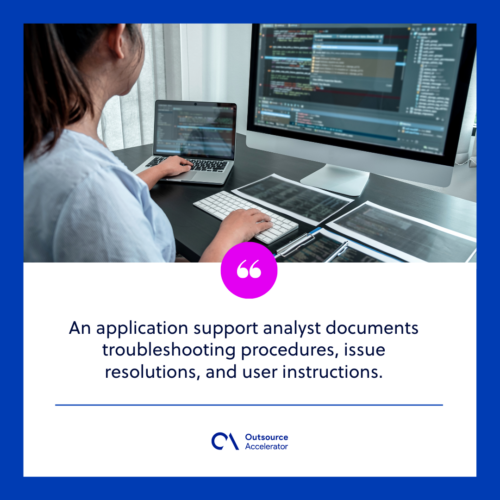
Good records matter in IT support. In addition, an application support analyst writes down troubleshooting steps, fixes, and user guides.
This work helps the team share knowledge. As a result, onboarding and offboarding go more smoothly.
Collaboration with development teams
An application support analyst works with software development teams. They give feedback and help improve app performance.
Part of the role is to share user pain points. In addition, they suggest changes that improve the experience.
Cost-effective IT support
An application support analyst can cost less than a full in-house dev team or outsourcing support services.
Still, they provide expert help built around your app systems. Many firms also weigh whether to outsource technical support to scale coverage.
Common tools used by an application support analyst
Application support analysts use many tools to do their work. Common ones include:
- Ticketing systems. These help track user issues and requests.
- Monitoring tools. These help analysts watch how key apps perform.
- Remote access software. These tools let analysts access users’ systems remotely for fixes and support.
- Data management software. This helps them organize data and tune database performance.
- Web platform development software. These tools help build and manage websites and web apps.
- Collaboration tools. These support communication and knowledge sharing across the team.
To compare popular options, see our roundup of technical support tools.
Skills to look for in an application support analyst
When you hire an application support analyst, a few skills matter most.
- Problem-solving. They must analyze complex issues and find effective fixes.
- Communication. They must explain technical topics to non-technical users.
- Attention to detail. They must be careful so no issue slips by.
- Technical proficiency. They need a strong base in programming, databases, and apps. They should know SQL, coding, and scripting.
- Customer service orientation. Good listening and empathy help them deliver a positive user experience.
Why your business needs an application support analyst
A dedicated application support analyst brings clear benefits. Here are the main ones.
Reduced downtime
Application support analysts help cut system downtime. They watch systems closely so key apps stay up. As a result, the business loses less time and money.
Enhanced user experience
In addition, these analysts improve how people use software. For example, they give quick help and fix issues fast. So teams stay more productive.
Efficient issue resolution
An application support analyst can diagnose and fix software issues fast. Because of this, they save time for staff who would otherwise struggle alone. For high-volume needs, an outsourced help desk can extend their reach.
Continuous improvement
By working with developers, analysts help apps get better over time. For example, their feedback points to areas to improve. In turn, this keeps your software stable and reliable.
Frequently asked questions
What is the difference between an application support analyst and a developer?
An application support analyst keeps existing apps running and helps users. A developer builds and codes new features. Still, the two roles work closely together to improve software.
What qualifications does an application support analyst need?
Most hold a degree in computer science, IT, or a related field. Many also earn certifications like ITIL Foundation. In addition, they need SQL, coding, and troubleshooting skills.
Can application support be outsourced?
Yes. Many firms outsource application support to cut costs and get around-the-clock coverage. This works well for growing teams that need reliable help fast.
What tools do application support analysts use?
They use ticketing systems, monitoring tools, remote access software, and data management tools. These help them track issues, watch performance, and fix problems quickly.
Why is an application support analyst important?
They keep key apps stable and reduce downtime. Because of this, staff stay productive and users stay happy. They also help developers improve apps over time.
Key takeaways
- An application support analyst keeps business apps stable and helps users.
- Core duties include support, troubleshooting, monitoring, documentation, and dev collaboration.
- Key skills are problem-solving, communication, attention to detail, and technical know-how.
- The role reduces downtime, speeds up fixes, and improves the user experience.
- Firms can hire in-house or outsource application support to scale coverage.






 Independent





