
Top 10 skills for a certified coding associate

What skills does a certified coding associate need?
A certified coding associate needs strong technical coding skills, sharp attention to detail, and clear communication, backed by good analytical, organizational, and time-management habits.
- They translate medical records into standardized codes with high accuracy.
- They work well with software, doctors, and insurance providers.
- They stay compliant with rules like HIPAA at every step.
Technology has reshaped the fast-growing healthcare industry. As a result, it has a big impact on the quality of medical services.
Today, doctors and nurses are not the only ones who help patients. Many support roles matter too. For example, medical coding[1] and medical billing are in high demand. These roles sit close to a wider medical coder career path.
One such role is the certified coding associate. These professionals have coding skills for both hospitals and medical practices. With the rise of electronic health records[2], more institutions need certified coding associates. So these coders handle codes, claims, and reimbursements.
This article covers the basics about certified coding associates. It looks at their role, their duties, and the skills they need. We also explain why they matter in healthcare.
What is a certified coding associate (CCA)?
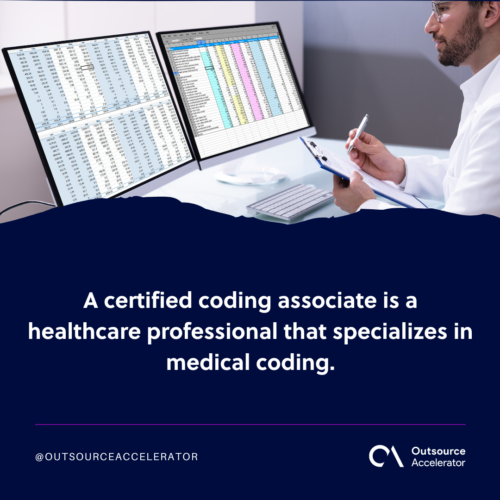
A certified coding associate is a healthcare professional who specializes in medical coding. They play a vital role in health information management. You will find them in hospitals, diagnostic centers, and care providers.
It is an entry-level certification for medical coders. A medical coder turns diagnoses, services, and equipment into standardized codes. There is also a growing market for medical coding services. In fact, the global medical coding market keeps expanding. Analysts value it in the tens of billions of dollars, and they expect it to grow about 10% a year through the early 2030s.
Roles and responsibilities of a certified coding associate
A certified coding associate handles many duties. Above all, this coder makes sure every detail is coded with high accuracy. They also support medical billing and claims work. Here is a breakdown of their main tasks:
- Translating patient information into standardized codes
- Assigning CPT, HCPCS, ICD-10-CM, APC, ASA, and DRG codes
- Making sure work meets medical coding policies and guidelines
- Keeping databases secure to protect patient data
- Preparing charts and reports, and running chart audits
- Submitting and following up on claims with insurance companies
- Collecting payments for each patient account
Essential skills of a certified coding associate
A certified coding associate needs a mix of hard and soft skills. These coders play a key role, and the job is as rewarding as many others in healthcare. So here are the skills the role demands.
1. Communication and interpersonal skills
Coders do not deal with patients directly. Still, strong communication and people skills matter. For example, they often talk with doctors, nurses, and other healthcare staff about important details.
They may also contact insurance providers or clients about patient records. So a professional tone and active listening are key. This helps make sure data is not lost, whether spoken, written, or entered into a system.
2. Technical skills
A certified coding associate must be strong with computers and quick to learn new tools. Most organizations use electronic health records (EHR) software for coding and billing. Some technical skills include:
- Medical coding
- CPT coding
- Inpatient coding
- ICD-10
- HCPCS coding
- Customer billing
- Health information technology
- Clinical documentation
- Health Insurance Portability and Accountability Act (HIPAA) compliance
3. Understanding of medical terminologies
In addition, certified coding associates need broad knowledge of clinical anatomy. Like other practitioners, they understand anatomy, physiology, pharmacology, and disease. They also know the main classification systems. As a result, they can assign the right procedural and diagnostic codes.
4. Analytical skills
Similarly, strong analytical skills help a coder review health records and pick the right codes. This keeps billing accurate. So the provider gets paid on time for the care given.
5. Computer literacy
Coders must be computer literate to use certain software programs. Some tools include Homecare, AdvancedMD, Homebase, DrChrono, Nextivity, and Centricity. In addition, coders enter data and codes with fast, accurate 10-key typing.
6. Conflict management
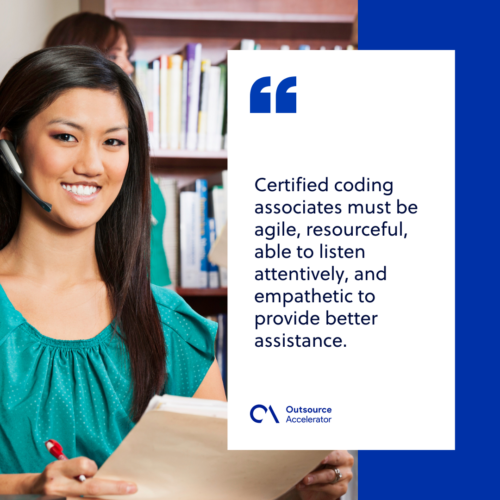
Coders often face tough situations. For example, they may negotiate payments with clients and insurers over denied claims. Problems can arise. So conflict management is another key skill. Coders should stay agile, resourceful, and empathetic to help well.
7. Attention to detail
Likewise, attention to detail is critical for coders and billers. It helps them avoid errors in coding and billing software. So certified coding associates make sure alphanumeric codes are assigned correctly. They also check that each payment detail matches the record in the system.
8. Organizational skills
Good organization helps coders save time and stay productive when things get busy. Certified coding associates manage all the data for many cases and patients at once. So keeping information tidy and accurate is a must.
9. Works independently
Coders can work proactively and finish on time with little supervision. This holds true even in a busy environment. As a result, they keep up strong output and performance.
10. Time management
Certified coding associates juggle many duties. So managing workload and schedule can be hard. To handle data and patients at once, time management is key. It helps them work well and fast.
Importance of certified coding associate in the healthcare industry
Overall, medical coding is critical in any healthcare setting. A skilled certified coding associate can fill this role and keep processes running in hospitals and offices. The work also shapes the wider revenue cycle management that keeps providers paid.
This role is valuable for more than coding alone. It also affects procedures, diagnoses, treatments, and patient care tied to quality healthcare service. In short, a certified coding associate improves daily operations by giving quality service. Demand is strong, and the future of medical coders looks bright.
FAQs
How do you become a certified coding associate?
First, learn medical coding and terminology through a course or program. Next, pass the CCA exam from AHIMA. Then apply for entry-level coding roles to build experience.
What is the difference between a CCA and a CPC?
The CCA is an entry-level credential from AHIMA. The CPC comes from AAPC and often suits outpatient coding. Both show coding skill, so the best choice depends on your career path.
Is a certified coding associate a good career?
Yes. Demand for medical coders keeps growing with healthcare. As a result, the role offers steady work and clear paths to advance.
Can a certified coding associate work from home?
Often, yes. Many coders work remotely using secure EHR systems. Still, employers may require some onsite time during training.
What tools does a certified coding associate use?
They use EHR and coding software every day. For example, tools like AdvancedMD and DrChrono are common. They also rely on ICD-10, CPT, and HCPCS code sets.
Article References:
[2] Electronic health records. Jensen, P.B., Jensen, L.J. and Brunak, S. (2012). Mining electronic health records: towards better research applications and clinical care. Nature Reviews Genetics, 13(6), pp.395-405. doi:10.1038/nrg3208.






 Independent






