
How legal process outsourcing improves efficiency in law firms


This article is a submission by Select Voicecom, a Philippines-based call center and BPO company providing inbound, outbound, back-office, and AI-powered outsourcing solutions to businesses across the U.S., Australia, and other global markets.
- Legal process outsourcing (LPO) helps law firms reduce administrative workloads and improve operational efficiency.
- Outsourced legal support can streamline client intake, document processing, scheduling, and administrative tasks.
- By delegating routine work, legal professionals can spend more time on client service and billable activities.
- Scalable outsourcing solutions enable firms to adapt to changing caseloads without significantly expanding internal teams.
Law firms today face increasing demands to deliver exceptional client service while managing growing caseloads and controlling operational costs.
As administrative responsibilities continue to expand, attorneys and legal staff often spend valuable time on tasks that, while necessary, do not directly contribute to legal strategy or client representation.
Legal process outsourcing (LPO) has emerged as a practical solution for firms looking to improve efficiency by delegating routine legal support and administrative functions to dedicated professionals. By streamlining day-to-day operations, law firms can better allocate internal resources toward higher-value legal work.
What is legal process outsourcing?
Legal process outsourcing is the practice of delegating legal support and administrative functions to an external service provider. Depending on a firm’s needs, outsourced teams may handle operational tasks that support attorneys and in-house legal staff while allowing the firm to maintain oversight of legal decision-making.

Commonly outsourced functions include:
- Client intake and lead qualification
- Appointment scheduling and calendar management
- Data entry and case documentation
- Form preparation and document processing
- After-hours call handling
- Administrative support
- Legal research support
- Database management
Many outsourcing providers offer structured workflows, trained professionals, and scalable staffing models that allow firms to adjust support as workloads fluctuate.
Administrative challenges facing modern law firms
As firms grow, administrative responsibilities often increase alongside legal workloads. Without efficient operational support, routine tasks can consume significant amounts of time that could otherwise be devoted to client representation.
Common operational challenges include:
- Attorneys spending time on administrative work instead of billable legal activities
- Delays in responding to prospective clients
- High volumes of documentation requiring manual processing
- Increased workloads during litigation, settlements, or seasonal demand
- Administrative bottlenecks that slow overall case progression
Over time, these inefficiencies can affect client satisfaction, staff productivity, and overall firm performance.
6 ways legal process outsourcing improves law firm efficiency
1. Streamlined client intake
First impressions matter. Dedicated intake specialists can collect client information, answer initial questions, and ensure prospective clients are routed appropriately using standardized workflows.
This creates a more consistent intake experience while allowing attorneys to focus on legal consultations.
2. Extended client availability
Many prospective clients seek legal assistance outside traditional business hours. Outsourced support teams can help firms manage after-hours inquiries, ensuring potential clients receive timely responses and reducing the risk of missed opportunities.
3. Reduced administrative workloads
Routine administrative responsibilities—including scheduling, document preparation, data entry, and case updates—can be delegated to trained support professionals.
This allows attorneys, paralegals, and legal assistants to dedicate more time to legal analysis, client advocacy, and case strategy.
4. Flexible operational support
Legal workloads often fluctuate depending on case volume, litigation schedules, or firm growth.
Outsourcing allows firms to increase or reduce administrative support as needed without the long-term commitments associated with expanding permanent staff.
5. Improved client communication
Consistent follow-up and timely communication contribute to a better client experience.
Dedicated support teams can assist with appointment reminders, client updates, follow-up calls, and administrative inquiries, helping firms maintain stronger client relationships throughout the legal process.
6. Better documentation and workflow organization
Accurate documentation is essential in legal practice.
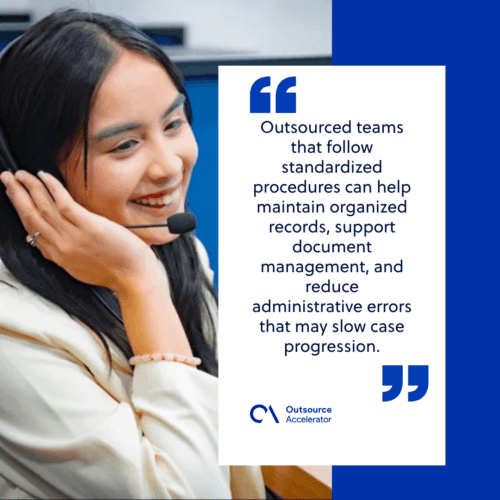
Outsourced teams that follow standardized procedures can help maintain organized records, support document management, and reduce administrative errors that may slow case progression.
Best practices for implementing legal process outsourcing
To maximize the benefits of outsourcing, firms should establish clear expectations and maintain close collaboration with their outsourcing provider.
Successful implementations often include:
- Clearly documented workflows and responsibilities
- Comprehensive onboarding and legal process training
- Secure systems for handling confidential information
- Regular performance reviews and communication
- Integration with existing case management and document management systems
A collaborative approach helps ensure outsourced professionals function as an extension of the firm’s existing operations. Many law firms work with an experienced legal process outsourcing provider to put these systems in place while keeping attorneys focused on billable work.
Frequently Asked Questions
What is legal process outsourcing?
Legal process outsourcing is the practice of working with an external provider to manage administrative and legal support functions such as client intake, scheduling, document management, and operational support.
Is legal process outsourcing only for large law firms?
No. Firms of various sizes use legal process outsourcing to improve operational efficiency, reduce administrative workloads, and gain access to scalable support as their needs evolve.
Can outsourced teams handle sensitive client information?
Reputable outsourcing providers implement security measures, confidentiality policies, and compliance practices designed to safeguard sensitive client information. Firms should evaluate providers based on their security standards and operational controls.
Which legal tasks are commonly outsourced?
Frequently outsourced services include client intake, appointment scheduling, administrative support, document preparation, legal research support, case documentation, data entry, and after-hours customer service.
How long does implementation typically take?
Implementation timelines depend on the complexity of the engagement, required training, and system integration. Many outsourcing partnerships can be established through a structured onboarding process over several weeks.






 Independent





