
Everything you need to know about electronic invoicing


Buyers and sellers trade invoices every day. However, manual methods are slow and prone to mistakes. They can bog down payment and purchase records. So many firms now turn to electronic invoicing to fix this.
Electronic invoicing has changed how companies handle money matters. It lets suppliers create and send customer invoices in a structured digital format. This article explains electronic invoicing from its meaning to how it works and why it helps.
What is electronic invoicing and how does it help businesses?
Electronic invoicing is the digital creation, sending, receipt, and processing of invoices, which cuts cost, speeds up payment, and reduces errors compared to paper methods.
- It removes paper, postage, and manual data entry.
- It sends invoices in seconds through secure digital channels.
- It links straight into accounting and ERP systems for fast payment.
Defining electronic invoicing
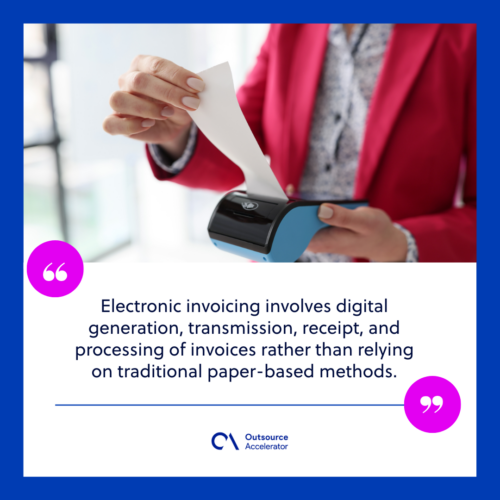
Electronic invoicing, or e-invoicing, is a modern way to invoice. It uses technology to speed up what was once a slow task. In short, it covers the digital creation, sending, receipt, and processing of invoices. So there is no need for paper-based methods.
By cutting out physical paperwork and manual entry, it also lifts efficiency. As a result, it lowers the risk of errors.
Electronic invoicing vs. Traditional invoicing
First, it helps to see how electronic invoicing differs from the old way.
Traditional invoicing
Traditional invoicing means creating and mailing paper invoices. These invoices are usually made in one of these ways:
- Using word processing software
- Printing from accounting software
- Signing a copy by hand and sending it by post
Once it arrives, the recipient types the details into their system by hand. Only then can they process and pay it.
Electronic invoicing
By contrast, electronic invoicing needs no paper. Instead, invoices are made digitally and sent online. E-invoices can travel through many channels. For example, they can go by email, electronic data interchange (EDI), or dedicated e-invoicing platforms. They also use structured data formats. As a result, automated systems can read and process them with ease. For firms moving off paper, choosing the right accounting software is often the first step.
How electronic invoicing works
Electronic invoicing runs through a well-ordered digital system. So it changes how businesses manage financial transactions. Here is a closer look at how it works.
Producing digital invoice data
The process starts with the creation of digital invoice data. Instead of drafting paper invoices, firms use e-invoicing platforms to make these documents. This step adds all the key details. For example, it includes invoice numbers, dates, line items, and payment terms.
Encoding invoice data into a structured format
Next, the invoice data is encoded into a structured format. So it can flow into other systems with ease. Common formats used in electronic invoicing include:
- eXtensible Markup Language (XML)
- Universal Business Language (UBL)
These formats make the data easy to pull and read. As a result, both the sender and recipient systems can process it smoothly.
Securing the transmission of the invoice data
Electronic invoicing systems use encryption and digital signatures. So they protect the privacy and integrity of each document. Because of this, the invoice data stays safe as it moves from sender to recipient.
Generating receipt and validation of the electronic invoice
When the invoice arrives, the recipient system sends a receipt confirmation. This confirmation does two jobs. First, it verifies that the invoice arrived. Then it starts the validation process. Validation includes several checks, such as the following:
- Verifying the sender’s identity
- Confirming data accuracy
- Ensuring compliance with legal and regulatory standards
Integrating with ERP systems for processing
Once validated, the invoice data flows into the recipient’s enterprise resource planning (ERP) or accounting system. This link speeds up the accounts payable process. So records update on their own, and payment workflows start right away.
Tracking payment initiation
Many systems also let both sides track the invoice through its life. Real-time visibility is a key perk of e-invoicing. As a result, firms can follow a payment from the moment it is sent to its final settlement.
Benefits of electronic invoicing
Electronic invoicing gives real gains to firms of all sizes. Let us look at the main benefits.
Cost savings
Electronic invoicing can cut the costs of paper-based invoicing by a wide margin. These savings come from less paper, postage, printing, and manual entry. In addition, firms save on storage space. They also face fewer late fees, because invoices move and clear faster.
Time efficiency
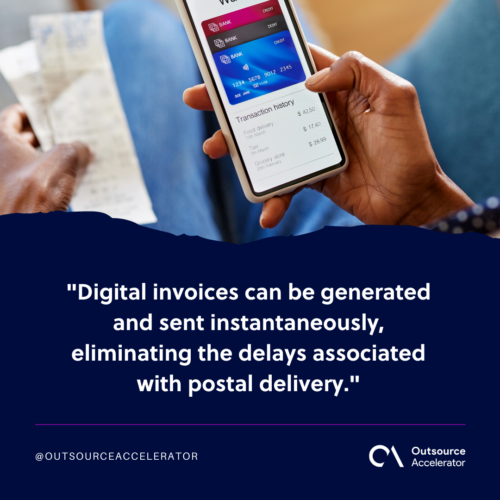
Time savings are one of the biggest perks. Digital invoices can be made and sent at once. So there are no postal delays. Automated entry and processing also cut the time spent on invoice management. As a result, staff can focus on more important work.
Accuracy and reduced errors
Electronic invoicing lowers the risk of errors that come with manual entry. With structured digital invoices, there is less room for human slips. As a result, invoices are more accurate. This also means fewer disputes and payment delays. When a dispute over an invoice does come up, a clear digital trail makes it faster to resolve.
Enhanced security
E-invoicing also gives better security for sensitive financial data. Digital invoices can be encrypted and sent safely. So the risk of interception or tampering drops.
Eco-friendliness
There are green gains too. The environmental benefits of e-invoicing include less deforestation and lower carbon output. In short, digital invoicing fits well with sustainability goals.
Archiving electronic invoices for record-keeping
For extra data safety, electronic invoices are archived digitally. This supports record-keeping and compliance. The digital archive acts as a secure store. So you can find past invoices fast for audits, tax checks, and reference. Many teams pair this with outsourced accounts payable support to keep records tidy and current.
The digital world keeps changing. So e-invoicing is a smart move toward more efficiency and an edge in today’s market. It also pairs well with the broader shift to digital bookkeeping that many firms now follow. For businesses that still send paper, it may be time to hand invoicing to a specialist team.
Frequently asked questions about electronic invoicing
Is electronic invoicing the same as sending a PDF invoice by email?
No. A PDF is just an image of an invoice. Electronic invoicing uses structured data, like XML or UBL. So systems can read and process it without manual entry.
Is electronic invoicing legally valid?
Yes, in most countries. However, rules differ by region. Many governments now require e-invoicing for tax purposes. So always check your local standards before you switch.
Do small businesses benefit from electronic invoicing?
Yes. Small firms often gain the most. They save time, cut costs, and get paid faster. In addition, many platforms offer low-cost plans built for small teams.
How secure is electronic invoicing?
It is very secure when done right. Systems use encryption and digital signatures. As a result, data stays private and hard to tamper with in transit.
Can electronic invoices link with my current accounting system?
In most cases, yes. E-invoicing platforms connect with popular ERP and accounting tools. So records update on their own, and payments move faster.






 Independent






