
Why AEC leaders are turning to the Philippines for remote drafting and design


This article is a submission by Intelassist. Intelassist a BPO and remote staffing provider serving various industries. It offers skilled remote professionals aligned with each client’s tools, culture, and standards.
Why are AEC leaders turning to the Philippines for remote drafting and design?
AEC leaders turn to the Philippines for remote drafting and design because it offers skilled CAD and BIM talent at a much lower cost, with time zones that support round-the-clock work.
- It helps firms fill a severe talent shortage in architecture and engineering.
- It cuts overhead while keeping quality high.
- It adds flexible capacity that scales with project load.
The architecture, engineering, and construction (AEC) sector faces a big workforce shift. Talent shortages and high turnover put growth at risk. For example, in a 2023 survey, 96% of U.S. engineering and architecture leaders said staffing gaps would limit growth.
At the same time, more than half of AEC professionals still feel “Great Resignation” pressure. In fact, 55% would consider leaving for a new role. Burnout is common too. Many younger engineers and architects now value flexibility highly. One study found 30% of job-seekers cite flexibility, and quality of life ranked first when choosing an employer.
So AEC firms face thin margins and fierce competition. As a result, many now turn to remote staffing and global talent pools as a smart fix.
Pandemic acceleration and the remote work shift
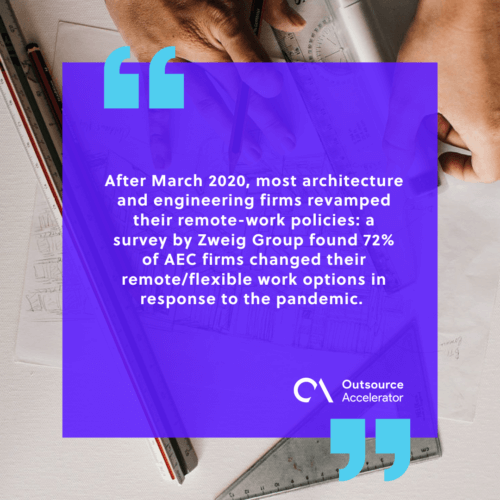
The COVID-19 pandemic pushed a fast move to remote work across industries. AEC was no exception. Afterward, most architecture and engineering firms revamped their remote-work rules. For example, a Zweig Group survey found 72% of AEC firms changed their flexible work options.
Cloud collaboration and BIM tools have made remote design and drafting easy. So what was once a niche perk is now a mainstream way to work. Industry evidence also shows productivity held up well. CMG’s survey reported that 86% of engineers and architects saw stable or higher output while remote.
Remote work also lets firms tap a much wider talent pool. Now they can recruit architects, engineers, and BIM specialists anywhere. As a result, they are no longer limited to local markets.
By removing distance limits, firms can fill niche roles with offshore experts. For example, they can staff detailed BIM modeling or structural drafting. In addition, local staff gain better work-life balance.
Remote staffing can also drive real cost savings. Global labor arbitrage means hiring skilled talent abroad costs far less than U.S. rates. For example, a U.S. design architect earns around $108,000 per year on average. In the Philippines, an equally skilled architect costs a small fraction of that. So a firm can hire one U.S. senior architect, or build a remote team of four to five skilled pros in the Philippines for a similar cost.
These savings go straight to the bottom line. By offloading routine drafting, takeoff, and documentation, U.S. firms cut overhead on office space and benefits. In addition, well-integrated teams often ramp up fast. After the first 90 days of setup and training, many see strong productivity and clear cost savings. Firms new to this model can review offshore staffing solutions in the Philippines to plan the shift.
Benefits beyond cost: Flexibility and productivity
Cost is a strong driver. Still, remote staffing also boosts flexibility, scale, and quality. For example, offshore AEC teams can work around the clock to speed up timelines.
Philippine-based teams often sync to North American hours. Many Filipino engineers start in the evening U.S. time. As a result, firms get true 24/7 production. Design revisions can happen overnight, and feedback lands by the next U.S. workday.
Remote staffing also adds headcount fast. So firms can scale up or down for busy periods without long hiring cycles. Niche skills are easier to find too. For example, offshore teams often include BIM, MEP, and energy analysis experts. To learn more, see this guide to outsourcing engineering work.
Because these teams handle routine drafting, senior staff stay focused on design and clients. In turn, project throughput improves.
Remote staffing can also aid retention. Many AEC professionals crave the flexibility that remote or hybrid models bring. Today, flexible options are table stakes in other industries. So firms that skip them risk losing talent. As the 2024 Engineering Management Institute survey noted, many architects and engineers would leave for better flexibility.
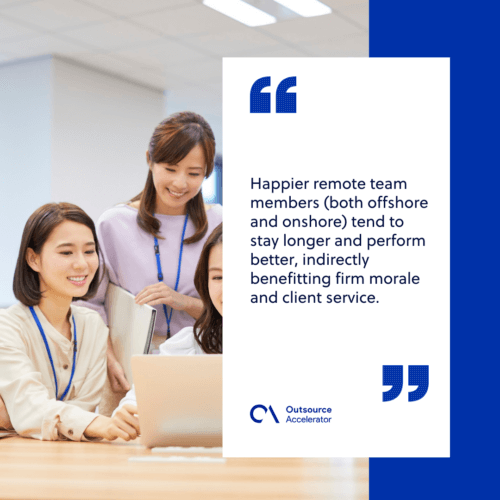
By adding offshore teams, firms can offer local staff more flexible hours. As a result, burnout drops. Remote work often lifts satisfaction too. In one study, Filipino remote workers reported higher job satisfaction and better work-life balance. Happier team members tend to stay longer and perform better.
The Philippines: An offshore AEC hub
The Philippines has become a top source of offshore AEC talent. Its outsourcing sector has remained robust. It generated 120,000 new jobs and 1.4% revenue growth even in a tough period. In fact, the country is often ranked as the top outsourcing destination worldwide.
A large English-speaking workforce is a key strength. Many Filipinos also hold CAD, Revit, BIM, and engineering skills that U.S. firms need. In addition, they know U.S. business culture and communication styles well. So Filipino staff often integrate smoothly and act as a flexible extension of a firm’s team.
Time zones help too. Philippine teams usually work nights to match U.S. days. As a result, meetings and handoffs happen in real time. In effect, American firms gain a “second shift” that moves work forward overnight.
The Philippines also offers a full suite of AEC roles. Beyond drafting and modeling, firms can offshore project management, detailing, MEP coordination, and even sustainability analysis. For example, dedicated BIM teams can handle large 3D models and quantity takeoffs. Then they feed updated data straight into U.S. project schedules.
Software skills run deep offshore. Many Philippine AEC workers are certified in Revit, Navisworks, Tekla, and AutoCAD. Because overhead is lower, firms can keep a bench of trained talent. This global mix also speeds up innovation, since new markets bring fresh design ideas.
In practice, a Philippine team works as an extension of your office. These specialists take on clear deliverables, such as shop drawings and BIM coordination. Meanwhile, your senior staff focus on front-end design and clients. Regular virtual meetings and shared platforms keep everyone aligned. When firms use tools like BIM 360, Asana, or Microsoft Teams, offshore staff join fully. Over time, they match local output while delivering big cost gains.
Tailored AEC services from remote teams
Philippine outsourcing firms offer a wide range of AEC services. For example, these often include:
- CAD/Revit drafting and 3D modeling. Detailed production drawings and BIM models built to your spec.
- Shop drawings and detailing. Mechanical, electrical, plumbing, and structural shop drawings for fabrication.
- BIM coordination and modeling (LOD 100 to 500). Full 3D models, clash detection, and 4D/5D sequencing.
- Quantity takeoff and estimation. Accurate material takeoffs and early cost estimates from plans or models.
- Structural and MEP analysis support. Calculations, load studies, and code checks by licensed engineers.
- Drafting revisions and redline support. Fast turnaround on plan revisions and markups.
In short, offshore AEC pros can handle nearly any task that does not need on-site presence. Their skills are shaped by their providers. For example, new hires often train in U.S. building codes and advanced design software. As a result, firms gain an on-demand staff pool that scales with project load. Many providers focus on architectural outsourcing specifically.
Best practices for success
Outsourcing works best as a long-term partnership, not a quick fix. Experts advise clear role definition and strong communication from day one.
Firms should document clear deliverables, metrics, and workflows for the offshore team. In practice, structured onboarding pays off. Companies with formal plans ramp up faster and retain staff better than those that “hire and hope.” These offshore team best practices help protect quality. With good management, the real ROI grows as the team takes on more complex work.
Finally, security and data control matter. Reputable providers keep ISO-grade facilities and secure VPN access. In addition, contracts protect intellectual property, and project data moves through encrypted channels. With the right protocols, such as NDAs and code reviews, the risks stay low next to the gains.
Building the future AEC workforce
The future AEC workforce will be hybrid and international. Firms that embrace remote staffing gain access to top global talent. As a result, they ease the domestic skills shortage and cut overhead.
By treating offshore teams as extensions of their own staff, firms boost productivity and flexibility. Their teams handle CAD and BIM drafting, estimation, detailing, and more. In addition, meeting the desire for flexibility helps retain talent.
Remote work in architecture and engineering is likely to stay high. So it will keep reshaping how projects get delivered. In the end, AEC leaders who adapt now will be more competitive and ready to grow, even amid talent shortages.
Frequently asked questions
Why do AEC firms hire remote teams in the Philippines?
They hire there for skilled talent at a lower cost. The Philippines offers strong CAD and BIM skills. In addition, its time zones support round-the-clock work.
What AEC tasks can offshore teams handle?
Offshore teams handle drafting, 3D modeling, and shop drawings. They also cover BIM coordination, takeoffs, and MEP support. In short, they manage most tasks that do not need on-site presence.
Is quality reliable with remote AEC staff?
Yes, with good onboarding. Many Filipino pros are certified in tools like Revit and AutoCAD. As a result, they match local output over time.
How do firms protect data with offshore teams?
Reputable providers use secure facilities and VPN access. In addition, contracts and NDAs protect intellectual property. Project data also moves through encrypted channels.
How much can firms save with Philippine AEC teams?
Savings are large. For the cost of one U.S. senior architect, a firm can build a small offshore team. So the same budget covers far more capacity.
Key takeaways
- AEC firms face severe talent shortages, high turnover, and a strong pull toward flexibility.
- The Philippines offers skilled CAD and BIM talent at a fraction of U.S. cost.
- Overlapping time zones give firms a productive second shift and faster turnaround.
- Offshore teams handle drafting, modeling, detailing, takeoffs, and MEP support.
- Clear onboarding, strong communication, and solid security make the model succeed.






 Independent





