
Top tips for choosing the right outsourcing partner in 2026


How do you choose the right outsourcing partner?
Choosing an outsourcing partner means matching a provider’s skills, security, and culture to your business goals before you sign.
Here is the short version:
- First, define your needs and how you will measure success.
- Then check their experience, tech, and data security.
- Finally, confirm pricing, support, and cultural fit.
This article is a submission by VIZX Global. VIZX Global short for Vision Execution, is a BPO solutions provider that was established with a clear vision: to nurture transformative ideas from conception to fruition, ultimately cultivating thriving enterprises.
Over recent decades, outsourcing has become a smart move for businesses. It helps them optimize operations, drive efficiency, and scale well. Global outsourcing spending keeps rising. So choosing an outsourcing partner is more important than ever.
The wrong choice can bring waste, security risks, and lost money. However, the right partner can spark real growth. Many firms outsource for clear reasons, and you can review the top reasons companies outsource first.
So what should decision-makers weigh when they compare options? This guide shares the top tips for choosing an outsourcing partner. As a result, you can build a smooth, value-driven partnership.
10 tips for choosing the right outsourcing partner
Make these decisions when it is time to look for an outsourcing partner:
1. Define your business needs and objectives
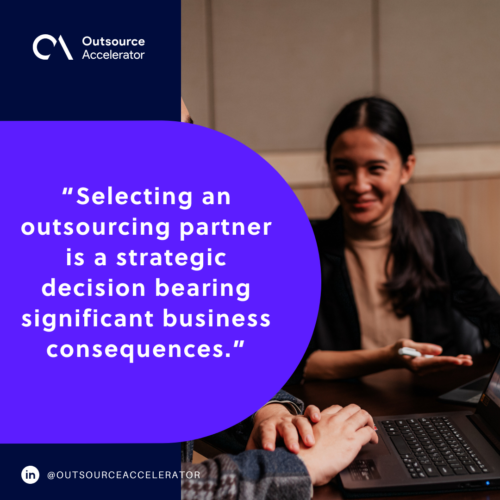
Choosing an outsourcing partner is a strategic decision. So define your goals before you engage a provider. Why do you want to outsource? For example, are you after lower costs, special skills, more efficiency, or better scalability? A clear view of your needs helps you judge each partner well.
Here are other questions to ask when you define your needs:
- What specific processes or services do you need to outsource?
- What key performance indicators (KPIs) will measure success?
- Do you want a long-term partnership or a short-term project?
A clear roadmap helps you pick the best fit. In addition, tracking the right outsourcing ROI keeps the partnership honest.
2. Evaluate industry experience and expertise
A provider’s niche expertise matters a lot. In fact, it shapes the quality of the service. A partner with deep industry knowledge knows your sector’s challenges and rules. So check these factors:
- Years of experience in your industry
- Case studies and success stories
- Certifications and industry recognition
- Understanding of compliance and regulatory standards
For example, SOC 2 compliance and data security are non-negotiable in healthcare or finance.
3. Assess technological capabilities
Digital transformation keeps shaping the outsourcing landscape. So the ideal partner should use cutting-edge tools. These include artificial intelligence (AI), automation, and cloud-based solutions. As a result, they boost efficiency and productivity.
Here are some tech questions to ask:
- Does the provider use AI-driven automation for repetitive tasks?
- How do they ensure data security and cybersecurity?
- Are they set up with cloud tools for easy collaboration?
- Do they have proprietary tech that improves service?
A tech-savvy, agile partner keeps your business competitive and ready for the future.
4. Verify scalability and flexibility
Over time, your needs will change. So your partner should scale their services to match. They should adapt to new demands throughout the work. For example, they may shift the scope, try new tech, or meet a fresh business need.
Your partner should also grow or shrink the team as needed. If your project grows, they add people. If your needs drop, they scale down without disruption. So discuss this upfront to avoid a rigid partner. You can also ask about their past scaling work. In addition, check the contract terms for the flexibility you need. It helps to know the main types of outsourcing before you decide.
5. Prioritize data security and compliance
Cyber threats and rules keep growing. So partners must have robust data security measures in place. Today, firms that handle sensitive data need real assurance.
Verify that your provider meets global data standards. They should show compliance with rules like SOC 2, ISO 27001, HIPAA, and GDPR. Also ask about their security protocols and disaster recovery plans. Otherwise, a weak partner could expose you to financial and reputational risk.
6. Assess communication and cultural compatibility
Outsourcing means working across time zones and cultures. So strong communication prevents mix-ups and keeps work smooth. Success here needs clear talk and good cultural fit, as follows:
Language proficiency: Check that the team can communicate well in your preferred language.
Cultural fit: See whether the provider knows your culture. Also check that their values align with yours. As a result, work ethic and communication styles will match.
Time zone compatibility: Time zones matter in outsourcing. Poor alignment causes delays. So pick a partner whose hours overlap with yours.
7. Review cost structure and pricing transparency
Cost savings drive much of outsourcing. So you need clear pricing. Understand your partner’s pricing model well. That way, you avoid hidden fees and budget surprises.
Consider partners with a clear model, whether time and materials, fixed-price, or hybrid. The right partner also offers flexible pricing as your needs change. For more detail, compare common outsourcing pricing models first.
8. Analyze customer support and Service Level Agreements (SLAs)
Reliable support keeps your business running. This matters most when a problem hits. So make sure your provider offers help by phone, chat, and email. They should also meet the response times set in the SLA. A strong SLA drives accountability and quality.
Here is an SLA checklist to verify a good partner:
- Response times for critical issues
- Availability of 24/7 customer support
- Defined escalation steps for problem resolution
- Performance guarantees and service credits
In addition, review the fine print in their BPO contracts before you sign.
9. Check client references and reputation
Before you sign, verify your partner’s past work. So conduct due diligence first. Review their testimonials, case studies, and industry reviews. As a result, you gain real insight into their reputation. A proven track record shows credibility and reliability.
Here are due diligence steps:
- Request references from past and current clients
- Check online reviews and ratings
- Look for independent third-party assessments
- Run pilot projects to test performance firsthand

10. Foster a collaborative partnership mindset
Outsourcing is more than a simple transaction. In fact, it should be a strategic partnership. Remember, you work with a partner to reach your business goals. So firms that build strong, collaborative ties tend to see better results.
For the best outcomes, consider these best practices:
- Involve the partner in strategic planning talks
- Keep open communication and regular check-ins
- Share insights, goals, and growth plans
- Build a culture of mutual trust and transparency
Finding the outsourcing partner for your needs
Choosing an outsourcing partner is a strategic call. As a result, it shapes your efficiency, security, and scalability.
The process is not just about comparing credentials. Instead, you want a partner that shares your values and understands your needs. So the right one brings strategic insight that drives success.
As you make outsourcing part of your plan, take time to weigh each factor. For example, check industry expertise, tech, scalability, data security, communication, and transparency. That way, you build a collaboration that lasts.
Choosing an outsourcing partner FAQs
What is the first step in choosing an outsourcing partner?
First, define your goals and needs. Ask why you want to outsource. Then set the KPIs that will measure success.
How do I check if an outsourcing partner is secure?
Ask about their data security measures. For example, look for SOC 2, ISO 27001, HIPAA, or GDPR compliance. Also review their disaster recovery plan.
Why does cultural fit matter in outsourcing?
Cultural fit shapes communication and work ethic. As a result, a good match prevents mix-ups. So it helps the partnership run smoothly.
What pricing model should I look for?
Look for a clear model with no hidden fees. It may be fixed-price, time and materials, or hybrid. The best partner also offers flexible pricing.
How can I verify a partner’s reputation?
Check references, reviews, and case studies. In addition, run a small pilot project. As a result, you see real performance before you commit.
Key takeaways
- Choosing an outsourcing partner starts with clear goals and KPIs.
- Next, check their industry experience, tech, and data security.
- Also confirm scalability, pricing, support, and cultural fit.
- Always verify references and run a pilot before you sign.
- The best partner shares your values and drives long-term growth.






 Independent





