
The role of virtual assistants in business development


This article is a submission by WorkStaff360. WorkStaff360 delivers tailored virtual assistant services, combining personalized support and industry expertise for diverse sectors.
What is the role of virtual assistants in business development?
The role of virtual assistants is to handle admin, research, leads, client care, and marketing, so owners can focus on growth.
- VAs take over time-consuming, repetitive tasks.
- They support lead generation, CRM work, and market research.
- As a result, they free your time for strategy and partnerships.
The business world has never been more competitive. Every day, owners and CEOs look for smart ways to improve operations, expand reach, and build strong relationships.
However, business development has grown more complex, even for seasoned pros. This is where the role of virtual assistants (VA) comes in. In short, VAs give the support that lets businesses focus on growth while daily tasks stay on track.
Demand keeps rising too. According to Technavio, the virtual assistant market may grow by about US$64.5 billion, at a CAGR of 51% during the 2023 to 2028 forecast period.
This article looks at how VAs drive growth. It also covers their roles, the benefits of adding VAs to your business, and how to get the most from them.
Business development: The way to organizational growth
Many people think business development is only for big firms. But that is far from the truth.
Business development is not a one-time task. Instead, it is a non-stop process. So it can take your business from okay to excellent.
In short, it means building long-term value. You do this by forming relationships, spotting new markets, and managing customer contact. So if you want steady growth, you need to expand your network, find fresh chances, and make new partnerships.
However, most businesses struggle to keep up with growth work and daily duties. For example, limited time, tight resources, and skill gaps can slow things down. As a result, owners must balance operations with growth. Virtual assistants can fill this gap. In turn, they offer a smart, low-cost fix.
5 key roles of virtual assistants in business development
Virtual assistants have moved from administrative management into wider business development roles. Today, they handle many tasks that help firms simplify work and scale.

“Virtual Assistants are the secret weapons of successful people.” – Tim Ferriss.
Tim Ferriss is a very successful American entrepreneur, investor, author, and coach. He also wrote The 4-Hour Work Week, where he explains how to work smart.
So the idea is simple. You grow the business yourself and pass daily tasks to a VA. Even small firms and startups use virtual offices to cut costs and put that money into scaling.
It is also worth noting one point. A virtual assistant is an independent contractor. So a business does not owe them the same benefits or taxes as a full-time hire. In short, a VA is not an in-house admin assistant. As a result, they are not paid or taxed the same way.
Here are the main ways a VA takes admin and repetitive work off your plate.
1. Administrative support
Virtual assistants shine at time-consuming admin tasks. For example, they handle scheduling, emails, travel plans, and data entry. So owners and executives get free time for high-level strategy.
For instance, a VA can book meetings with potential partners. So you can focus on the negotiation itself. In addition, VAs help prepare presentations, reports, and other materials. As a result, productivity and flow improve. To see the full scope, review the duties of a virtual assistant.
2. Market research and analysis
Business development needs fresh insight on trends, rivals, and market chances. So virtual assistants can run deep research to find new markets. In turn, they offer useful insights for strategy.
For example, a startup might use a VA to track new trends. As a result, the team can adjust its plans with real-time data.
3. Lead generation and CRM management
One of the most valuable VA services is lead generation. After all, every business needs more quality leads to scale.
Scoop Market U.S. reported that 53% of marketers spend more than half their budget on lead generation. Furthermore, 61% said lead generation and conversion is their hardest challenge.
Virtual assistants can find potential clients, research their needs, and add details to your CRM. In addition, they manage the CRM for timely follow-ups. So you can close more deals and build lasting bonds. To sharpen this work, explore proven lead generation techniques.
For context, 39.5% of marketers said better market and ICP data improved their lead-generation process. As a result, this steady contact keeps a healthy pipeline. So you can focus on nurturing leads. VAs also keep client databases up to date.
4. Customer relationship management
Strong client bonds sit at the core of business development. So VAs help by scheduling follow-ups, sending personal emails, and handling concerns fast. As a result, you build long-term partnerships, lift satisfaction, and win more referrals.
Research by HubSpot found that about 78% of sales leaders say their CRM improves alignment between sales and marketing. In turn, this lifts ROI.
In fields where service sets you apart, a VA who manages client contact is a big help. So clients feel heard and valued. As a result, loyalty and trust grow. A good grasp of the benefits of CRM makes this even more effective.
5. Digital marketing and social media support
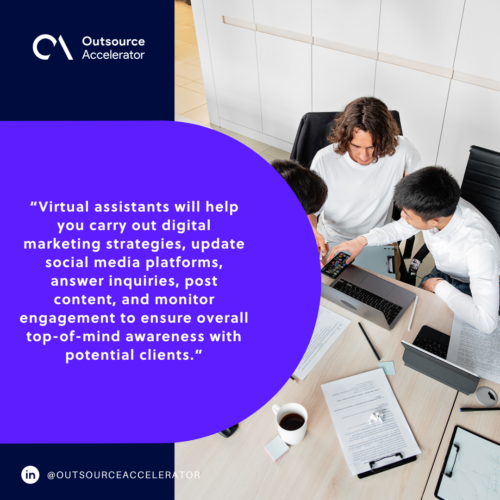
A strong online presence is the lifeline of business development today. So virtual assistants help run digital marketing plans. For example, they update social platforms, answer questions, post content, and track engagement. As a result, your brand stays top of mind.
In addition, VAs assist with email campaigns, newsletters, and promo material. So your business stays visible to the right audience. Many firms hire a dedicated social media virtual assistant for this work.
Advantages of leveraging the roles of virtual assistants to develop business
The role of virtual assistants brings clear benefits. So it is worth the investment for any growth plan.
1. Cost efficiency
Full-time staff cost more, especially for small firms and startups. Virtual assistants are cheaper, since they work on contract or by the hour. So you skip big overheads like office space, gear, and benefits.
In addition, VAs give you access to global talent. In other words, you can find skilled people at fair rates anywhere in the world.
2. Scalability
Another big plus is flexibility. VAs can scale up or down with your needs. For example, you could hire additional VAs on busy days. Then you can ease the load when things settle. As a result, VAs suit any business in growth mode.
3. Sharper focus on core business operations
Pass non-core jobs to virtual assistants. So you can focus on core growth. For example, you can build partnerships, plan strategy, and launch new products. In short, this smart move lets you use your time and resources for faster growth.
How virtual assistants can be included in business development strategies
To get the most from VAs, you need to fold them into your plans. Here is how.
1. Identifying the right tasks to delegate
First, decide what work to pass to VAs. For example, admin work is a good fit. So is market research and client contact. In addition, study your workflow to see where VAs help most.
2. Choose the right virtual assistant for a particular task
Not every VA is the same. So look for skills that fit your goals. For instance, some VAs focus on lead generation. Others suit digital marketing or research. So pick a VA with the right expertise for real growth. It helps to know the key skills you should look for in a VA.
3. Effective communication and collaboration
Working well with VAs takes clear communication. So use a project tool like Asana or Basecamp. In addition, give steady feedback. As a result, both sides stay on the same page.
Frequently asked questions about the role of virtual assistants
What is the main role of virtual assistants?
The role of virtual assistants is to handle admin, research, leads, and client care. So owners can focus on growth and strategy.
Can virtual assistants help with lead generation?
Yes. VAs find prospects, research their needs, and manage your CRM. As a result, they help you close more deals.
Are virtual assistants cost-effective?
Yes. VAs work on contract or by the hour. So you avoid big overheads like office space and benefits.
How do I choose the right virtual assistant?
Match the VA’s skills to your goals. For example, pick a lead-generation VA for sales or a marketing VA for content.
How do I work well with a virtual assistant?
Use clear communication and a project tool. In addition, give steady feedback so both sides stay aligned.
Key takeaways
- The role of virtual assistants spans admin, research, leads, client care, and marketing.
- VAs free owners to focus on strategy and partnerships.
- They are cost-effective and easy to scale up or down.
- Match each VA’s skills to the task for the best results.
- Clear communication and steady feedback keep the work on track.






 Independent





