
Simplify admin tasks: Outsource administrative services


In general, routine and ordinary business tasks still require time and priority. However, with various tasks that should be completed, in many instances, administrative services tend to be neglected.
Companies are compelled to outsource administrative tasks to focus on more significant areas integral to meeting the company’s core objectives.

What is administrative outsourcing?
Administrative outsourcing refers to the systematic handling of administrative functions by third parties.
Businesses partner with reputable agencies, like Boomering, to offload certain admin tasks and functions.
This type of outsourcing is a subsector of business process outsourcing and can either be done offshore, nearshore, or even onshore (domestic).
As the industry continues to grow, the more administrative responsibilities to do. Administrative tasks consist of many workloads, including preparing emails and letters, organizing files, and other monotonous tasks related significantly to the bottom line.
Different administrative outsourcing services
Today, there are many different administrative outsourcing services provided for businesses. Here are the common services that companies usually outsource:
Data entry
Data entry involves the encoding of business-related information into a computer system. Data may come from handwritten documents, recordings, or even phone calls.
The goal is to achieve an organized and systematic database for keeping track of data. Some companies use a specific software system built to meet their specific needs.
Reports, presentations, and transcription
Administrative tasks also include generating numerous reports and memos. These include research reports regarding competitors, legal issues, and information about professional associations.
In business meetings, administrative jobs are also useful for creating PowerPoint presentations and keeping a record of meeting minutes. Firms usually hire an in-house transcriptionist professional, but this may also fall under administrative tasks.
With knowledge of business terminology, administrative professionals are responsible for transcribing audio and video recordings and live meetings.
Customer relationship management
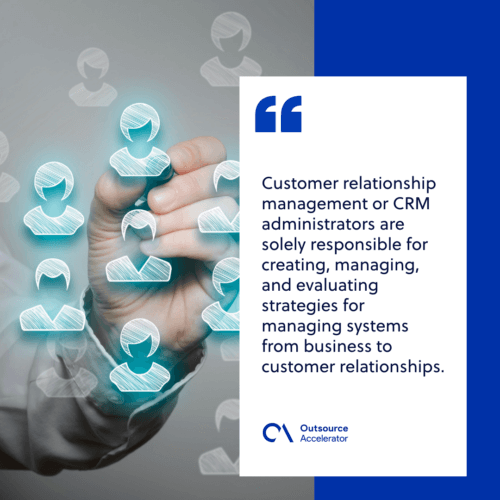
Customer relationship management (CRM) administrators are solely responsible for creating, managing, and evaluating strategies for managing systems from business to customer relationships.
CMR aims to establish and protect ongoing relationships with the company’s key clients. This includes resolving customer complaints efficiently.
CMR systems also track up-to-date customer data and help elevate the quality of business products or services.
Database management
As a business continues to expand, the amount of data rapidly grows, which makes it crucial for organizations to build a good database.
It is important that all pertinent data is well-organized in a specially designed database system. Companies with a poor data management system may suffer from “implosions and failures.”
Having a good database management system allows businesses to have quality storage optimization and solid security and privacy.
How does administrative outsourcing help your business?
The nature of administrative tasks is often viewed as repetitive and time-consuming. Some companies fail to realize that they play a significant role in their success.
Here are the key benefits of administrative outsourcing for your business:
Cost-saving
Outsourced teams will assist your business’s in-house departments in handling administrative tasks. Depending on the arrangements with outsourcing companies, it guarantees reduced management costs.
From on-site expenses and employee benefits to hiring and onboarding costs, administrative outsourcing is a smarter choice for your business. It allows you to see the revenue-generating areas where your business invests time.

Better focus on core business
The never-ending list of time-consuming tasks is usually the company’s fear. With that, outsourcing emerges as an ideal course for business owners to eliminate those tasks off their plates.
While the outsourcing team handles the paperwork, business owners and their internal teams can focus on bigger projects.
Flexibility
Outsourcing offers a level of flexibility for small and medium-sized businesses. They can hire outsourced admin services as a substitute for hiring in-house administrative employees, which is more expensive and time-consuming for companies.
Enhanced efficiency
Companies don’t need to check whether the outsourced team is competent enough for the business’s administrative tasks.
Outsourcing companies provide people with the right area of expertise to handle complicated tasks. An outsourced team can be appointed to generate invitations and emails, copywriting, or even content writing for websites.
Tasks can also be related to finances, such as bookkeeping, payroll, calendar management, and bill payments, which can be exhausting and take longer to finish.

Reduced margin of errors
In business operations, outsourcing is the best way to build a team in a variety of fields. Administrative tasks can be dull and repetitive, affecting employee performance and increasing the risk of errors.
Outsourcing companies are known to hire and train competent individuals to handle administrative tasks. The team will be responsible for consistent work quality and organized and systematic execution of tasks.
Achieve all these benefits with administrative outsourcing
There are many positive administrative outsourcing benefits that the company might gain, and we’ve only listed five.
Whether to outsource is not a dilemma that every business owner experiences in the early phase of operations. However, if you aim to reach more prospects and outstanding growth, you should consider outsourcing administrative functions and eliminate hurdles to your company’s success.
Partnering with reputable outsourcing firms like Booth and Partners will significantly help you in this aspect






 Independent





