
How BPO firms can embed real-time data to drive team performance

This article is a submission by Express International. Express International, a privately owned BPO and transportation company founded by a Guyanese entrepreneur, operates with teams across four countries and delivery centers in both nearshore and offshore regions.
How can real-time data drive BPO team performance?
Real-time data drives BPO team performance by putting live metrics in front of agents every day, so they can self-correct, coaches can step in early, and clients can see progress as it happens.
- Live dashboards replace lagging weekly reports. As a result, issues get fixed the same day.
- Also, when agents see their own numbers, they take ownership of quality and output.
- Data-informed coaching beats after-the-fact scoring. So skills and client outcomes improve faster.
In the outsourcing sector, cost reduction has long been the main selling point. However, global clients today expect far more than labor arbitrage.
They want visibility, accountability, and steady improvement. Meanwhile, BPO firms that rely only on static reporting often fall short of these demands.
Real-time analytics is changing that. By embedding live performance data into daily work, BPOs improve coaching, evaluation, and service delivery. So this article shows how firms can move from static reports to real-time insights, and the outcomes that follow.
From vanity metrics to business-driven KPIs
Many outsourcing teams fall into the trap of tracking vanity metrics. These numbers look good in a report, but they do not reflect client satisfaction or real efficiency.
High-performing firms shift focus instead. So they track actionable KPIs that link directly to client outcomes.
Contact center metrics that matter:
- First-call resolution rates (FCR)
- Call disposition accuracy as a quality proxy
- Customer satisfaction (CSAT) scores tied to agent behavior
- Resolution time adjusted for issue complexity
Back-office metrics that matter:
- Task accuracy and error reduction percentages
- Processing speed and throughput
- Alignment of client feedback with individual output
Insight: In one case, a focus on call disposition accuracy revealed training gaps. Traditional productivity metrics had missed them. As a result, closing those gaps improved data quality by over 30% and lifted client satisfaction. For a wider view, see this guide to improving call center metrics.
Such refinements also help leaders decide with confidence. So the data reflects reality, not vanity. Clear customer service KPIs keep that focus sharp.
Real-time visibility as a daily discipline
Embedding real-time reviews into daily rituals strengthens alignment across teams. In addition, it shifts accountability from managers to agents. Instead of waiting for a weekly report, teams surface issues at once and act the same day.
Over time, this lowers escalation rates. As a result, continuous improvement becomes second nature.
Dashboards are common in outsourcing. Still, they often become wall decor, ignored after a few days of novelty. The real value comes when dashboards sit inside daily team rituals.
The dashboard huddle approach. For example, it covers:
- First, morning reviews of live performance against targets
- Surfacing of trending issues before they escalate
- Recognition of agents who hit or improve metrics
- Resource shifts based on real-time demand
Tip: Start small. First, introduce three core metrics. Next, make sure teams act on them. Only then should you expand the dashboard.
Transparency builds ownership
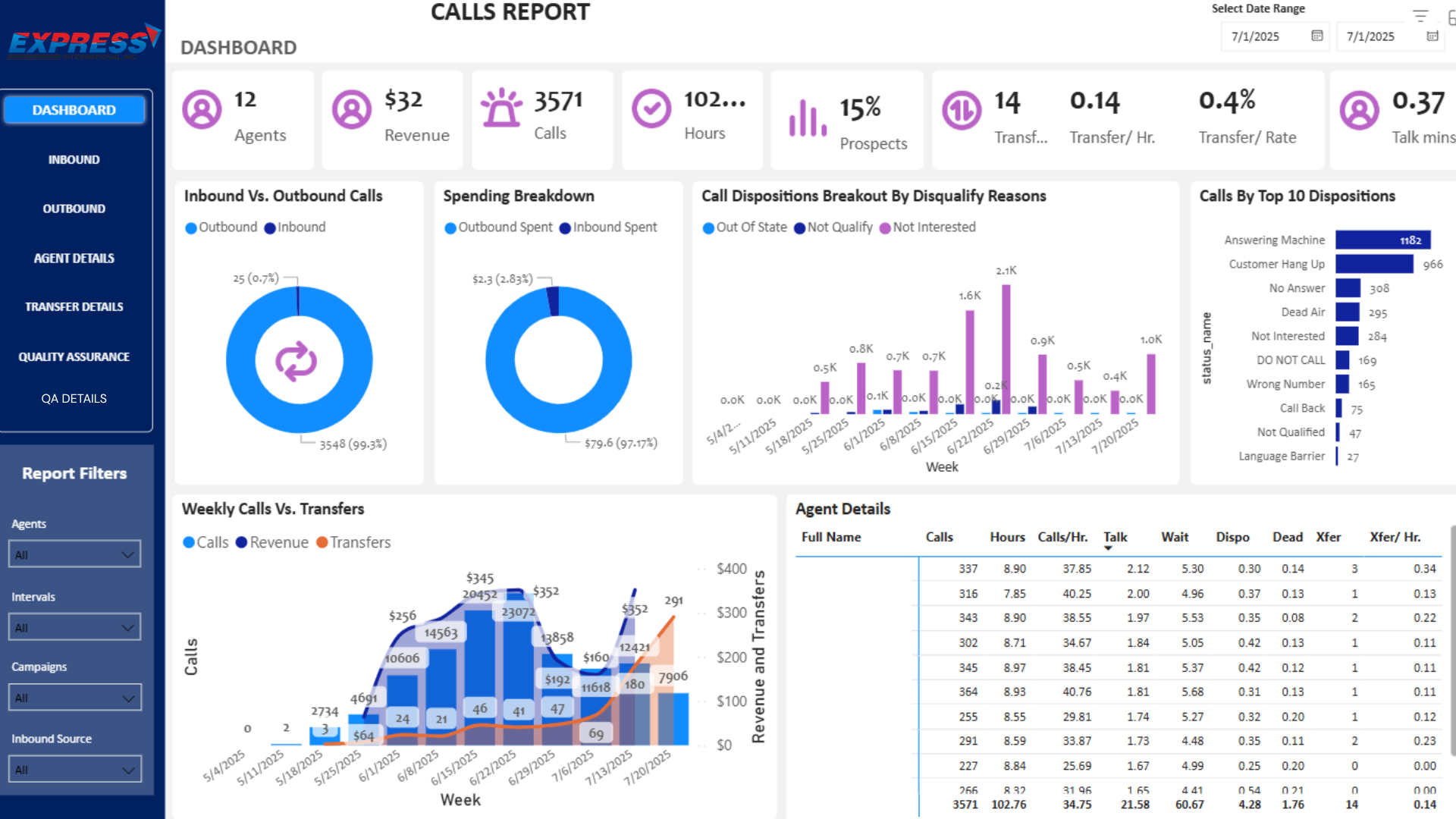
Data loses power when it stays siloed with managers. However, when frontline agents see their own numbers, they take ownership of performance.
Elements of a transparency framework. For example, these help:
- First, individual dashboards that show personal trends
- Team rankings that highlight improvement, not just top performers
- Peer comparisons that spark healthy competition
- Client impact stories that link metrics to real outcomes
Result: Industry-wide experience shows a clear pattern. When agents see their own metrics, break adherence and call quality can improve by double digits within a few months.
Coaching with data instead of policing
Traditional QA often feels punitive. It scores agents after the fact. A data-driven approach reframes QA as a coaching tool instead.
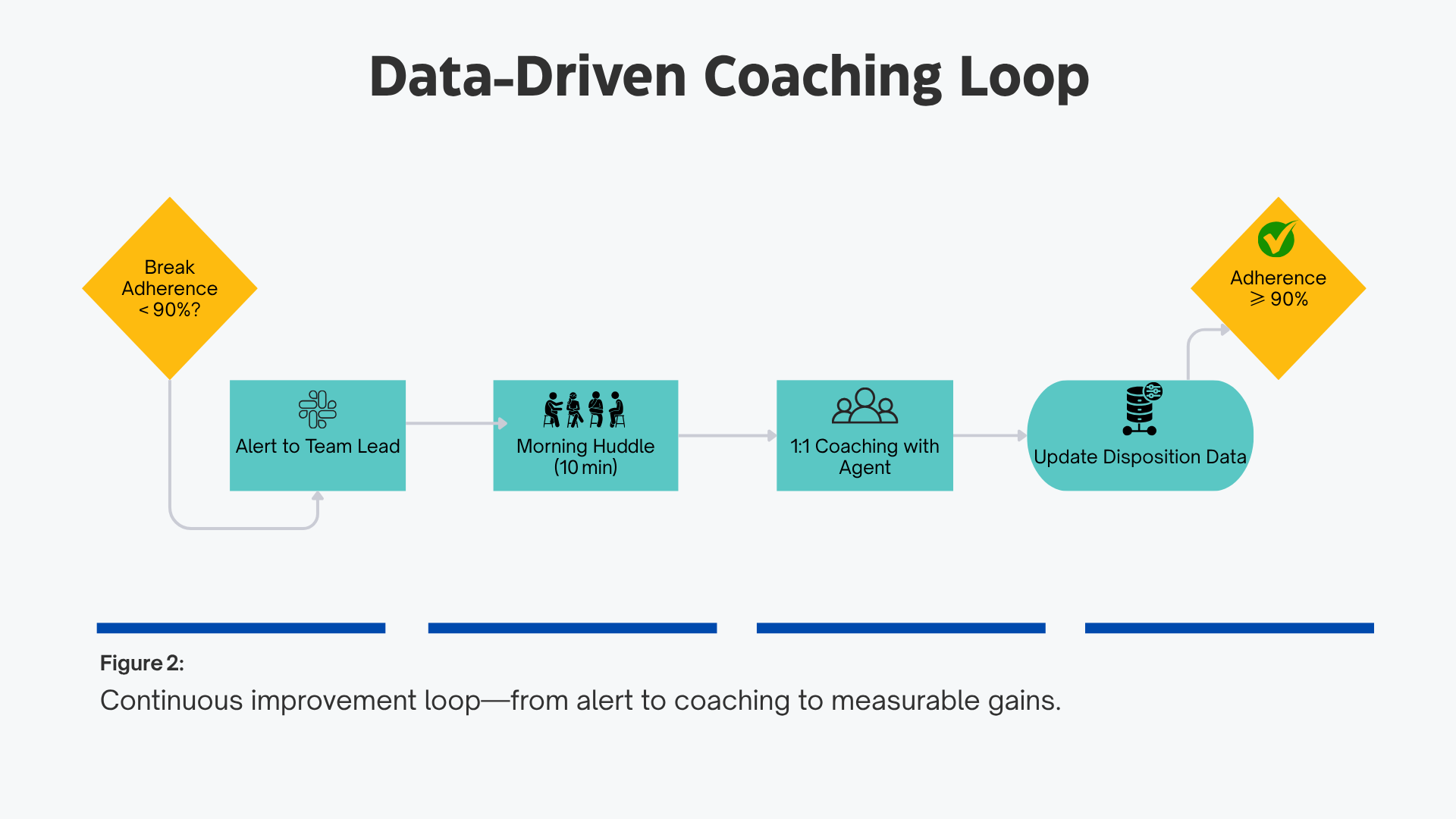
Data-driven coaching cycle:
- Spot patterns of errors or drop-offs in live dashboards.
- Trigger coaching sessions based on those patterns.
- Track progress with before-and-after metrics.
- Recognize improvements in public, with evidence.
Example: Industry examples show strong gains. For instance, documentation accuracy can rise by over 25 percentage points when data-informed coaching replaces generic feedback. This is where quality assurance as a service adds real value.
Building data literacy across the workforce
Data literacy also opens career paths. Agents who understand and act on their metrics can move into analyst, QA, or supervisory roles. So the firm builds a stronger internal pipeline of future leaders.
This cuts external hiring costs. In addition, it raises retention by showing staff that growth ties to mastering performance data. Strong employee engagement grows from that clarity.
Even the best dashboard is useless if teams do not understand it. So data literacy needs to scale across the whole organization.
Practical data literacy tactics. For example, try these:
- First, short workshops that teach agents how to read their own KPIs
- Peer-to-peer mentoring led by data-savvy colleagues
- Simple visuals that demystify complex datasets
- Storytelling training that connects numbers to client impact
Result: Agents who grasped the “why” behind their metrics outperformed peers by 18%. They also improved reporting accuracy by 34%.
Comparing traditional vs. real-time reporting
| Aspect | Traditional reporting | Real-time data integration |
|---|---|---|
| Frequency | Weekly or monthly | Daily or live |
| Team engagement | Passive (after-the-fact) | Active (self-correcting) |
| Error detection | Lagging, post-mortem | Immediate, proactive |
| Client impact | Limited transparency | High visibility, faster resolution |
This contrast shows why real-time data is becoming an industry standard, not a nice-to-have.
Global context: Why this matters now
The outsourcing industry is changing fast:
- Client expectations: For example, enterprises want transparency to prove ROI on outsourcing contracts.
- Technology adoption: In addition, affordable cloud tools put real-time dashboards within reach of mid-sized providers.
- Talent engagement: Meanwhile, younger workers expect feedback loops, not annual reviews.
By embedding data into culture, BPO firms in the Philippines, India, Guyana, Eastern Europe, and beyond can stand out. So they compete not just on cost, but on measurable outcomes.
This shift reflects a broader trend. As a result, outsourcing is judged on the value it delivers, not cost alone.
Getting started: A practical checklist
For firms starting this journey, here are three quick steps:
- Select 3 core metrics. First, choose KPIs that reflect client impact directly.
- Pilot dashboard huddles. First, test daily reviews with one team before you scale.
- Invest in literacy. Finally, train agents to understand and act on their own numbers.
Measuring the performance shift
When real-time data becomes part of team DNA, measurable gains follow:
Operational gains. For example, firms report:
- +28% break adherence
- +31% call quality
- +34% data accuracy
- +25% faster issue resolution
- +18% lift in data-literate agent performance
Business-level outcomes. In addition, firms see:
- Higher client satisfaction
- Lower operational costs
- Better agent retention through transparent feedback
- Scalable quality frameworks during growth phases
A culture of real-time data integration
Real-time data works best as a mindset built into daily operations. Firms that weave actionable metrics into their culture gain agility, transparency, and client trust.
So the move from static reports to live dashboards is fast becoming the standard model across the BPO sector.
By starting small, scaling literacy, and embedding data into daily work, outsourcing firms can grow beyond cost savings. As a result, they deliver lasting performance excellence.
Ultimately, the goal is clear. Outsourcing partnerships should be judged not only on efficiency, but on the real value they create.
Frequently asked questions (FAQs)
What is real-time data in a BPO setting?
Real-time data is live performance information that updates as work happens. For example, it shows call outcomes, accuracy, and queue status minute by minute. So teams act on current facts, not last week’s report.
Which metrics should a BPO track first?
Start with a small set tied to client impact. First-call resolution, CSAT, and accuracy are strong picks. Next, add more only after teams act on the first three with consistency.
Do small BPO firms need expensive tools for this?
No. Affordable cloud dashboards now bring real-time reporting within reach of mid-sized providers. So the main investment is culture and training, not costly software.
How long until real-time data improves results?
Many firms see gains within a few months. However, the pace depends on buy-in. When agents own their numbers and coaches act on them, improvement comes faster.






 Independent





