
Population health analytics: Data-driven insights for healthcare improvement


What is population health analytics?
Population health analytics uses data analysis on large health datasets to spot trends and guide better healthcare decisions.
- It finds patterns across a whole population’s health.
- It supports evidence-based, data-driven choices.
- It helps improve care quality and public health.
Gone are the days when providers had to comb through stacks of paper. Data can now be analyzed on a mass scale. As a result, this opens new ways to improve social health.
Population health analytics is one result of this shift. So much health data now exists. Because of this, analytics can unlock valuable insights and drive better decisions. Many providers pair it with healthcare BPO support to handle the workload.
What is population health analytics?
Specifically, population health analytics applies data analysis and statistics to large health datasets. Its goal is to find patterns, trends, and links. In turn, these insights guide decisions that improve a population’s health.
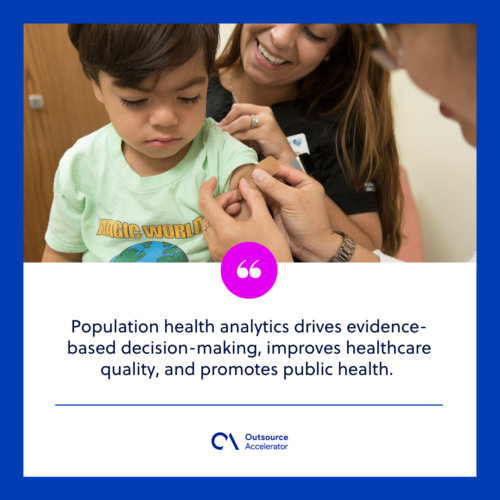
This work drives evidence-based decisions and better care quality. It also promotes public health. So providers and stakeholders can address issues at both the individual and population level.
How is population health data collected?
Data for population health analytics comes from many sources. This healthcare data is mined to reveal a population’s health status, behaviors, and outcomes.
Here are common ways to collect population health data:
Surveys and questionnaires
First, surveys and questionnaires gather self-reported details from people or households. For example, they ask about health conditions, lifestyle habits, and healthcare access.
Electronic health records (EHRs)
Similarly, EHRs hold medical data that providers collect during visits. They capture diagnoses, treatments, medications, lab results, and demographics. As a result, pooled EHR data gives a full view of a population’s health.
Administrative data
Administrative data shows healthcare use, costs, and procedures. So it helps analysts study population-level patterns and trends.
Administrative data includes:
- Insurance claims
- Billing records
- Hospital discharge records
Vital statistics and registries
Likewise, vital statistics give demographic and health details about a population. For example, they include birth and death records. Meanwhile, disease registries track people diagnosed with certain conditions.
Biometric and wearable devices
Thanks to new technology, biometric devices, and wearables can collect real-time data. Most often, these are fitness trackers or smartwatches.
These devices track activity, heart rate, and sleep patterns. As a result, they offer useful insights into individual and population health.
Social determinants of health (SDOH) data
SDOH data covers non-medical factors that shape health outcomes.
This covers:
- Socioeconomic status
- Education
- Housing
- Environmental conditions
This data can come from surveys, records, or community assessments.
Epidemiological studies and clinical trials
Research studies also collect data on a set population. For example, they study disease rates, risk factors, and treatment results. So they provide valuable data for analysis and decisions.
Challenges involved with population health analytics
Population health analytics faces several challenges. These can affect how well it works.
Data quality and interoperability issues
Good data quality is vital for accurate analytics. However, several issues can get in the way:
- Inaccurate or incomplete data – Missing values and errors can weaken results.
- Lack of standardization – Data arrives in many formats. So it is hard to combine and analyze.
- Limited interoperability – Systems may not share data well. This blocks a full view of population health.
Because of this, many providers turn to data management outsourcing to clean and organize records.
Privacy and security concerns
Population health analytics handles sensitive patient data. So firms must keep it well protected.
- Protected health information (PHI) – This work must follow privacy rules such as the Health Insurance Portability and Accountability Act (HIPAA). Keeping data secure can be complex.
- Data breaches and cyber threats – Digital data brings the risk of breaches. These can expose private health information.
Resource constraints and technical barriers
Indeed, this work needs real resources. For example, it needs funding, technology, and skilled staff.
- Limited funding – Tight budgets make it hard to invest enough.
- Technical expertise and training – A shortage of pros with data and analytics skills limits progress.
- Technological limitations – Old systems can slow data work. Upgrades can be costly and slow.
To ease this strain, some organizations use healthcare outsourcing for extra capacity.
Ethical and legal considerations
Population health analytics raises ethical questions. These cover data ownership, consent, and responsible use.
- Data ownership and consent – Ownership and consent can be complex. Firms must balance privacy rights with public benefit.
- Legal and regulatory landscape – New data laws add duties. Examples include GDPR and rules specific to health data.
Bias and equity issues
Bias in health data can deepen health gaps.
- Data bias – Analytics leans on past data. This data may hold existing biases. So it can lead to skewed conclusions.
- Health disparities – Social determinant data can be hard to gather. This limits efforts to address health gaps.
Benefits of population health analytics
Population health analytics brings many benefits. Above all, it improves outcomes and supports public health.
Some key benefits include:
Identifying health trends and patterns
In particular, analytics helps spot health trends within or across populations. By studying large datasets, teams can detect outbreaks and risk factors. As a result, they can design targeted actions.
Predictive modeling for disease prevention and intervention
This work uses predictive models to forecast health outcomes. So it can flag people at high risk of certain diseases. In turn, providers can step in early with prevention. Modern predictive analytics tools make this faster and more accurate.
Assessing the impact of interventions and healthcare policies
Likewise, analytics helps evaluate programs and policies. By comparing outcomes before and after a change, teams can measure impact. As a result, leaders make data-driven policy choices.
Targeted interventions for high-risk populations
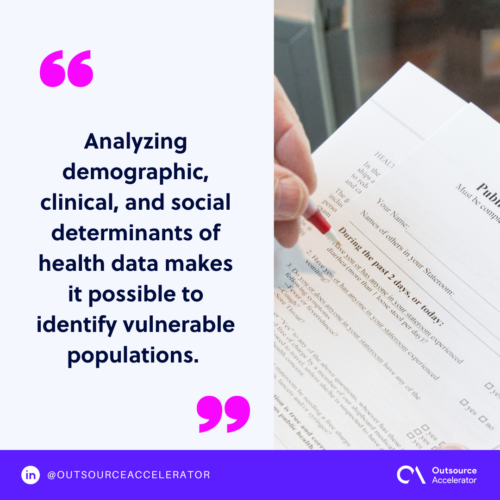
Analytics helps find high-risk groups that need extra support. Teams study demographic, clinical, and social determinants of health data to spot vulnerable people. So they can design actions that fit specific needs.
Evaluating healthcare outcomes and performance metrics
Analytics helps measure outcomes at the individual and population level. By studying usage data, organizations can find areas to improve. As a result, they support quality work and value-based care. Many teams add BPO services for healthcare to keep reporting on track.
Resource allocation and planning
In addition, analytics guides resource planning too. Organizations can find areas of high need and direct resources there. So they cut costs and deliver the right services to the right people.
Frequently asked questions about population health analytics
What is population health analytics used for?
It is used to study large health datasets. It finds trends, forecasts risk, and guides decisions. As a result, care and public health both improve.
Where does population health data come from?
Data comes from many sources. These include EHRs, surveys, claims, registries, and wearables. Together, they give a full view of a population.
What are the biggest challenges in population health analytics?
Common challenges include poor data quality and privacy risks. Limited funding and skills also slow progress. So does bias in historical data.
How does population health analytics improve care?
It flags risks early and guides targeted action. It also measures what works. In turn, providers deliver safer, more efficient care.
Key takeaways
- Population health analytics turns large datasets into useful insights.
- Data comes from EHRs, surveys, claims, registries, and wearables.
- Key challenges include data quality, privacy, cost, and bias.
- Benefits include early risk detection and better resource planning.
- Outsourcing can add the data skills and capacity many teams lack.






 Independent





