
How patient care coordination enhances healthcare services


What is patient care coordination and why does it matter?
Patient care coordination organizes a patient’s care across providers so it is safe, smooth, and connected.
- It links doctors, nurses, and caregivers around one plan.
- It cuts errors, delays, and repeat tests.
- It lifts patient outcomes and satisfaction.
Patient care coordination is a key part of high-quality healthcare. It treats the patient as a whole person, not a set of separate problems.
Good coordination brings continuity, teamwork, and shared information. As a result, care improves, costs drop, and patients feel more satisfied. The methods may vary by setting, but the core ideas stay the same. Read on to learn how patient care coordination improves healthcare services.
What is patient care coordination?
Patient care coordination focuses on delivering care that leads to the best outcomes. It relies on clear organization, communication, and teamwork. In short, it connects providers, patients, and caregivers across the full care journey.
Modern healthcare is complex. Patients often see many specialists in different settings. So patient care coordination acts as a guiding framework. It helps care stay efficient and effective.
At its core, this work has a few key parts. For example, it includes interprofessional teamwork. Here, providers from different fields work together to give complete, connected care.
Importance of patient care coordination in healthcare
Patient care coordination tackles the challenges of modern health systems. Because of it, patients get steady care across many providers and settings.
It also strengthens continuity of care. It does this through clear communication and information sharing among healthcare professionals. As a result, medical errors drop and outcomes improve.
Patients also take a bigger role in their own care. So engagement and satisfaction both rise. Many providers now use healthcare outsourcing to keep this support running smoothly.
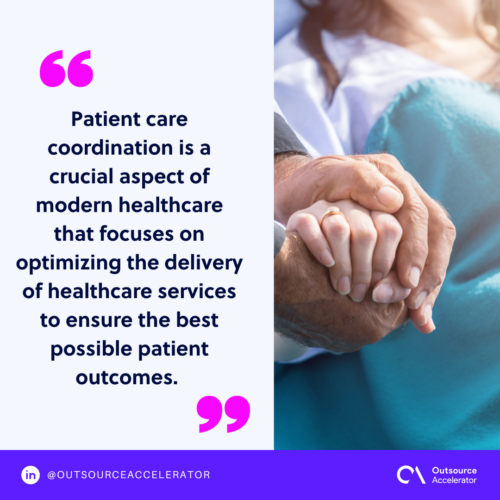
Benefits of patient care coordination
Patient care coordination offers many benefits for patients and health systems. Above all, it lifts the quality, safety, and efficiency of care.
Here are some ways it improves healthcare services:
Enhanced continuity of care
Patient care coordination keeps care smooth across many providers and settings. It shares records, test results, and treatment plans among the team.
As a result, fragmented care drops. So does the risk of conflicting advice or repeat tests. In turn, care becomes safer and better connected.
Improved healthcare outcomes
Good coordination links to improved healthcare outcomes. It cuts delays by timing appointments, tests, and treatments well.
It also helps prevent errors, such as drug interactions or missed steps. Because of this, patients see better results and fewer readmissions.
Increased patient satisfaction
Patient care coordination brings patients into their own care. It helps them join key decisions.
As a result, patients feel more informed and supported. So their experience and satisfaction both improve.
Cost savings and efficiency
Coordination helps providers streamline care and cut waste. For example, it avoids repeat tests and duplicate treatments. It also reduces hospital readmissions.
Because of this, systems save money and use resources better. In turn, care reaches the right patients at the right time. A medical call center can support this by handling scheduling and follow-ups.
Better patient safety
Moving between care settings can be hard for patients. So patient care coordination manages these transitions with care.
It arranges discharge plans, follow-up visits, and clear instructions. As a result, care stays steady during each handoff. This improves safety and cuts complications.
Key elements of effective patient care coordination
Strong patient care coordination rests on a few key parts. These building blocks help providers, patients, and caregivers work as one team. The next sections explore each one.
Interprofessional collaboration
Interprofessional collaboration means providers from different fields work together. It needs teamwork, respect, and shared decisions.
Care coordinators help by setting clear lines of communication. So information flows well and the team stays aligned. As a result, patients get better care and a smoother experience.
This is exactly what a third-party healthcare provider should aim for. For instance, Connext Global‘s healthcare services support a cohesive, patient-centered approach across the care journey.

Communication and information sharing
Communication is a fundamental element of patient care coordination. It means a clear, timely exchange of information among providers, patients, and caregivers.
Good communication keeps everyone up to date. For example, it shares records, test results, treatment plans, and care instructions. As a result, the whole team works from the same facts.
Care transition management
Care transitions happen when patients move between settings. For example, they may go from hospital to home, or primary care to a specialist.
Good transition management keeps care steady and prevents gaps. Care coordinators lead this work. They arrange discharge plans and follow-up visits. They also check medications and give patients clear self-care resources. Strong remote healthcare staffing can add extra support during busy periods.
Patient engagement and empowerment
Patient engagement means patients take an active role in their care. Care coordinators support this by teaching patients about their conditions and options.
They urge patients to ask questions and share preferences. So patients help shape their own care plans. In addition, shared decisions and clear resources build patient empowerment. This overlaps closely with patient care management, which guides long-term health goals. Many providers add healthcare BPO support to keep these efforts on track.
Frequently asked questions about patient care coordination
What does a patient care coordinator do?
A care coordinator organizes a patient’s care across providers. They set up appointments, share records, and manage handoffs. As a result, care stays smooth and safe.
Why is patient care coordination important?
It cuts errors, delays, and repeat tests. It also lifts outcomes and patient satisfaction. In short, it makes care safer and more efficient.
How does care coordination reduce costs?
It avoids duplicate tests and treatments. It also lowers hospital readmissions. So health systems save money and use resources better.
Can patient care coordination be outsourced?
Yes. Many providers use trusted partners for support tasks. For example, they outsource scheduling, follow-ups, and record management. This frees clinical teams to focus on care.
Key takeaways
- Patient care coordination connects providers around one clear plan.
- It improves continuity, safety, and health outcomes.
- Strong communication and teamwork are its core elements.
- Good coordination cuts costs and reduces readmissions.
- Trusted partners can support coordination tasks at scale.






 Independent





