
Navigating staff shortages and high costs with remote healthcare staffing


What is remote healthcare staffing and how does it help?
Remote healthcare staffing uses offsite or offshore teams to handle billing, scheduling, and other support tasks, so clinics can fill gaps, cut costs, and keep staff focused on patients.
- It eases staff shortages without adding local overhead.
- It can cut labor costs by 20% to 70% versus on-site roles.
- It lets health systems scale support up or down in weeks.
Remote healthcare staffing is fast becoming a key fix for a deep workforce crisis. The U.S. healthcare system faces growing strain. Demand keeps rising with an aging population and more chronic conditions. However, staffing levels lag far behind.
The Association of American Medical Colleges projects a shortfall of 86,000 physicians by 2036. Meanwhile, nursing shortages run even sharper. Studies predict over 1 million fewer nurses by 2030. In addition, nearly 40% of current nurses plan to leave the profession within five years.
The American Hospital Association warns of a possible gap of about 100,000 critical healthcare workers by 2028. So the impact hits rural and underserved areas hardest. As a result, hospitals and clinics already struggle to keep care timely and safe.
Costs have risen just as fast as demand. Between 2019 and 2022, provider labor costs rose more than 20%. Meanwhile, total operating expenses climbed 17.5%. Staff turnover makes it worse. For example, each time bedside nurses cycle through, hospitals can lose between $5.2 and $9 million. To fill gaps, many turn to contract staffing. However, agency rates have surged 213% since 2019, with margins above 60%.
So healthcare leaders must balance budgets with strong patient care. As a result, some analysts now call outsourcing Revenue Cycle Management (RCM) and support functions a strategic must.
The financial toll of turnover and understaffing
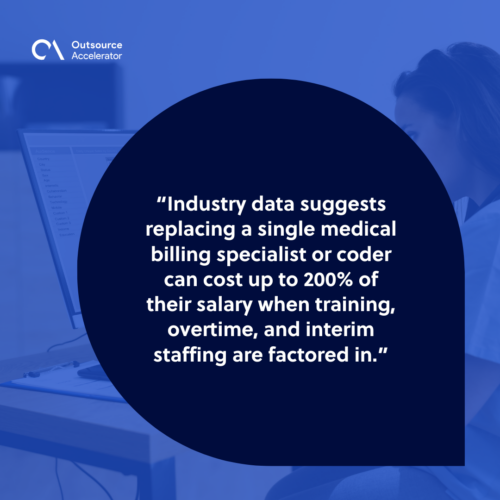
Vacancies carry direct costs like recruiting, onboarding, and training. However, they also bring hidden ones. For example, productivity drops, burnout rises, and temporary labor costs more. Industry data suggests replacing one medical billing specialist or coder can cost up to 200% of their salary. This counts training, overtime, and interim staffing.
By contrast, outsourcing back-office roles can save 20% to 30% versus in-house teams. In one survey, 77% of providers who outsourced whole departments for over five years reported better service. In addition, nearly half saw improved ROI.
Savings are more than spreadsheet numbers. For example, every dollar saved on overhead can go back into clinical care. Deloitte reports that outsourcing billing, data entry, and similar work can save U.S. providers millions each year.
Cutting admin work also helps retain clinical talent. As one provider puts it, “Healthcare providers can reduce costs, improve efficiency, and maintain high-quality patient care without disruption.” So remote staffing does more than cut expenses. In short, it turns fixed labor costs into flexible, performance-driven spending, even when margins are tight.
Remote staffing as a strategic solution
Remote staffing uses offsite or offshore teams to handle support roles. So it has become a practical answer to these challenges. These teams can be onshore, nearshore, or offshore. In addition, they cover many non-bedside tasks:
- Medical coding and billing: Offshore coders speed up claims and reduce denials.
- Patient scheduling and records: Virtual assistants handle booking and updates, so on-site staff gain time with patients.
- Insurance verification and authorizations: Remote teams confirm coverage and secure pre-authorizations. As a result, patients get care faster.
- Telehealth coordination: Virtual medical assistants organize digital visits and follow-ups around the clock.
- Patient support lines: Remote call centers handle routine questions and triage non-urgent issues.
These functions let clinical teams focus on care, not paperwork. In addition, remote teams can scale up or down in weeks, not months. Many partners also specialize in healthcare compliance. For example, they offer HIPAA-trained staff and secure systems to protect patient data. Done right, remote staff keep service steady and cushion the loss of local staff.
Virtual nursing and telehealth support
Remote staffing now reaches clinical support through virtual nursing. Registered nurses working remotely can handle documentation, patient education, and follow-up calls. In fact, these tasks eat up to 40% of an on-site nurse’s shift. Early adopters report strong results. For example, one Philadelphia hospital cut length-of-stay by 7% and readmissions by 2% after adding virtual nursing. Meanwhile, two other hospitals saw nurse turnover drop by more than 70% when virtual RNs worked with on-site teams.
These nurses are not bound by geography. For example, some providers hire licensed foreign nurses trained to U.S. standards under nearshore models. So a Caribbean-based RN can follow U.S. protocols at lower cost. As a result, patients get triage, follow-ups, and medication reminders with reliable, 24/7 support.
Remote Patient Monitoring and care coordination
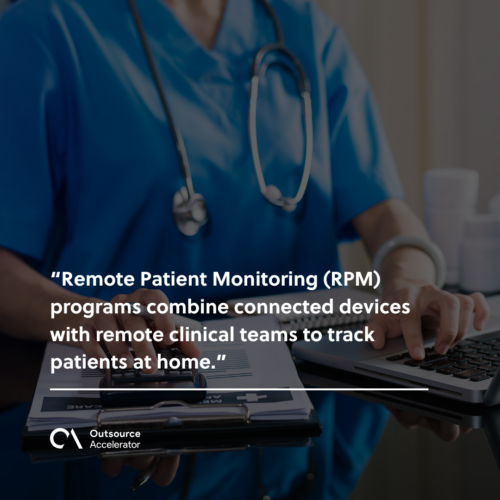
Remote Patient Monitoring (RPM) programs pair connected devices with remote clinical teams. So they track patients at home, catch problems early, and cut readmissions. For example, one managed RPM service used offshore nurses to triage alerts in real time. As a result, they filtered false alarms and stepped in when needed. In addition, a partner organization cut its on-site telehealth nursing team in half. So it saved around $10,000 a year while improving patient adherence.
Benefits of remote healthcare staffing
The advantages are clear:
- Cost savings: Offshore roles can cut labor costs by 20% to 70% versus on-site ones. In addition, nearly half of providers report positive ROI.
- Scalability and flexibility: Teams can grow fast for surges or scale back when demand dips.
- Productivity gains: By shifting routine tasks offsite, clinicians focus on care. For example, one survey found 56% of medical practices reported higher productivity after adding hybrid or remote support.
Remote staffing is not just about trimming budgets. It also extends care capacity and helps prevent burnout. As one expert notes, “The future of healthcare is global, agile, and remote.”
Implementation considerations in remote healthcare staffing
To succeed, these programs need careful planning. So keep these steps in mind:
- Identify roles suited to remote work. First, target admin and protocol-driven clinical tasks.
- Select experienced partners. Choose providers with proven compliance, language skills, and secure systems.
- Integrate seamlessly. Share workflows, training, and communication to keep teams aligned.
- Protect data rigorously. Require encryption, role-based access, and audit trails.
- Measure performance. Track claims turnaround, patient satisfaction, and workload to show impact early.
Done well, remote staffing strengthens patient care rather than replacing it. In fact, virtual nurses, RPM programs, and offshore back-office hubs are no longer experimental. Instead, they are key strategies for quality in a strained labor market.
The path forward for remote healthcare staffing
Staff shortages and rising costs demand fresh ideas. So remote staffing gives leaders a way to ease pressure, control costs, and keep patients first. By shifting admin work and supporting virtual care, health systems can stay efficient under strain.
As one industry analysis puts it, “now is the time for healthcare providers to rethink their staffing strategies and embrace outsourcing as a sustainable solution.” So for CEOs and executives, remote staffing is not a temporary fix. Instead, it builds a more agile, scalable workforce that helps both patients and the bottom line.
Frequently asked questions
What is remote healthcare staffing?
It uses offsite or offshore teams to handle healthcare support tasks. For example, they cover billing, scheduling, and insurance checks. So local staff can focus on patients.
Is remote healthcare staffing HIPAA compliant?
It can be, with the right partner. Good providers use HIPAA-trained staff and secure systems. In addition, they add encryption and audit trails to protect data.
How much can remote healthcare staffing save?
Savings vary by role and location. However, offshore roles can cut labor costs by 20% to 70%. In addition, many providers report better ROI.
Can nurses work remotely?
Yes. Virtual nurses handle documentation, education, and follow-up calls. As a result, on-site teams gain more time for bedside care.
What tasks work best for remote healthcare teams?
Admin and protocol-driven tasks fit best. For example, coding, billing, scheduling, and insurance verification are common choices.
Key takeaways
- Remote healthcare staffing helps fill gaps left by physician and nurse shortages.
- It can cut labor costs by 20% to 70% while keeping care quality high.
- Virtual nursing and RPM extend care beyond the bedside.
- Careful planning and strong compliance make these programs work.






 Independent





