
How to start a corporation in India


How do you start a corporation in India?
To start a corporation in India, meet the minimum requirements, pick a business structure, register with the authorities, and follow local labor laws.
- You need at least two shareholders and two directors, with one Indian resident director.
- Register the company and get a Certificate of Incorporation.
- Follow Indian labor laws, including EPFO and ESIC rules.
India is a strong place to build a business. Still, the legal side calls for a clear grasp of the basics.
You must know the key requirements, the legal duties, and the rules under Indian labor laws. So a clear roadmap is a must. Many global firms also outsource to India before they set up a full corporation.
Here is a simple guide to kickstart your journey. In this article, learn how to start a corporation in India.
How to start a corporation in India: List of minimum requirements
Setting up a corporation calls for a few set prerequisites. These come from the legal framework.
Before you begin, get to know the basic criteria. These form the base of any corporation.
These minimum rules are the pillars for a company. So they keep you in line with Indian corporate law.
Here are the minimum requirements to start a corporation in India:
| How to start a corporation in India: Minimum requirements | |
| Requirements | Purpose |
| At least 2 shareholders | Ensures shared ownership and investment in the company |
| At least 2 directors | Establishes a governing body for decision-making and compliance |
| An Indian resident director | Ensures local representation and compliance with residency regulations |
| Registered office | Serves as the official address for communication and legal notices |
| Capital | Forms the initial financial base for company operations |
| Digital Signature Certification | Enables secure online transactions and document filing |
At least 2 shareholders
You need at least two shareholders. This is a core rule.
These shareholders can be people or firms. They help fund the company’s share capital. As a result, they shape its organizational structure and ownership.
So securing two shareholders is a key step on the roadmap to start a corporation in India.
At least 2 directors
Like the shareholder rule, a corporation in India needs at least two directors. These directors form the governing body. So they steer decisions and compliance.
One director must be an Indian resident. This person needs a Director Identification Number (DIN) from the Ministry of Corporate Affairs.
This rule ensures local presence in leadership. It also fits the wider regulatory framework.
So knowing the two-director rule is part of the broader process of how to start a corporation in India.
An Indian resident director
The Companies Act of India sets this rule. You need at least one director who has lived in the country for at least 182 days in the past calendar year.
This residency rule ensures a local voice in company governance. As a result, it builds a deeper tie to the Indian business scene.
Registered office
You must also set up a registered office. It serves as the formal address for the corporation. So it marks the company’s official presence in India.
Capital
Unlike some countries, India sets no minimum capital rule. However, you must disclose the authorized capital during setup.
This capital is the top value of shares a company can issue. So it shows transparency and financial trust during formation.
Digital Signature Certificates (DSCs)
Digital Signature Certificates (DSCs) enable secure online transactions, document filing, and dealings with government bodies.
India leans on digital, streamlined steps. So DSCs confirm that electronic documents are real. As a result, they support compliance and build trust in corporate deals.

Legal requirements for incorporating in India
How do you start a corporation in India? First, you must meet several legal requirements when you incorporate.
These steps keep you in line with the rules set by Indian regulators. To plan costs, it also helps to know the average salary in India.
Certificate of Formation
You must secure a Certificate of Incorporation from the Registrar of Companies (RoC). This is the first step to incorporate in India.
To get it, you submit key documents and meet set criteria. Regulators define these rules.
The Certificate of Formation marks the company as a legal entity. So it is a base requirement for the following:
- Commencing operations
- Opening bank accounts
- Engaging in business activities within the country
Company name availability
Picking a unique, available name is also key. So check the name before you register.
You must confirm the name is free and fits the Companies Act guidelines. As a result, you avoid conflicts and legal hurdles later.
A clear, compliant name gives your corporation a strong base for its identity and branding.
Founder’s agreement
A founder’s agreement is not required. Still, it adds huge value by setting clarity among founders. It acts as a blueprint of roles, duties, and ownership.
It also helps prevent disputes. So it spells out what each founder expects.
The agreement covers decisions, equity splits, and dispute steps. As a result, it supports a calm, cohesive working setup.
By outlining these points early, a founder’s agreement cuts confusion. So co-founders share the same understanding.
Legal Licenses and permits
You must secure the right licenses and permits to operate legally in India. The type of business sets the licenses you need. These range from industry permits to general business licenses.
Regulators enforce these rules for safety and compliance. So you must meet local and industry laws.
This may cover food, health, trade, or professional permits. However, missing a license can bring legal trouble. As a result, it can stall your operations.
Business entity registration
India offers several business structures. Next, let us explore each one, including how to register it. To compare markets, you can also review how to start a corporation in the Philippines.
Sole proprietorship
A sole proprietorship is a simple structure. One person owns and runs the business.
This setup gives full control and easy decisions. However, the owner is personally liable for all debts.
Steps to register:
- Acquire necessary business licenses and permits based on the nature of the business.
- Register for Goods and Services Tax (GST) if applicable.
- Open a bank account in the name of the proprietorship using the owner’s PAN card.
One Person Company (OPC)
An OPC supports solo entrepreneurs. It lets one person run a corporate entity. So it offers limited liability, which keeps personal assets apart from business debts.
Steps to register:
- Obtain Digital Signature Certificates (DSC) for directors and shareholders.
- Apply for a Director Identification Number (DIN) for the sole director.
- Apply for name approval of the OPC.
- Draft the Memorandum of Association (MOA) and Articles of Association (AOA) and submit them for registration.

Partnership firm
A partnership has two or more people. They share ownership, duties, and profits. It is flexible and easy to form. Still, partners are jointly liable for debts.
Steps to register:
- Choose a unique name for the partnership.
- Draft a partnership deed outlining the terms and conditions.
- Register the partnership deed with the Registrar of Firms in the state where the business operates.
Private limited company
A private limited company is a separate legal entity from its owners. It gives limited liability to shareholders and follows strict rules. So it suits medium to large businesses.
Steps to register:
- Obtain DSC for directors and shareholders.
- Apply for DIN for all directors.
- Apply for name availability and obtain approval.
- File the initial draft of the Indian Memorandum and Articles of Association.
- Attain a Certificate of Incorporation from the Registrar of Indian Companies.
Public limited company
A public limited company suits large operations. It lets the public buy shares through stock exchanges. It also gives limited liability to shareholders.
Steps to register:
The first steps match those of a private limited company.
However, public companies must meet extra rules. For example, they must issue a prospectus and get a certificate for the commencement of business.
Adherence to Indian Labor Laws
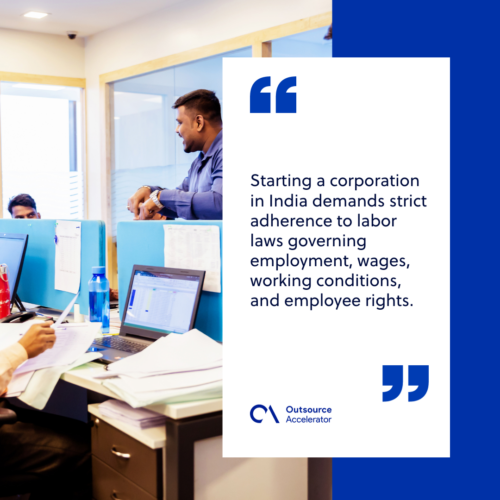
To start a corporation in India, you must follow labor laws. These cover employment, wages, working conditions, and employee rights.
You must comply with the Employees’ Provident Fund Organization (EPFO) and the Employee’s State Insurance Corporation (ESIC). So plan for these from the start. Some firms also outsource tax preparation in India to stay compliant.
How to start a corporation in India: Follow the guidelines
How do you start a corporation in India? It can be a complex yet rewarding journey.
With a clear grasp of the requirements, legal duties, and labor laws, you can navigate the process with ease. It also helps to see which companies that outsource to India already trust the market.
As you start, seek help from legal experts or company formation consultants. So the setup goes smoothly.
The steps above give you a strong starting point to build a corporation in India. Good luck on this journey.
Frequently asked questions
What are the minimum requirements to start a corporation in India?
You need at least two shareholders and two directors. One director must be an Indian resident. You also need a registered office, capital, and Digital Signature Certificates.
Does India require a minimum capital to incorporate?
No. India sets no minimum capital rule. However, you must disclose the authorized capital during setup.
What business structures can I register in India?
You can choose a sole proprietorship, One Person Company, or partnership firm. You can also form a private limited or public limited company.
Do I need an Indian resident director?
Yes. At least one director must have lived in India for 182 days in the past year. This ensures local presence in leadership.
How long does it take to start a corporation in India?
Timelines vary by structure and paperwork. Name approval and document filing take the most time. So a consultant can help speed things up.
Key takeaways
- Start a corporation in India by meeting set minimum requirements.
- You need two shareholders, two directors, and one Indian resident director.
- Get a Certificate of Incorporation and pick the right business structure.
- India sets no minimum capital, but you must disclose authorized capital.
- Follow labor laws, including EPFO and ESIC rules, from day one.






 Independent





