
The role of a hiring manager: Key responsibilities and best practices


What does a hiring manager do?
A hiring manager leads the recruitment, interview, and selection of candidates for a team, and they often work with HR and outsourcing partners to fill roles fast.
- They set the hiring needs and skills for each open role.
- They screen, interview, and choose the best candidates.
- They coordinate with HR and outside providers to speed up hiring.
Hiring managers play a key role in shaping an organization’s workforce. In companies that partner with outsourcing firms, their work grows even more dynamic. So they must team up both inside the company and with outside providers.
This teamwork helps the company attract the right talent, from outsourced roles to internal ones, through a smooth process. For example, when a hiring manager aligns with in-house goals and outsourcing expertise, good things happen. As a result, they fill roles faster, onboard with ease, and add value to growth. In this article, we look at the role of a hiring manager and how they make hiring smoother.
What is a hiring manager?
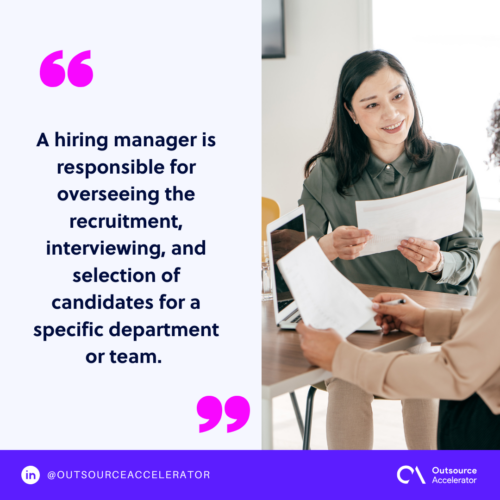
A hiring manager oversees the recruitment, interview, and selection of candidates for a team or department. In most companies, the HR team usually handles the early stages. So the hiring manager steps in with department knowledge and clear role needs.
Their insight makes sure each hire fits the role on skills and on culture. In companies that use outsourcing firms, the hiring manager links internal teams with the provider. As a result, they tap extra recruitment resources, reach a wider talent pool, and speed up hiring for niche roles. This often works best as part of a wider recruitment process outsourcing plan.
5 key responsibilities of a hiring manager
The hiring manager usually handles these core duties:
1. Collaborating with HR and senior management
First, a hiring manager must grasp the hiring needs of their team. So this means close work with HR and senior leaders. Together, they define the skills needed, set timelines, and agree on budgets. As a result, expectations stay clear for both in-house and outsourced roles. When outsourcing is involved, the manager also makes sure partners fully understand each role.
2. Crafting effective job descriptions
Next, the right job description attracts the right people. So hiring managers work with HR to craft detailed descriptions that list duties, skills, and qualifications. For outsourced roles, clarity matters even more. For example, outsourced candidates often need extra detail on tasks, culture, and reporting lines. In the end, a clear description helps HR and providers attract the right fit.
3. Screening and shortlisting candidates
Once applications arrive, the hiring manager screens resumes and spots strong candidates. This step checks technical skills and job experience. For firms that use outsourcing, it may also include pre-vetted candidates from the partner. In addition, managers may run first interviews to test fit, communication, and culture. Good talent sourcing makes this stage far easier.
4. Leading the interview process
Hiring managers lead the interview process with HR and other stakeholders. So they prepare role-specific questions and set up any skills tests. A structured interview process helps them judge each candidate fairly. This step matters most for outsourced roles. For example, it shows how well a candidate fits remote and outsourced work.
5. Decision-making and extending offers
Finally, the hiring manager makes the call and extends an offer. With HR, they set pay, benefits, and terms, then share these with the chosen candidate. For outsourced roles, they often align with the partner to keep terms clear. As a result, onboarding starts smoothly and the working relationship gets off to a strong start.
Best practices for hiring managers
Keep these best practices in mind for the hiring managers you source:
1. Define clear hiring goals and requirements
Clear, reachable hiring goals are vital for any hiring manager. When companies use outsourcing providers, this clarity matters even more. So clear goals help you judge a new hire’s performance against a real benchmark.
2. Build a structured interview process
A structured interview process lets managers assess candidates in a consistent way. As a result, it reduces bias and makes hiring more efficient. This structure helps most for firms that partner with outsourcing teams. For example, it sets one standard for both in-house and outsourced candidates. So managers can build a set list of questions on key skills and judgment to compare people fairly. Strong structured interviews keep the whole process objective.
3. Engage in proactive candidate outreach
To attract top talent, hiring managers should reach out in a proactive way. For example, they can use professional networks, social media, and outsourcing partners. As a result, this outreach builds a pipeline of qualified candidates. It also strengthens the employer brand and draws people who share the company’s mission.
4. Enhance the candidate experience
Candidate experience is now a critical part of hiring. A good experience leaves a lasting mark and lifts the employer brand. So managers can create it through clear communication, timely feedback, and respect for a candidate’s time. When working with partners, this experience shapes both reputation and future talent. In addition, strong talent acquisition depends on it.
Frequently asked questions
What is the difference between a hiring manager and a recruiter?
A recruiter finds and screens candidates, often across many roles. A hiring manager owns the final choice for their own team. So the recruiter fills the pipeline, while the manager picks the best fit.
What skills make a good hiring manager?
Good hiring managers communicate clearly and judge skills well. In addition, they plan ahead and work smoothly with HR and partners. Because of this, they fill roles faster and with better fit.
How does a hiring manager work with an outsourcing partner?
The hiring manager shares role needs, goals, and culture with the partner. Then the partner pre-vets candidates and sends the strongest ones through. As a result, the manager saves time while keeping control of the final choice.
How can a hiring manager reduce bias in hiring?
The best way is a structured interview process with set questions. For example, every candidate answers the same prompts and skills tests. So the manager can compare people fairly and judge them on merit.
How does a hiring manager improve the candidate experience?
Clear, timely communication is the biggest factor. For instance, quick updates and honest feedback show respect for a candidate’s time. In turn, this builds a strong employer brand that draws future talent.






 Independent






