
The registered nurse shortage is now a hospital revenue crisis. Here’s how global healthcare BPO is becoming the quiet solution.

This article is a submission by Corpshore Solutions, a multinational business process outsourcing (BPO) management consortium, Information Technology (IT) Outsourcing & Artificial Intelligence (AI)-Delivery provider.
Reading time: ~10 minutes
How is global healthcare BPO helping hospitals with the nurse shortage?
Global healthcare BPO moves non-clinical admin work to trained offshore teams, so in-house nurses can spend their time on patient care.
- The nurse shortage is now a revenue problem, not just a staffing one.
- Nurses lose a quarter to a third of their time to paperwork that others could do.
- Global healthcare BPO absorbs that work at 60% to 75% below in-house cost.
The story hospital CFOs are not telling their boards
In nearly every health system in the United States, a quiet drama plays out behind the public talk about the nursing shortage.
The American Hospital Association has projected a shortage of more than 100,000 registered nurses by 2028. The US Bureau of Labor Statistics estimates an average of 195,400 RN openings per year through 2032. This is driven by retirements, staff leaving, and an aging patient population.
These are the figures quoted in news articles and political speeches.
But the figures quoted in hospital boardrooms, the ones the CFOs watch, are different. They are also more consequential:
- Medical coding backlogs at major US health systems are eating up 8% to 12% of net revenue in delayed and denied claims
- Length-of-stay extensions driven by nursing capacity limits cost acute care hospitals $1,500 to $2,500 per patient per day in unrecovered costs
- Locum nurse rates in many US markets have climbed to $150 to $250 per hour, three to four times the levels seen before 2020
- Prior authorization workloads now take an average of 14 hours per physician per week, time that comes straight out of clinical productivity
- Emergency department boarding, the practice of holding admitted patients in the ED because no inpatient bed is free, has reached crisis levels at many urban health systems
These are not separate problems. Instead, they are connected signs of the same underlying issue: the people who should be doing clinical work spend too much time on non-clinical work, and the people who should be doing non-clinical work do not exist in enough numbers to absorb the volume.
As a result, the nursing shortage is no longer just a clinical staffing problem. It is a hospital revenue crisis. And it is being solved quietly, deliberately, and at scale by a type of outsourcing partner most health system leaders have not yet heard of: global healthcare BPO operators that absorb the non-clinical work, freeing internal clinical staff to do the work only clinical staff can do.
This article is about what that solution looks like, why it works, and how Corpshore Talent’s healthcare BPO practice has been built around exactly this opportunity.
What “non-clinical work” actually means in a modern health system
The phrase “non-clinical work” does a lot of heavy lifting in the talk about healthcare workforce shortages. So it is worth unpacking what it covers, because the volume is huge and still growing.
At the bedside and in the clinic:
- Clinical documentation and chart completion
- Prior authorization phone calls and faxes
- Insurance verification and benefits checking
- Medication reconciliation administration
- Care coordination phone calls with payers and post-acute facilities
- Patient education material distribution and follow-up
In the back office:
- Medical coding (ICD-10, CPT, HCPCS) for inpatient and outpatient encounters
- Charge capture review and reconciliation
- Claims preparation, submission, and follow-up
- Denied claims appeals and rework
- Patient access registration and financial counselling
- Health Information Management (HIM), release of information, transcription review, deficiency tracking
- Revenue cycle analytics and performance reporting
In compliance and risk:
- Patient consent management
- HIPAA compliance documentation
- Quality measure abstraction
- Regulatory reporting (CMS, state agencies)
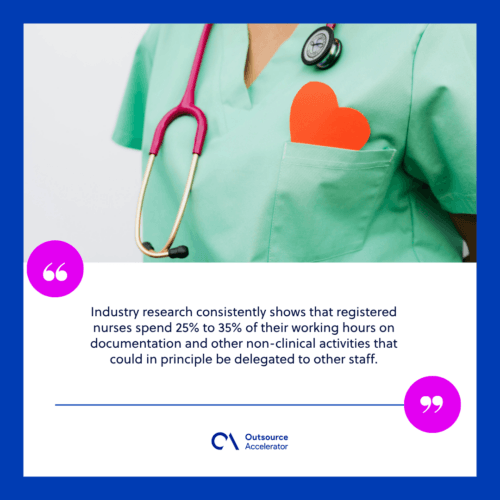
Industry research shows a clear pattern. Registered nurses spend 25% to 35% of their working hours on documentation and other non-clinical tasks that could be handed to other staff. Physicians spend even more. In fact, 49% of their working time goes to administrative tasks rather than direct patient care, according to research published in the Annals of Internal Medicine.
When there are not enough nurses to do clinical work, asking nurses to also do non-clinical work makes no sense.
Yet many US health systems do exactly that. The alternative, hiring more admin staff in their local market, is either too expensive or simply impossible given local labour market conditions.
Global healthcare BPO is the structural alternative.
How global healthcare BPO works in practice
The model is simple in concept. A health system picks categories of non-clinical work that can be done off-site. Then a healthcare BPO partner takes ownership of those workflows under a service-level agreement. The partner delivers them from offshore or nearshore centres staffed by trained healthcare administrative professionals.
The work still meets US healthcare standards (HIPAA, payer-specific protocols, hospital-specific policies). But it runs at a fraction of US labour cost, typically 60% to 75% below in-house staffing costs.
The work that suits this model well includes:
- Medical billing and coding, ICD-10, CPT, and HCPCS coding for inpatient and outpatient encounters
- Prior authorization operations, phone calls, fax submissions, payer portal interactions
- Insurance verification and patient access, benefits checking, eligibility confirmation, financial counselling
- Claims processing and denial management, claim submission, follow-up, appeals, rework
- Revenue cycle analytics, KPI dashboards, AR aging analysis, payer performance reporting
- Health Information Management, release of information, chart abstraction, deficiency tracking
- Clinical documentation review, non-clinical aspects of chart completeness and accuracy
- Patient communications, appointment scheduling, reminders, satisfaction surveys, billing inquiries
Corpshore Talent’s Healthcare BPO service delivers across this full set of categories. It runs with a HIPAA-ready operational posture and a BAA available on request.
Why most US health systems have not yet adopted this model
If global healthcare BPO is so compelling, why is adoption among US health systems still fairly modest? The reasons are predictable, and worth addressing directly.
Reason 1: HIPAA and patient privacy concerns
Healthcare BPO needs the offshore delivery partner to run under HIPAA-aligned protocols. That means documented Business Associate Agreements (BAAs), data residency controls, and ongoing audit infrastructure.
Many BPO providers cannot meet this bar, especially those whose core business is not healthcare. So healthcare buyers default to vendors they trust on HIPAA, even when those vendors cost more or do less.
Corpshore Talent’s healthcare BPO practice runs under a HIPAA-ready posture with a BAA available on request. Because of this, it addresses the concern directly at procurement. Choosing a partner that meets HIPAA standards is the first screen most buyers apply. Trust Center documentation is published at corpshoretalent.com/trust-center.
Reason 2: Quality risk perception
Health system leaders worry, reasonably, that offshore admin staff will not match the quality of US-based staff.
This concern is increasingly out of date. The healthcare BPO talent pools in the Philippines, India, and the Caribbean have matured. In fact, coding accuracy rates at leading offshore providers now beat those of average US-based teams.
Corpshore Talent’s healthcare BPO delivery is staffed by trained healthcare administrative professionals. Where required, they hold documented coding certifications (CPC, CCS, CCA).
Reason 3: Vendor consolidation paralysis
Many US health systems have let their healthcare operations vendors multiply. They use separate vendors for coding, billing, prior auth, claims, denials, and patient access. As a result, consolidation starts to feel impossible.
Corpshore Talent’s unified service stack lets health systems bring multiple workflows under a single vendor. So they get one consistent SLA, a single point of accountability, and aligned data infrastructure.
Reason 4: Implementation complexity perception
Health system leaders fear the disruption of moving operational workflows to a new vendor.
Corpshore Talent’s implementation model handles this through phased transitions. For example, it often begins with a single workflow, such as denied claims management for one service line. Then the scope grows as confidence in the partnership grows.
The revenue mathematics
The financial case for healthcare BPO is genuinely strong at today’s unit economics. Consider a mid-sized US regional health network with:
- 350 inpatient beds across three facilities
- $850M annual net revenue
- Combined coding, billing, prior auth, and patient access headcount of 180 FTEs
- Average US-loaded cost per FTE: $85,000 (salary, benefits, facilities, technology)
- Total annual operational cost: ~$15.3M
Now picture a Corpshore Talent healthcare BPO partnership delivering the same throughput across an offshore-nearshore hybrid model:
- Equivalent throughput delivered by 165 FTEs (a modest productivity uplift via AI augmentation)
- Blended cost per FTE: ~$28,000
- Annual partnership cost: ~$4.6M
- Annual saving: ~$10.7M (70% reduction)
This is the financial logic behind Corpshore Talent’s active healthcare engagements. For example, it includes a medical coding throughput project for a regional health network in the Southeast US and the sourcing of 12 RN case managers for a Midwest health system.
More revenue usually follows, too. Better coding accuracy reduces denied claims. Faster prior authorization cuts length-of-stay extensions. A smaller denials backlog speeds up cash flow. Strong revenue cycle management turns these gains into recovered cash.
For an $850M revenue health system, a 1% to 2% gain in net revenue capture means an extra $8.5M to $17M of recovered revenue. This often beats the operational cost savings on its own.
Why Corpshore Talent, and why now
Corpshore Talent’s healthcare BPO practice runs across an active multi-country footprint. This gives US health system clients several specific advantages:
HIPAA-ready operational posture: Documented protocols, BAA available, ongoing audit infrastructure, role-based access controls, secure data handling
Time-zone-matched delivery: Corpshore Talent’s Santo Domingo, Manila, and US delivery centers give US health system clients follow-the-sun coverage
AI-augmented coding workflows: Corpshore Talent’s AI-augmented service line offers AI-assisted coding suggestions that human coders review and verify, which lifts both throughput and accuracy
Throughput-based pricing: Health systems pay for completed work (claims processed, charts coded, prior authorizations completed) rather than vendor headcount, so vendor incentives line up with health system outcomes
Trust posture for procurement: HIPAA-ready with BAA, GL $2M / E&O $1M / Cyber $1M insurance, SOC 2 Type I on roadmap (first healthcare client engagement)
Mid-market healthcare focus: Corpshore Talent is built for health systems and revenue cycle organisations between 1,000 and 10,000 employees. This is exactly the buyer segment most underserved by both the Fortune 100 vendors (Accenture Health, Optum) and the small offshore providers
Corpshore Talent is backed by Corpshore Solutions Corporation , ranked among the world’s leading BPO providers by Outsource Accelerator. This includes #1 in the Philippines region and standing across multiple emerging healthcare BPO markets.
The question hospital executives should be asking
Most health system leaders still frame the nursing shortage as a recruiting problem. How do we hire more nurses? How do we keep the ones we have? How do we use locums to bridge gaps?
The more strategic question is the reverse: how much of our nurses’ working time are we spending on work that does not need a nurse to perform?
For most US health systems, the honest answer sits at 25% to 35%. That gap is the same as having 25% to 35% more clinical capacity than current headcount, without hiring a single extra clinician. You simply move the non-clinical work to a partner built to handle it. Managing the wider healthcare staffing crisis starts with that one shift.
That is what healthcare BPO does. That is what Corpshore Talent was built to deliver. And that is why this category is growing as quietly and quickly as it is.
Begin a conversation with Corpshore Talent
Corpshore Talent’s healthcare BPO practice is open for new engagements with US health systems, revenue cycle organisations, payers, and clinical research firms.
The team responds to all proposal requests within 48 hours with a worked plan, an indicative price, and a named senior operator.
About Corpshore Talent
Corpshore Talent (corpshoretalent.com) is the talent operations and managed workforce subdivision of Corpshore Solutions Corporation.
It delivers AI-augmented RPO, sourcing and research, outsourced HR operations, compliance operations, healthcare back-office BPO, customer support staffing, and AI-augmented talent services for healthcare, financial services, technology, and government subcontracting clients across 10 countries, 25 markets, and 15 languages. It is built specifically for the global mid-market.
About Corpshore Solutions Corporation
Corpshore Solutions Corporation (corpshore.solutions) is a global BPO, IT outsourcing, and AI services firm headquartered in Toronto, Canada. It has a US subsidiary (Corpshore Inc.) incorporated in Florida and headquartered in Miami.
It is ranked among the top BPO companies in the Philippines, USA, Canada, UK and ranked #1 by Outsource Accelerator in Uzbekistan, Ghana, Uganda, Turkey, New York, Los Angeles, and Washington DC.
Frequently asked questions about global healthcare BPO and the nurse shortage
What is global healthcare BPO?
Global healthcare BPO is the practice of moving non-clinical health system work to trained teams in offshore or nearshore centres. The work covers coding, billing, prior authorization, claims, and patient access. It runs against US standards like HIPAA, but at a much lower cost. So hospitals free up clinical staff while keeping quality and compliance intact.
Does healthcare BPO put patient data at risk?
Not when the partner is set up for it. A HIPAA-ready provider works under a signed Business Associate Agreement, with data residency controls, role-based access, and regular audits. These controls are the first thing buyers check. For this reason, a vendor that cannot show them should not handle protected health information.
How much can a hospital save with healthcare BPO?
Savings usually land at 60% to 75% below in-house staffing costs for the same work. For a mid-sized network, that can mean millions of dollars a year. On top of that, better coding and faster prior authorization often recover extra revenue, which can beat the direct cost savings.
Will offshore staff match the quality of US teams?
Mature providers now match or beat average US accuracy on tasks like medical coding. Their staff hold recognised certifications such as CPC, CCS, and CCA where the work needs them. Ongoing audits and oversight keep standards high over time.
How does healthcare BPO help with the nurse shortage?
Nurses spend a quarter to a third of their hours on admin work. When a BPO partner takes that work, nurses get those hours back for patient care. In effect, the health system gains clinical capacity without hiring a single extra nurse.






 Independent





