
Bookkeeping outsourcing: Costs, benefits & how to choose a provider in 2026


This article is a submission by Kinetic Innovative Staffing, a leading offshoring solution provider based in Australia. Kinetic Innovative Staffing offers access to a diverse, international talent pool, serving roles across operations, customer support, marketing, IT, and back-office functions.
What is bookkeeping outsourcing?
Bookkeeping outsourcing is the delegation of financial record-keeping functions—transaction coding, bank reconciliation, accounts payable/receivable processing, payroll ledger maintenance, and month-end close—to an external provider or offshore team.
The client retains strategic financial oversight while a third party manages the operational data layer.
In 2026, this most commonly means a Filipino offshore team embedded inside your accounting software stack, operating under structured compliance agreements and service-level frameworks.
Bookkeeping outsourcing in 2026: The full picture
The global finance and accounting business process outsourcing market reached USD 76.5 billion in 2026, according to Grand View Research, tracking toward USD 142.7 billion by 2033 at a 9.3% CAGR.
Within that market, growth isn’t evenly distributed. Source-to-Pay is the fastest-growing service segment, and Asia Pacific is the fastest-growing region (10.7% CAGR through 2033) — a sign that offshore delivery, rather than pure automation, remains a core growth driver even as AI and automation tools get layered into F&A BPO service offerings.
Bookkeeping Outsourcing Engagement Model Decision Tree 2026
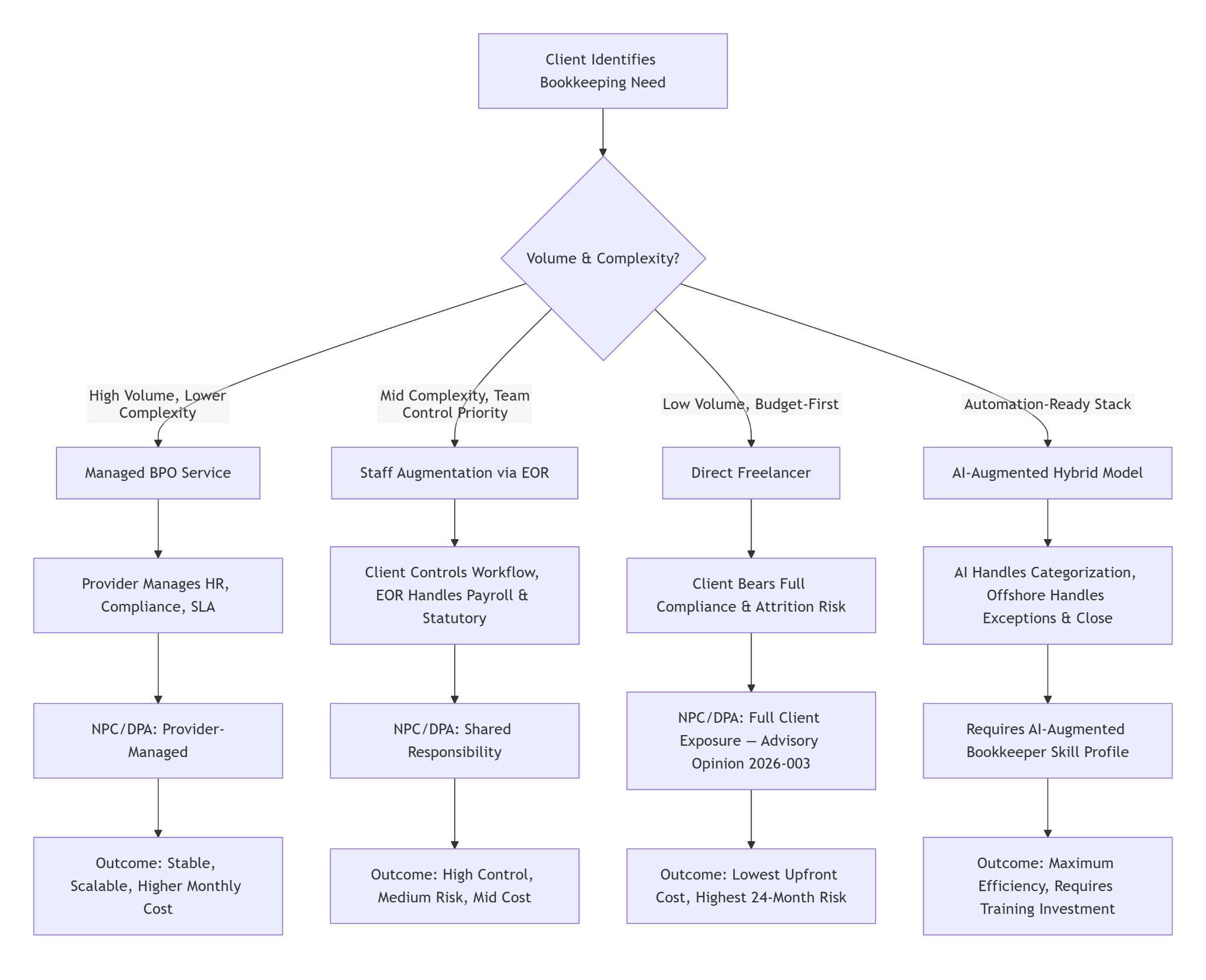
Mid-market U.S. firms with 50–500 employees are driving this shift, pairing tools like Dext and QuickBooks Online with Filipino bookkeeping teams handling exception management and close cycles.
This is a structural change in how the work gets divided—not a marginal efficiency play.
Why the 80% savings figure is misleading
The advertised 78–85% cost savings is real at the base salary level—but it erodes significantly once the full operational cost stack is applied. After accounting for software licensing, compliance infrastructure, onboarding, management oversight, and attrition replacement, real-world savings land at 52–61%.
That is still a compelling number. But firms that budget for 80% and land at 55% in month three tend to make reactive decisions—cutting training budgets that were already too thin.
The hidden cost stack
| Hidden Cost Item | Estimated Monthly Cost (USD) | Notes |
|---|---|---|
| Software licensing (QBO, Xero, Dext) | $85–$220 | Per-user seat costs multiply with team size |
| Secure VPN + endpoint security | $30–$60 | Required under NPC-mandated PIP-PIC compliance |
| Onboarding & training (amortized) | $120–$200 | First 90 days; drops to $40–$60 post-stabilization |
| Client data segregation infrastructure | $50–$90 | Required under Philippine Data Processing Agreements |
| Management oversight (local) | $180–$350 | Approx. 0.25 FTE of a local manager’s time |
| Attrition replacement cost (annualized) | $95–$140 | Philippine BPO attrition: 18–24% annually |
Total hidden cost addition: $560–$1,060 per bookkeeper per month.
Philippine data privacy compliance: What is actually required
Any offshore bookkeeping engagement handling foreign client financial data must satisfy four distinct compliance requirements under the National Privacy Commission Philippines framework. These are not optional.
- NPC-mandated PIP-PIC agreements — must be executed before any financial data is transmitted offshore
- Data Processing Agreements (DPA) — governing lawful basis, retention schedules, and 72-hour breach notification timelines
- Privacy Impact Assessments (PIA) — required for engagements processing more than 1,000 unique client financial records monthly
- Active NPC Registration — offshore BPO providers processing foreign data must maintain annual registration
NPC Advisory Opinion 2026-003 clarified that U.S.-based CPA firms are jointly liable for data breaches if the DPA does not explicitly name the U.S. firm as the Personal Information Controller.
Firms using informal freelancer arrangements—no structured BPO contract, no executed DPA—carry active foreign client financial data compliance exposure.
The attrition problem
Attrition is a genuine, material cost in Philippine BPO operations — industry-wide figures commonly cited in the 30–40% annual range, higher than many buyers expect going in. Turnover erodes institutional knowledge, disrupts client relationships, and creates recurring hiring and training costs.
Firms that implement structured career pathing — for example, a defined Junior → Senior → Accounting Supervisor track over roughly 24 months — tend to see meaningfully better retention than firms that don’t offer a growth path, since a lack of career progression is one of the most commonly cited reasons offshore staff leave.
Career pathing is not a retention perk. It is a cost control mechanism.
AI and offshore bookkeeping: The displacement myth
AI is not eliminating offshore bookkeeping roles — it is shifting the work up the value chain.
Gartner’s own 2026 CFO research finds finance functions moving AI from pilots into production, with efficiency gains as the clearest realized benefit so far — but Gartner has also flagged that AI talent development, not tool access, is now CFOs’ top near-term challenge.
That gap is exactly where trained offshore bookkeepers who can work alongside AI tools add value, rather than being displaced by them.
An emerging “AI-Augmented Bookkeeper” role — Filipino professionals trained to work alongside AI-powered accounting tools — is increasingly in demand, and providers report these professionals commanding a premium over traditional bookkeeping roles.
Precise, verified headcount and premium figures for this specific role aren’t yet publicly available from TESDA or other government sources.
How bookkeeping outsourcing works
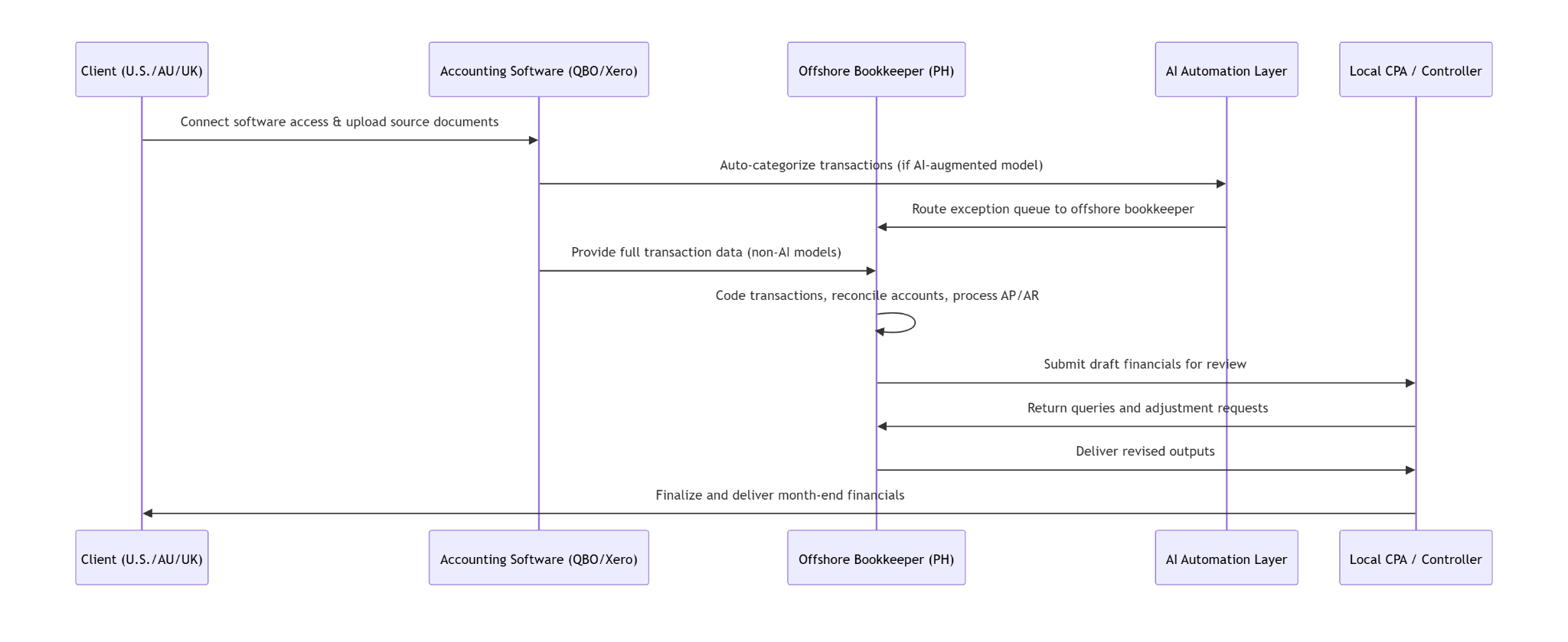
Bookkeeping outsourcing follows a structured workflow: the client connects software access, the offshore team processes transactions, outputs are reviewed locally, and financials are finalized—with the engagement model determining who owns each layer of that chain.
The three active engagement models in 2026
Model 1: Managed BPO service
A BPO provider supplies a dedicated bookkeeping team, manages HR and compliance, and delivers outputs against a service level agreement. The client interacts with a team lead or account manager—not individual bookkeepers.
This is the most common structure for U.S. and Australian accounting firms using Philippine delivery centers.
Model 2: Staff augmentation / offshore direct hire
The client hires a Filipino bookkeeper through an employer-of-record (EOR) or offshore staffing firm. The bookkeeper is functionally embedded in the client’s team, uses the client’s software, and attends the client’s standups.
The EOR handles payroll, statutory contributions, and HR compliance. The client controls the work.
Model 3: AI-augmented hybrid model
The emerging 2026 structure. AI tools handle transaction categorization and matching; the offshore bookkeeper handles exception queues, client communication, and month-end close.
This model requires a different skill profile—more judgment, less data entry. Platforms in active use include Vic.ai, Botkeeper, and native QuickBooks automation.
The standard workflow sequence
Offshore Bookkeeping Monthly Close Workflow 2026
Time zone workflow considerations
Only 31% of U.S. accounting firms using Philippine bookkeepers have implemented mid-shift scheduling, leaving same-day close capability unused. The mid-shift model (2 PM–11 PM PHT) creates a 2–4 hour overlap with U.S. West Coast business hours—enabling same-day query resolution and faster close cycles.
For U.S. East Coast firms, an asynchronous close protocol is more practical. Define your close cycle requirements before hiring—not after.
Key benefits of bookkeeping outsourcing
Offshore bookkeeping delivers five measurable operational advantages: cost reduction at scale, capacity elasticity, access to a deep talent pipeline, AI-augmented capability, and same-day close potential—each with specific, quantifiable impact.
Cost reduction at scale
Even at the realistic 52–61% savings figure, a firm with five bookkeeping roles saves $180,000–$250,000 annually. That is not a marginal efficiency—it is a structural reallocation of capital toward higher-value functions.
Capacity elasticity
Offshore teams can scale from two to twelve bookkeepers faster than domestic hiring cycles allow. During tax season surges or acquisition integrations, this speed-to-capacity advantage is operationally significant.
Access to a deep talent pipeline
The Philippines produces several thousand accounting graduates annually. Historical Professional Regulatory Board of Accountancy data (drawing on Commission on Higher Education enrollment figures) shows roughly 7,000–14,000 accounting graduates per year in recent cycles, alongside a licensed CPA population that has grown into the hundreds of thousands.
The talent pipeline is not thin — combined with strong English proficiency, it remains one of the deepest accounting talent pools globally relative to the country’s size, even without needing to inflate the raw graduate count.
AI-augmented capability
The AI-Augmented Bookkeeper role commands a 22–28% salary premium and represents the fastest-growing skill segment in Philippine offshore accounting. Firms that invest in this capability now are building a structural advantage over those still treating offshore bookkeeping as pure data entry.

Same-day close capability
Mid-shift scheduling (2 PM–11 PM PHT) creates a 2–4 hour overlap with U.S. West Coast business hours, enabling same-day close cycles that most firms are not currently using. This is an underutilized operational lever.
Benefits summary
| Benefit | Quantified Impact | Condition Required |
|---|---|---|
| Cost reduction | 52–61% real-world savings | Full hidden cost stack budgeted |
| Capacity scaling | 2 to 12 bookkeepers in under 30 days | Managed BPO or EOR model |
| Talent pipeline | 60,000 accounting graduates/year (PH) | Proper screening and domain training |
| AI-augmented roles | 22–28% premium, 4,200 qualified professionals | Training investment required |
| Same-day close | 2–4 hr overlap window available | Mid-shift scheduling implemented |
| Attrition reduction | 19.3% → 8.7% with career pathing | Structured career path from day one |
Bookkeeping outsourcing costs & pricing
Philippine offshore bookkeeping costs range from $482–$1,383 per month in direct employer cost, depending on seniority—compared to $4,200–$5,800 per month for a fully loaded U.S.-based bookkeeper.
Philippine labor cost benchmarks: Q2 2026
Data sourced from the Philippine Statistics Authority Occupational Wages Survey 2025, published February 2026. All figures represent total employer cost including statutory add-ons.
| Role | PHP/Month | USD Equivalent | Statutory Add-ons (12–15%) | Total Employer Cost (USD/Month) |
|---|---|---|---|---|
| Junior Bookkeeper (1–2 yrs) | PHP 25,000–30,000 | $430–$515 | +$52–$77 | $482–$592 |
| Senior Bookkeeper (3–5 yrs) | PHP 38,000–48,000 | $653–$825 | +$78–$124 | $731–$949 |
| Accounting Supervisor | PHP 55,000–70,000 | $945–$1,203 | +$113–$180 | $1,058–$1,383 |
Statutory add-ons are non-negotiable and cover SSS employer contributions, PhilHealth employer share, Pag-IBIG Fund (HDMF), and 13th Month Pay prorated monthly. Any quote that excludes them is incomplete.
U.S. benchmark for comparison: $4,200–$5,800 per month fully loaded, per the Bureau of Labor Statistics May 2025 Occupational Employment Statistics.
All-in cost by engagement model
| Engagement Model | Senior Bookkeeper Monthly Cost | What Is Included |
|---|---|---|
| Managed BPO Service | $1,200–$1,800 all-in | HR, compliance, SLA management, quality oversight |
| Staff Augmentation (EOR) | $900–$1,200 all-in | Payroll, statutory contributions, HR admin |
| Direct Freelancer | $600–$900 | Base rate only — compliance and attrition risk not included |
| U.S.-Based Bookkeeper | $4,200–$5,800 | Fully loaded domestic cost |
Hidden cost stack (per bookkeeper per month)
| Hidden Cost Item | Estimated Monthly Cost (USD) | Notes |
|---|---|---|
| Software licensing (QBO, Xero, Dext) | $85–$220 | Per-user seat costs multiply with team size |
| Secure VPN + endpoint security | $30–$60 | Required under NPC-mandated PIP-PIC compliance |
| Onboarding & training (amortized) | $120–$200 | First 90 days; drops to $40–$60 post-stabilization |
| Client data segregation infrastructure | $50–$90 | Required under Philippine Data Processing Agreements |
| Management oversight (local) | $180–$350 | Approx. 0.25 FTE of a local manager’s time |
| Attrition replacement cost (annualized) | $95–$140 | 18–24% annual BPO attrition rate |
| Total hidden cost addition | $560–$1,060 | Applied per bookkeeper per month |
Real-world savings calculation
[GRAPH — re-insert from original: “Offshore Bookkeeping Real-World Savings Calculation vs Advertised Savings”]
For detailed pricing structures across engagement models, see offshore team pricing and engagement models.
Global case studies: Offshore bookkeeping in practice
The most instructive case studies in offshore bookkeeping are not the success summaries—they are the friction timelines, because the risk is concentrated in months two through four and is almost entirely preventable.
Case study 1: Bench Accounting — hybrid offshore transition (2024–2025)
Bench Accounting deployed a hybrid offshore model following their January 2025 acquisition by Employer.com after a brief shutdown, pairing a Philippine-based bookkeeping team in Cebu with a Canadian advisory team.
The friction was real and sequential:
Months 1–2: Three of the initial 14 Filipino bookkeepers were replaced within six weeks due to U.S. GAAP versus PFRS background mismatch. Software access provisioning delays caused a nine-day lag before live client work began. NPC-mandated DPA execution took three weeks longer than anticipated due to cross-border legal review.
Month 3: Client error rate spiked to 4.2% of reconciled transactions against a target of under 0.8%. Two enterprise clients escalated. One $18K ARR account temporarily paused service. Root cause: onboarding had covered QuickBooks mechanics but not U.S. industry-specific coding conventions—SaaS revenue recognition, contractor versus employee classification.
Months 4–5: Bench implemented a 40-hour U.S. GAAP Contextual Training Module developed with a U.S. CPA firm partner. Error rate dropped to 1.1% by end of Month 5. The paused client returned.
Months 6–12: Error rate stabilized at 0.6%—below the original target.
| Metric | Month 3 (Peak Friction) | Month 12 (Stabilized) |
|---|---|---|
| Transaction error rate | 4.2% | 0.6% |
| Bookkeeping labor cost per client | Baseline | -61% |
| Client accounts per management headcount | Baseline | +34% |
| Annualized labor savings | — | $2.3M |
| Transition + training + infrastructure cost | — | $380K |
| Net ROI | — | $1.92M annualized |
The lesson: Risk is concentrated in months two through four. It is almost entirely preventable with domain-specific training—not just software training.
Case study 2: Menzies LLP — India + Philippines dual-shore model (2025–Q1 2026)
Menzies LLP, a UK-headquartered chartered accountancy firm with approximately £85M in revenue, deployed a dual-shore model to address a 23% AAT-qualified staff vacancy rate, with India (Pune) handling high-volume transaction processing and Philippines (Manila) handling client-facing bookkeeping and reporting.
Key friction points:
- Handoff protocols between Pune and Manila teams required three iterations before error rates stabilized
- A single reconciliation query could take 36 hours to resolve through the dual-shore chain—versus four hours in a single-shore model
- Stabilization timeline: 14 weeks actual versus 8 weeks projected
The model ultimately worked. But firms considering dual-shore structures should budget explicitly for the extended stabilization runway. The coordination overhead is real and front-loaded.
| Factor | Single-Shore Model | Dual-Shore Model (Menzies) |
|---|---|---|
| Query resolution time | ~4 hours | ~36 hours (during stabilization) |
| Projected stabilization | 8 weeks | 8 weeks (projected) |
| Actual stabilization | 8–10 weeks | 14 weeks |
| Coordination overhead | Low | High (months 1–3) |
| Cost efficiency at scale | High | Higher (if managed correctly) |
Philippines relevance: Delivery centers, costs, and local context
The Philippines is not a monolithic offshore market—Metro Manila, Cebu, Clark, and Davao offer meaningfully different cost profiles, talent depths, and attrition rates that directly affect bookkeeping engagement outcomes.
Metro Manila vs. Cebu vs. Emerging markets
| Location | Base Salary Premium vs. Cebu | Talent Depth (Senior Roles) | Attrition Risk | Best Fit |
|---|---|---|---|---|
| Metro Manila (BGC, Ortigas, Makati) | +15–20% | High — deepest U.S. GAAP/IFRS pool | Higher (BPO poaching) | Complex engagements, senior judgment roles |
| Cebu (IT Park, Cebu Business Park) | Baseline | Medium — growing mid-level pool | Lower | Australian and U.S. mid-market firms |
| Clark | -10–15% vs. Cebu | Low–Medium | Low | High-volume, lower-complexity processing |
| Davao | -10–15% vs. Cebu | Low | Lowest | High-volume transaction processing |
Metro Manila hosts the deepest talent pool for senior bookkeepers and accounting supervisors with U.S. GAAP or IFRS exposure. Base salaries run 15–20% above Cebu equivalents. Higher attrition due to competitive poaching between BPOs is the primary trade-off.
Cebu offers lower base salaries, lower attrition, and a growing pool of mid-level bookkeepers. Cebu IT Park and Cebu Business Park host established delivery centers for Australian and U.S. accounting firms. The talent pool for AI-augmented bookkeeping roles is thinner than Manila but growing.
Clark and Davao are emerging markets with lower costs and significantly lower attrition, but shallower talent pools for specialized accounting roles. Better suited for high-volume, lower-complexity transaction processing.
PEZA registration and its relevance to bookkeeping BPOs
PEZA (Philippine Economic Zone Authority) registration provides BPO providers with significant tax incentives, including income tax holidays and preferential rates. For clients, PEZA-registered providers signal operational maturity and regulatory compliance—a meaningful due diligence filter when evaluating providers.
PEZA-registered delivery centers are concentrated in BGC (Bonifacio Global City), Ortigas, Makati, Cebu IT Park, and Clark Freeport Zone.
When evaluating a Philippine BPO for bookkeeping services, PEZA registration status is a baseline credibility indicator, not a guarantee of quality.
USD/month benchmarks by location
| Role | Metro Manila (USD/Month) | Cebu (USD/Month) | Clark/Davao (USD/Month) |
|---|---|---|---|
| Junior Bookkeeper (1–2 yrs) | $520–$620 | $482–$560 | $440–$510 |
| Senior Bookkeeper (3–5 yrs) | $820–$1,050 | $731–$900 | $680–$820 |
| Accounting Supervisor | $1,150–$1,500 | $1,058–$1,300 | $980–$1,200 |
All figures represent total employer cost including statutory add-ons (SSS, PhilHealth, Pag-IBIG, 13th Month Pay).
The talent pipeline
The Philippines produces several thousand accounting graduates annually — historical Commission on Higher Education data (via PRC Board of Accountancy figures) shows roughly 7,000–14,000 per year in recent cycles.
Philippine accounting education is PFRS-based (IFRS-aligned). U.S. GAAP domain training is not optional — budget for it explicitly, particularly for ASC 606 revenue recognition, ASC 842 lease accounting, and U.S.-specific tax classification rules.
Offshore bookkeeping model comparison: 2026
The three primary offshore bookkeeping engagement models differ significantly on cost, compliance exposure, control, and scalability—and the cheapest option on paper is frequently the most expensive over a 24-month horizon.
| Factor | Managed BPO Service | Staff Augmentation (EOR) | Direct Freelancer |
|---|---|---|---|
| Monthly Cost — Senior Bookkeeper | $1,200–$1,800 all-in | $900–$1,200 all-in | $600–$900 |
| NPC/DPA Compliance | Provider-managed | Shared (EOR + client) | Client bears full risk |
| Advisory Opinion 2026-003 Exposure | Low (if DPA structured correctly) | Low–Medium | High |
| Attrition Risk | Provider absorbs | Shared | Client bears full risk |
| Control Over Workflow | Low–Medium | High | High |
| Onboarding Speed | 2–4 weeks | 3–6 weeks | 1–2 weeks |
| AI-Augmented Capability | Depends on provider | Depends on hire | Rare |
| Scalability | High | Medium | Low |
| Quality Management | Structured SLA | Client-managed | None |
| 24-Month Total Cost Risk | Low–Medium | Medium | High |
Model selection logic
Offshore Bookkeeping Model Selection Decision Framework 2026
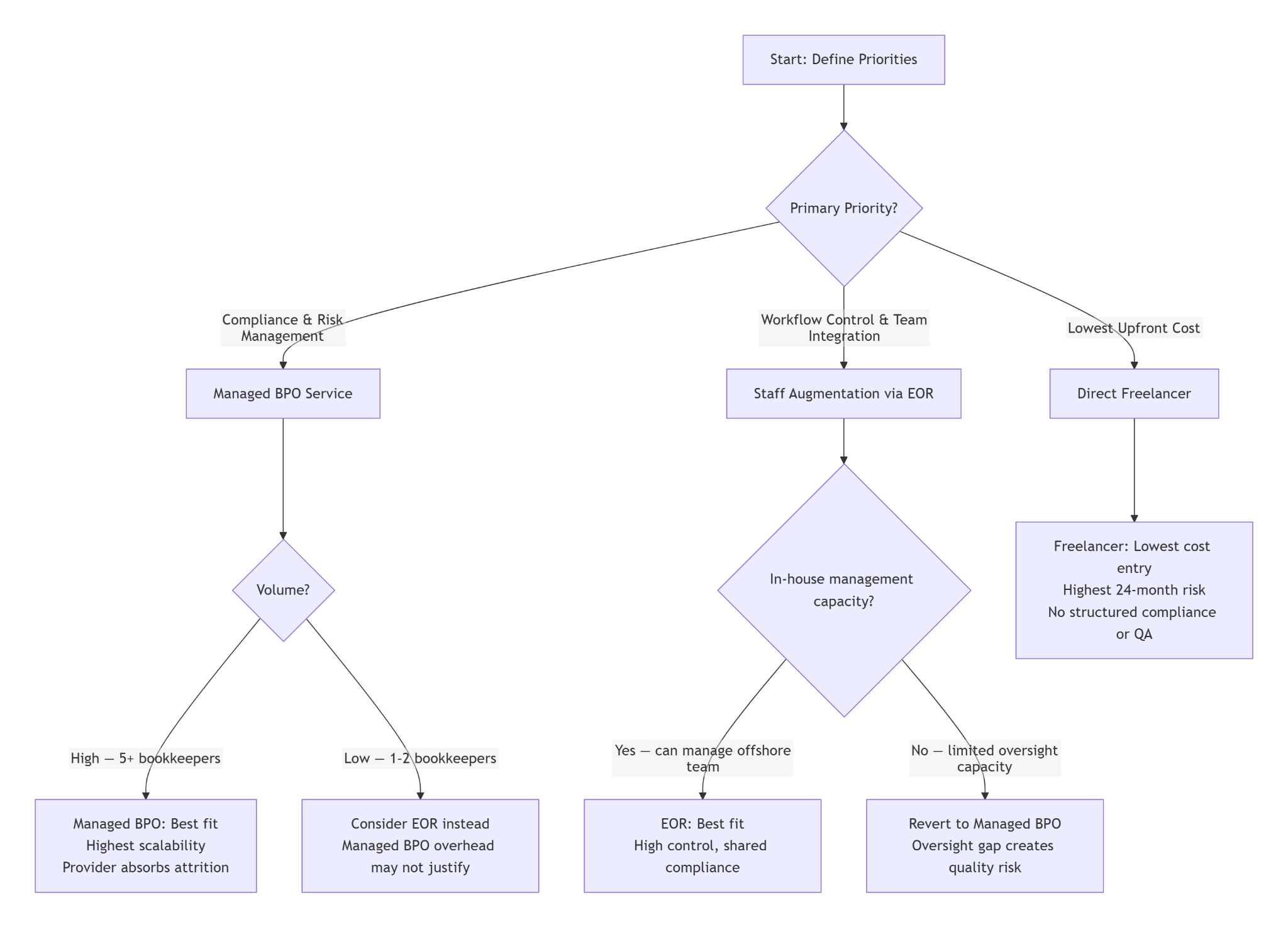
The freelancer model looks cheapest on paper. After adding compliance exposure under NPC Advisory Opinion 2026-003, attrition replacement cost, and the absence of structured quality management, it is frequently the most expensive model over a 24-month horizon.
Frequently Asked Questions: Bookkeeping outsourcing
What accounting software do Philippine bookkeepers typically use?
QuickBooks Online and Xero dominate the Philippine offshore bookkeeping market, with Dext widely used for document capture and MYOB common for Australian clients. Most senior bookkeepers in Metro Manila and Cebu have multi-platform exposure.
Verify platform-specific experience during screening—”familiar with QuickBooks” can mean anything from daily use to a one-day training certificate.
How do I handle month-end close across time zones?
The mid-shift scheduling model (2 PM–11 PM PHT) creates a 2–4 hour overlap with U.S. West Coast business hours, enabling same-day close cycles. For U.S. East Coast firms, an asynchronous close protocol is more practical. Define your close cycle requirements before hiring—not after.
Is a Filipino bookkeeper qualified to handle U.S. GAAP?
Philippine accounting education is PFRS-based (IFRS-aligned), not U.S. GAAP—meaning domain-specific training is required before a Filipino bookkeeper can reliably handle U.S. client accounts.
Key gap areas include revenue recognition under ASC 606, lease accounting under ASC 842, and U.S.-specific tax classification rules. Budget for a structured training module, not just a software orientation.
What happens if my offshore bookkeeper leaves?
Under a managed BPO model, the provider handles replacement. Under staff augmentation, your EOR partner manages the HR process but you own the knowledge transfer gap. Under a direct freelancer arrangement, you own everything.
The 19.3% annual attrition rate means this is a planning assumption, not a hypothetical. Structured career pathing reduces attrition to 8.7%.
Do I need to register with the NPC as a foreign firm using Philippine bookkeepers?
The NPC registration obligation falls on the Philippine-based processor, but under Advisory Opinion 2026-003, your firm must be explicitly named as the Personal Information Controller in the executed DPA.
Engage legal counsel familiar with both Philippine data privacy law and your home jurisdiction’s requirements before transmitting any client financial data offshore.
What is the realistic timeline to full productivity?
For a well-structured engagement with proper domain training, expect 90 days to operational stability and 120–150 days to full productivity benchmarks.
Any provider promising two-week full deployment for complex bookkeeping work is presenting the happy path, not the realistic path. The Bench Accounting case study confirms this timeline: error rates did not stabilize below target until month six.
What is the real cost saving after hidden costs are included?
After accounting for software licensing, compliance infrastructure, onboarding, management oversight, and attrition replacement, real-world savings land at 52–61%—not the advertised 78–85%.
The hidden cost stack adds $560–$1,060 per bookkeeper per month. A five-person team still saves $180,000–$250,000 annually at the realistic figure.
Will AI replace offshore bookkeeping jobs?
No—67% of SMB CFOs who adopted AI bookkeeping tools still retained or expanded their offshore bookkeeping teams, per Gartner’s CFO Technology Adoption Survey Q1 2026.
AI handles transaction categorization. Offshore bookkeepers handle exception management, client communication, and month-end close. The work is shifting up the value chain, not disappearing.
What is the difference between a managed BPO and staff augmentation for bookkeeping?
In a managed BPO model, the provider owns HR, compliance, quality management, and SLA delivery. In staff augmentation, the client controls the workflow and the EOR handles payroll and statutory compliance only.
Managed BPO costs more per month but absorbs attrition risk and compliance overhead. Staff augmentation gives higher control but requires the client to manage quality directly.
What statutory costs are mandatory for Philippine bookkeeping employees?
Philippine statutory add-ons are non-negotiable and total 12–15% above base salary, covering SSS employer contributions, PhilHealth employer share, Pag-IBIG Fund (HDMF), and 13th Month Pay prorated monthly.
Any offshore staffing quote that excludes these is incomplete and will understate your true cost.
Is Metro Manila or Cebu better for offshore bookkeeping?
Metro Manila offers the deepest talent pool for senior bookkeepers with U.S. GAAP or IFRS exposure but carries 15–20% higher base salaries and higher attrition. Cebu offers lower costs, lower attrition, and a growing mid-level talent pool suited to Australian and U.S. mid-market firms.
The right choice depends on role complexity, required seniority, and your attrition tolerance.
What compliance documents must be in place before starting an offshore bookkeeping engagement?
Four compliance documents are required before any financial data is transmitted to a Philippine-based bookkeeping team: a PIP-PIC agreement, a Data Processing Agreement (DPA), a Privacy Impact Assessment (PIA) for engagements over 1,000 records monthly, and confirmation of the provider’s active NPC registration.






 Independent





