
Why you should offshore technical support


Why should you offshore technical support?
You should offshore technical support to cut costs, reach skilled specialists, and give customers faster help without the overhead of an in-house team.
- It saves money on salaries, tools, and hiring.
- It gives you trained agents who focus only on support.
- It frees your core team to work on revenue tasks.
Many companies hand their non-core work to offshore providers. As a result, they save money and still get strong results. For this reason, firms often offshore technical support to business process outsourcing (BPO) partners.
Offshoring has been common for years. Still, some owners hesitate to offshore technical support or any task to a third party. Most of these firms are small and medium-sized enterprises (SMEs) with no outsourcing experience. However, turning to offshore outsourcing[1] helps these businesses grow. This guide shows how offshore technical support benefits your company.
What is technical support?
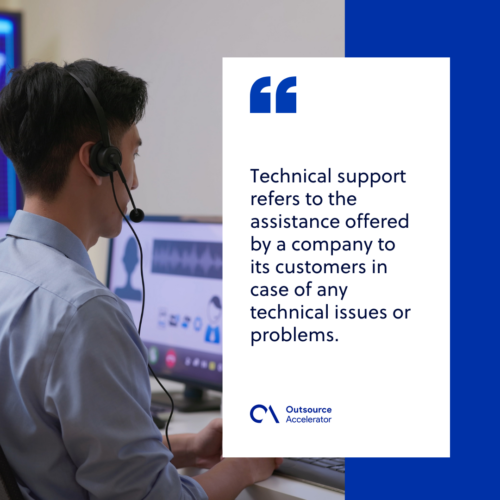
Technical support is the help a company gives customers when they hit a technical problem. People sometimes use the term alongside customer support or customer service.
Different experts provide this help, based on the company. A support worker can be an engineer, a programmer, or a specialist in another field. Technical support professionals answer users who have trouble with a product or service. Most issues involve software and apps.
Customers usually reach support by phone, email, or live chat. In some cases, a technician visits the office to fix what cannot be solved remotely. These agents are often the first point of contact with a business. For this reason, many firms offshore technical support to companies like ConnectOS, so issues get resolved fast. Teams like this often sit alongside wider customer service outsourcing and call center outsourcing setups.
How do you offshore technical support?
To offshore technical support, you hand these tasks to an offshore BPO firm. First, decide how much you want to spend. So think about your needs, your processes, and your requirements.
Next, once you know your budget, look for providers that fit it. Outsource Accelerator’s BPO Directory, for example, is a great place to find the right partner. In addition, many providers now offer flexible IT outsourcing services that pair support with wider tech help.
Outsourced builds dedicated technical support teams in the Philippines across 15+ industries, with a 98% staff retention rate and ISO-certified recruitment.
Also, many BPO companies now cater to small and medium enterprises[2]. As a result, even small firms can afford to offshore technical support. Finally, pick a country where workers share a language with your customers. For example, US firms often choose outsourcing to the Philippines because the workforce speaks strong English.
Benefits when you offshore technical support
Offshore technical support teams bring a host of benefits to companies. These gains range from cost savings to better results and higher productivity. Each one is explained below.
Cost savings
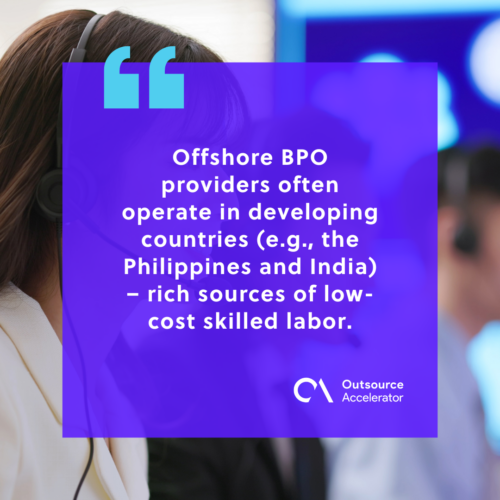
Offshore technical support nets big savings on salary and overhead. Most offshore BPO providers work in developing countries, such as the Philippines and India. These places offer low-cost skilled labor.
In addition, these firms already own the tools to run support. So you no longer pay for that equipment and software. Offshoring also cuts recruitment costs. Hiring is often slow and pricey, and a partner takes that job off your plate. For this reason, many teams also use offshore staffing to scale support fast.
Better results
When you find a good partner BPO, offshore teams often beat in-house ones. There are a few reasons for this:
- Better technologies
- More experienced specialists
- Staff who upskill often
Improved productivity
Handing support to an offshore firm lifts your in-house team’s output. It cuts their workload and lets them focus on core work. Meanwhile, your offshore team has one job: support. So they focus on it better than a stretched in-house team can.
Where to offshore technical support
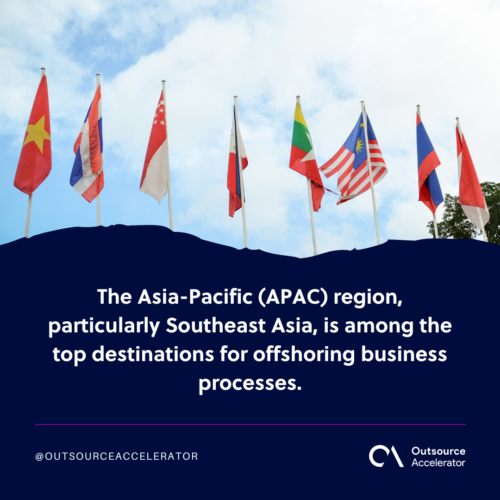
Firms in the US, Canada, the UK, and Australia often offshore technical support to developing countries. The Asia-Pacific region, particularly Southeast Asia, is a top choice.
In this region, the Philippines stands out as a leading offshore destination. Because of this strong record, many call it the “outsourcing capital of the world.” The country hosts more than a hundred BPO firms. These range from homegrown shops to global names like Accenture and Teleperformance.
For a full guide on offshore outsourcing, visit outsourceaccelerator.com. The site lists over 3,000 BPO firms and holds more than 5,000 articles about outsourcing.
Frequently asked questions
Is offshore technical support only for large companies?
No. Many providers now serve small and medium firms with flexible, pay-as-you-grow plans. So a small team can start with a few agents and add more later as demand rises.
Will offshore agents understand my customers?
Yes, when you pick the right country. For example, the Philippines offers a large, English-speaking workforce trained in Western service norms. As a result, agents handle calls and chats with little friction.
What tasks can an offshore support team handle?
They cover password resets, software bugs, device setup, and product how-to questions. Many teams also manage tier-two tickets and escalations. So you can offload both simple and complex work.
How do I keep quality high with an offshore team?
Set clear service targets and share scripts and product docs early. Then review call records and ticket data each week. Regular feedback keeps standards steady over time.
How much can I save by offshoring technical support?
Savings vary by role and location, yet many firms cut labor costs by a large margin. You also save on tools, office space, and hiring. For this reason, offshoring often pays for itself quickly.
References
[1] turning to offshore outsourcing. Buckley, P.J. Munjal, S. Requejo, I. (2022). “How does offshore outsourcing of knowledge-intensive activities affect the exports and financial performance of emerging market firms?” Journal of International Business Studies. https://doi.org/10.1057/s41267-022-00511-z
[2] BPO companies now cater to small and medium enterprises. György, O. Madaras, S. (2020). “Factors influencing SME outsourcing: Evidence from Romania.” Scientific Journal of Sapientia Hungarian University of Pennsylvania, 8(1) pp. 5-18. DOI: https://doi.org/10.2478/auseb-2020-0001






 Independent






