
How healthcare software companies use outsourced technical support teams


- Healthcare software companies are using outsourced technical support to scale coverage without scaling internal headcount at the same rate, particularly for after-hours and high-volume tier 1 support.
- The right outsourced team handles tier 1 and tier 2 issues with clear escalation pathways to internal engineers, freeing the product team for development rather than routine troubleshooting.
- HIPAA compliance and Business Associate Agreement capability are non-negotiable for any outsourced team that accesses covered systems or handles protected health information.
- SixEleven provides dedicated technical support teams from the Philippines for healthcare software companies, with structured escalation pathways and data handling protocols designed for HIPAA-compliant environments.
Healthcare software has a zero-tolerance threshold for support failures. System downtime, access issues, or slow response times affect clinical operations — and in some contexts, patient care directly.
For many healthcare software companies, the challenge is not whether their product works. It is whether their support function can keep pace with a growing user base without pulling engineers off development or building a large internal support function that scales proportionally with every new customer contract.
This is why outsourced technical support has become a structural part of how healthcare software companies operate at scale. This article explains how they use these teams and what matters most when selecting a support partner.
Why healthcare software companies outsource their technical support
The choice to outsource tier 1 support usually comes down to five recurring pressures. Healthcare SaaS companies feel them earlier than most.
- Volume growth outpacing internal hiring capacity — As a healthcare SaaS platform adds clients, tier 1 support volume grows with it; internal teams that were manageable at 50 clients are not manageable at 500.
- 24/7 coverage requirements — Clinical systems are used around the clock; staffing internal support for overnight and weekend coverage at the same quality level as business hours is expensive and logistically complex.
- Engineers pulled from product by repetitive tier 1 issues — Password resets, access provisioning, and basic account troubleshooting do not require an engineer, but they consume engineering time when there is no dedicated support layer.
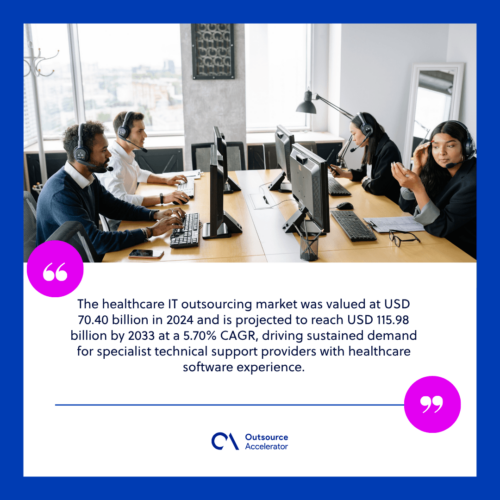
- Rapid expansion of the healthcare software market — The healthcare IT outsourcing market was valued at USD 70.40 billion in 2024 and is projected to reach USD 115.98 billion by 2033 at a 5.70% CAGR, driving sustained demand for specialist technical support providers with healthcare software experience.
- Cost of sustaining specialist in-house knowledge — Healthcare software support requires specific product knowledge that takes months to develop, creating ongoing training cost whenever staff turn over.
What outsourced technical support looks like for healthcare software
The standard scope splits into three tiers with clear ownership at each level:
| Tier | Scope | Handled by |
|---|---|---|
| Tier 1 | Password resets, login issues, account access, basic navigation questions, known bug workarounds | Outsourced support team |
| Tier 2 | EHR/EMR integration queries, API errors, configuration issues, go-live support, installation problems | Outsourced support team with product documentation access |
| Tier 3 | Undiagnosed system bugs, complex integration failures, security incidents | Internal engineering, escalated from tier 2 |
Beyond break-fix support, outsourced teams also cover go-live support during new client implementations. That’s typically the period of highest volume and highest stakes for a healthcare software company.
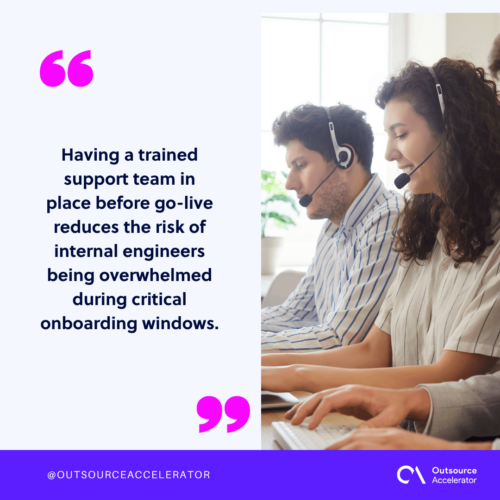
Having a trained support team in place before go-live reduces the risk of internal engineers being overwhelmed during critical onboarding windows.
Compliance requirements for outsourced healthcare software support
Any outsourced team that accesses covered systems or handles protected health information (PHI) falls under HIPAA’s Business Associate provisions.
A Business Associate Agreement (BAA) is required before work begins. Without it, the arrangement creates direct compliance liability for the covered entity.
What to verify before engaging a support provider:
- BAA capability — The provider must be willing and legally able to sign a BAA that meets your organization’s requirements
- Documented data handling protocols — How is PHI accessed, stored, and transmitted? These procedures should be documented, not ad hoc
- Access control procedures — Who on the support team can access which systems, and how is that access provisioned and revoked?
- Staff training on PHI — HIPAA training should be verified as part of onboarding and documented for audit purposes
- Breach notification procedures — The provider’s incident response and breach notification timeline should align with HIPAA’s 60-day notification requirement
What to look for when evaluating an outsourced technical support partner
- Healthcare software experience specifically — Not general IT support; the partner should understand EHR/EMR systems, clinical workflows, and the stakes of a support failure in a healthcare environment
- Documented HIPAA compliance framework and BAA capability — This should be verifiable, not asserted
- SLA commitments aligned with clinical uptime requirements — Response time and resolution time SLAs should reflect the impact of a support failure on clinical operations
- Clear escalation process to internal engineering — The handoff between tier 2 and tier 3 is the most failure-prone point in a support structure; it should be documented and tested before go-live
- Ticketing system integration — The outsourced team should work within your existing platform, not a parallel system
Scale your healthcare software technical support with SixEleven
SixEleven provides dedicated technical support teams from their BPO operations in the Philippines, serving healthcare software companies that need reliable, scalable coverage without building a large internal support function.
- Healthcare technology experience — teams experienced in healthcare software environments, with structured tier 1 and tier 2 escalation pathways and familiarity with clinical support requirements
- HIPAA-aligned data handling protocols — access controls, PHI training, and breach notification procedures designed for organizations operating in covered healthcare environments
- After-hours and go-live coverage — dedicated teams available for overnight, weekend, and implementation-window support without the cost of equivalent in-house staffing
- Ticketing system integration — SixEleven support teams operate within the client’s existing support platform, maintaining continuity of records and reporting
Get in touch with SixEleven to explore technical support solutions built for healthcare software platforms.
Frequently Asked Questions
Common questions about outsourced technical support for healthcare software companies.
Does HIPAA apply to outsourced technical support teams?
Yes. If the team accesses covered systems or handles protected health information, a Business Associate Agreement is required before work begins. Without a signed BAA, the covered entity is directly exposed to HIPAA’s enforcement provisions regardless of how the arrangement is structured contractually.
What is the difference between tier 1 and tier 2 technical support for healthcare software?
Tier 1 handles basic access and account issues — password resets, login problems, basic navigation. Tier 2 handles integration errors, configuration problems, and more complex troubleshooting that requires product-specific knowledge but does not require engineering intervention.
Clear documentation of what sits at each tier is essential before onboarding an outsourced team.
Can outsourced technical support cover after-hours clinical calls?
Yes. Many healthcare software companies use outsourced teams specifically for after-hours and weekend coverage, where internal staffing is most expensive relative to volume.
An outsourced team in a different time zone can provide this coverage at standard rates rather than requiring overnight premiums from onshore staff.
Key takeaways
- Outsourced technical support allows healthcare software companies to scale coverage without scaling internal headcount at the same rate.
- The standard scope covers tier 1 and tier 2 issues, with clear escalation pathways to internal engineering for complex cases that require product-level intervention.
- HIPAA compliance is non-negotiable: verify that any outsourced partner has a documented compliance framework and can sign a Business Associate Agreement before work begins.
- SixEleven provides dedicated technical support from the Philippines for healthcare software companies, with structured escalation pathways and HIPAA-aligned data handling protocols.






 Independent





