
Here’s what to do to decrease abandoned calls

How do you decrease abandoned calls?
You decrease abandoned calls by cutting hold times, fixing your welcome message, updating your software, offering callbacks, and adding enough agents to handle demand.
- Abandoned calls are calls that end before a conversation starts. So they often point to long queues or weak call setups.
- Most teams track the problem with call abandon rate and abandon time. As a result, small fixes can quickly lift results.
- A healthy abandon rate sits near 5% to 8%. Still, rates above 10% are a clear signal to review your process.
Customer demands keep rising, so global firms like yours must work hard to keep each client happy. A recurring issue, such as long waits on calls, can push customers away fast.
A 2020 research found that 96% of customers will leave a business over poor customer service. In many cases, repeated abandoned calls are part of the reason.
Connection issues on the customer’s side will always happen. However, abandoned calls caused by queues can and should be reduced. So read on to learn what you need to cut your abandoned calls right away.

What are abandoned calls?
Abandoned calls are calls that end before a conversation begins. People also call them abandoned contacts. They can occur on both incoming and outgoing calls.
On inbound calls, a customer may hang up due to long waits or connection issues. On outbound calls, the automatic call distributor (ACD) drops the call when no agents are free.
Teams measure abandoned calls with different KPIs. For example, abandon time and call abandon rate are the most common.
Calculating call abandon rates
Call abandonment rate, or call abandon rate, measures the share of customers who end a call before an agent answers. In short, it shows how well your agents resolve a concern before callers give up.
This metric usually ties back to customer satisfaction and service level. You can work it out with these steps:
- Get the number of calls received in a set period.
- Subtract the number of calls handled.
- Divide the result by the number of received calls.
An ideal call abandon rate for most companies is around 5% to 8%. Because of this, it helps to track it against your other call center metrics each month.
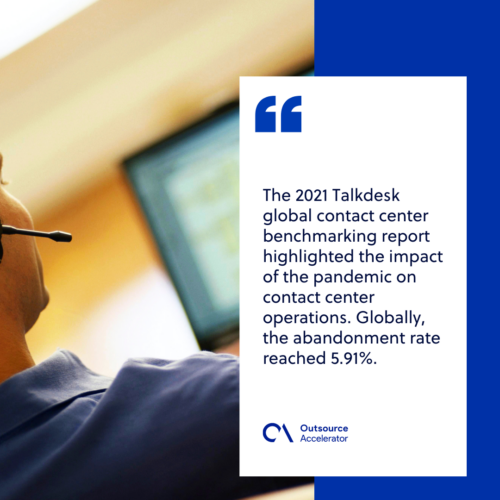
A Talkdesk global contact center benchmarking report put the global abandonment rate at about 5.9%. So most firms sit close to the healthy range, yet many still have room to improve.
Stages of abandoned calls
Meanwhile, abandon time measures how long a caller waits before dropping the call. This can happen at one of five stages, depending on the call.
IVR
Some callers dislike recorded greetings or long IVR menus. So a customer may abandon the call once it reaches the IVR or an answering machine.
Call queue
Even after the welcome message, calls can still drop in the call queue. This often happens when the caller picks the wrong IVR option or the message runs too long.
Wait queue
Abandoning calls in the wait queue is common for teams with high call volumes. Here, a caller gives up when it takes too long to reach an agent.
Voicemail
Like IVR, a call can drop when a customer hears a voicemail recording or a long message.
Ringing
Finally, a customer can abandon a call while it is still ringing. This usually comes from connection issues or an agent who does not pick up.
How to decrease abandoned calls
Abandoned calls will always happen. Still, you can lower abandonment rates and lift customer satisfaction. So try the steps below.
Change your welcome message
Your welcome message may be too long, off-topic, or cold for callers. First, audit your calls and see what you can change. Next, test new versions and track which one lowers your abandonment rates.
Lessen your hold time
You can hold a call for up to two minutes, and no more. Long hold times hurt your results and leave customers unhappy.
Use your metrics to see how long callers usually wait and when they drop. Then adjust your hold time without cutting the work your agents need to do. As a result, more callers stay on the line and reach first-call resolution.
Update your call center software
Your call center software can shape your agents’ performance and your service level. In fact, outdated systems often cause more dropped calls.
So update your call center software and CRM when needed. Check that you run the latest version, or find a tool that makes your work faster.
You can even replace the whole system and use a cloud call center like GetCallers.
Offer a callback
Remember that callers in the IVR or on hold do not count as abandoned. So offer a callback during long queues or sudden call surges. Because of this, you prevent many abandoned calls before they happen.
Expand your team
One of the best ways to avoid long holds is to add more agents. You can work out how many you need from your call volume and support goals.
At the same time, you can outsource your customer service if you want a more scalable option. For many firms, inbound call center outsourcing adds trained agents fast without heavy setup costs.
Effects of abandoned calls on a business
It is normal to have one or two abandoned calls per 100 calls. In fact, this shows you still handle your customers well. However, a 10% abandonment rate is a sign to review your process.
High abandoned calls can hurt how customers see your service. Over time, they can lower your efficiency and your output. As a result, they may lead to bad reviews and posts about your company.
High abandonment rates can also hit your current customers. Long holds and queues frustrate callers. So they may drop their concern and turn to your competitors, which weakens customer retention.
Frequently asked questions (FAQs)
What is a good call abandonment rate?
Most teams aim for a rate between 5% and 8%. A rate in this band shows your staffing and setup are working well. Still, a rate above 10% means you should review your queues and hold times.
How is call abandon rate different from abandon time?
Call abandon rate measures the share of callers who hang up before an answer. Abandon time, by contrast, measures how long they wait before they do. So one is a percentage, while the other is a duration.
Does an IVR cause more abandoned calls?
A poorly built IVR can, yes. Long menus and confusing options push callers to hang up. However, a short and clear IVR can route calls faster and actually lower your abandon rate.
Can outsourcing reduce abandoned calls?
Often, yes. An outsourced call center can add trained agents during busy periods. As a result, queues shrink and fewer callers give up before they reach support.






 Independent






